Season 1, Episode 57
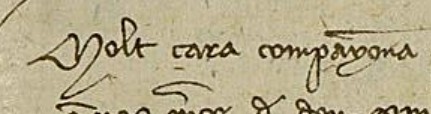
Joan writes a safe conduct letter for a troubadour who will be traveling through France.1
Episode 57
](/historians-notebook-s1-episodes/images/feb-19-aca-cr-r1827-f31v-joan.jpg)
ACA CR R1827 f31v Source: PARES
Today’s Document
- Subject: safe passage letter for a troubadour
- Date: February 19, 1387
- Day of the Week: Tuesday
- Language: Latin
- Archival Reference Number: ACA CR R1827 f31v
- Link to PARES
- Place: Barcelona
- Sender: Joan
- Recipients: regional authorities
Historical Thinking Notes
-
Sourcing: Joan’s authority as King of the Crown of Aragon gave Jacob de Bar a high status safe passage letter; in facilitating the travel of Jacob de Bar, Joan helps to keep the circuit of traveling musicians economically viable; as a minstrel from the Duchy of Bar, Violant’s familial region, Jacob would have had a particularly welcome reception at the court of the Crown of Aragon
-
Contextualization: troubadours frequently traveled from court to court; large-scale cultural diffusion in Western Europe during the Middle Ages allowed for elites to use their social networks for finding information about troubadours and then arranging for them to travel across far distances to play at their courts; the cultural connections forged between elites also served to reinforce political ties; the Duchy of Bar, although located on the far eastern side of France, regularly hosted noteworthy poets and troubadours2
-
Corroboration: this document further corroborates sources that demonstrate the near-constant travel of troubadours across Western Europe; other documents on troubadours have been previously examined in Episode 22, Episode 27, Episode 28 and Episode 36
-
Close-Reading: the timestamp on the validity of the document, restricting it to the month of April and none other, hints at some of the risks associated with a monarch vouching for a traveler
What is this document doing?
- This document invokes the authority of the king so that the holder receives special treatment at border crossings.
- The document also demonstrates the ample support that Joan routinely gave to musicians.
Questions
- What did it mean to have a minstrel specifically for Jaume, the three year-old prince?
- What kind of music did Jacob de Bar perform?
- How did these safe passage letters operate when presented? To whom were they presented?
- Would the financial aspect of the safe passage letter always be respected? How would local authorities know that the letter is legitimate and not a forgery?
- Did Violant have any special familiarity or connection to this minstrel?
The Duchy of Bar
](/historians-notebook-s1-episodes/images/duchy-bar-map.png)
Map of the territories of the Duchy of Bar Source: Wikimedia Commons

The Duchy of Bar took its name from the Latin word for a bar that obstructs entry, with an etymology shared with the English word barrier. Situated on what is today the border of France and Germany, the duchy was created by the French King Jean II for Violant’s father, Robert de Bar, as a reward for his loyalty.
Bibliography
- Alberni Jordà, Anna. “‘Ioculator Seu Mimus’. Performing Music and Poetry in Medieval Iberia.” Journal of Transcultural Medieval Studies 5, no. 2 (2018): 438–44.
- Boase, Roger. The Troubadour Revival: A Study of Social Change and Traditionalism in Late Medieval Spain. Routledge & K. Paul, 1978.
- Gómez Muntané, Maria del Carmen. ‘Minstrel Schools in the Late Middle Ages.’ Translated by Barbara Haggh. Early Music 18, no. 2 (1990): 213–16.
- Gomez Muntané, María del Carmen. La música medieval en España. Edition Reichenberger, 2001. Pagès, Amédée Gilles. La poésie française en Catalogne du XIIIe siècle à la fin du XVe. E. Privat, 1936.
- Schofield, Bertram. “The Adventures of an English Minstrel and His Varlet.” The Musical Quarterly 35, no. 3 (1949): 361–76.
- Stone, Anne. “Ars Subtilior.” In The Cambridge History of Medieval Music, edited by Mark Everist and Thomas Forrest Kelly, 1125–46. Cambridge University Press, 2018.
- Trenchs Odena, José, and Ignasi J. Baiges i Jardí. ‘Documents sobre música, músics i instruments musicals a la casa reial catalano-aragonesa (segles XIV-XV): el regnat de Joan I.’ Estudis castellonencs, no. 9 (2000): 135–318.
-
transcribed by José Trenchs Odena and Ignasi J. Baiges i Jardí, “Documents sobre música, músics i instruments musicals a la casa reial catalano-aragonesa (segles XIV-XV): el regnat de Joan I,” Estudis Castellonencs, no. 9 (2000): 135–318, at 141. ↩
-
Amédée Gilles Pagès, La poésie française en Catalogne du XIIIe siècle à la fin du XVe (Toulouse: E. Privat, 1936), 24-25. ↩