Season 1, Episode 28
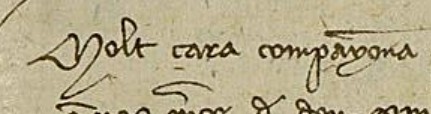
Violant’s treasurer authorizes a payment to Jacques and Isabel Portalbert, a husband-and-wife troubadour team. We worked with this folio in Episode 5.
Episode 28
](/historians-notebook-s1-episodes/images/jan-21-aca-rp-mr-vol-sg904-f72v-violant.jpg)
ACA RP MR, vol. SG, 904, f72v. (image 95) Source: PARES
Today’s Document
- Subject: record of payments to the Portalberts
- Date: January 21, 1387
- Day of the Week: Monday
- Language: Catalan
- Archival Reference Number: ACA RP MR, vol. SG, 904, f72v. (image 95)
- Link to PARES
- Place: Barcelona
- Account Holder: Violant
- Authorizer: Johan Callos
- Recipients: the minstrels Jacques and Isabel Portalbert
Historical Thinking Notes
-
Sourcing: this is a payment record and says nothing about the type of music or performance; the document does include the duration of service, which spans from October 1386 until into the new year
-
Contextualization: early in the fourteenth century, the art of troubadour performance experienced a revival in the city of Toulouse, in southern France; troubadours in the Occitan style grew in popularity throughout France and their style diffused across the Pyrenees into the Crown of Aragon throughout the fourteenth century 1 ; Gaston Fébus was a major force in the diffusion of French culture across the Pyrenees during the fourteenth century
- Corroboration: several records exist in the Archive of the Crown of Aragon documenting payments and recommendations for Jacques and Isabel Portalbert; few records have been identified for other husband-and-wife minstrel teams or for women troubadours; the MiMus database contains hundreds of records of minstrels in Crown of Aragon during the thirteenth and fourteenth centuries with 32 results for the search term ‘joglaressa’2
- Close-Reading: the inclusion of a daily rate implies that the Portalberts were not performing every day, probably making their pay higher than the baker’s in the payment record prior to this one
What is this document doing?
- This document initiates the transfer of funds from the royal treasury to the minstrels, Jacques and Isabel Portalbert.
- The document treats Jacques and Isabel as a team.
Questions
- Why are there so many payment records dated January 21st?
- Were the Portalberts being paid an exhorbitant amount of money?
- Were husband-and-wife troubadour teams present, even if uncommonly so, in the Crown of Aragon throughout the late fourteenth century?
- Why did Violant and Joan like the Portalberts’ performances so much?
- Did Gaston Fébus and Charles III of Navarre also enjoy the Portalberts’ performances?
- How did the Portalberts manage their performances and their finances?
- How did Jacques and Isabel become a team? Did they know each other since childhood?
Bibliography
- Alberni Jordà, Anna. “‘Ioculator Seu Mimus’. Performing Music and Poetry in Medieval Iberia.” Journal of Transcultural Medieval Studies 5, no. 2 (2018): 438–44.
- Boase, Roger. The Troubadour Revival: A Study of Social Change and Traditionalism in Late Medieval Spain. Routledge & K. Paul, 1978.
- Departament de Filologia Catalana i Linguistica General, Universitat de Barcelona, “Ioculator Seu Mimus. Performing Music and Poetry in Medieval Iberia (MiMus),” accessed January 11, 2026, http://mimus.ub.edu.
- Gómez Muntané, Maria del Carmen. ‘Minstrel Schools in the Late Middle Ages.’ Translated by Barbara Haggh. Early Music 18, no. 2 (1990): 213–16.
- Gomez Muntané, María del Carmen. La música medieval en España. Edition Reichenberger, 2001.
- Stone, Anne. “Ars Subtilior.” In The Cambridge History of Medieval Music, edited by Mark Everist and Thomas Forrest Kelly, 1125–46. Cambridge University Press, 2018.
- Trenchs Odena, José, and Ignasi J. Baiges i Jardí. ‘Documents sobre música, músics i instruments musicals a la casa reial catalano-aragonesa (segles XIV-XV): el regnat de Joan I.’ Estudis castellonencs, no. 9 (2000): 135–318.
- Vernier, Richard. Lord of the Pyrenees: Gaston Fébus, Count of Foix (1331-1391). Boydell Press, 2008.
-
Roger Boase, The Troubadour Revival: A Study of Social Change and Traditionalism in Late Medieval Spain (Routledge & K. Paul, 1978). ↩
-
Departament de Filologia Catalana i Linguistica General, Universitat de Barcelona, “Ioculator Seu Mimus. Performing Music and Poetry in Medieval Iberia (MiMus),” accessed January 11, 2026, http://mimus.ub.edu. ↩