Season 1, Episode 36
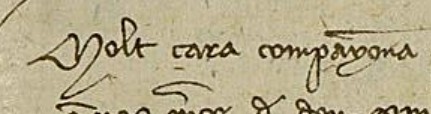
Joan writes to the King of France and the Duke of Touraine requesting a troubadour named Colinet.1
Episode 36
](/historians-notebook-s1-episodes/images/jan-29-aca-cr-r1751-f9v-joan.JPG)
ACA CR R1751 f9v Source: PARES
](/historians-notebook-s1-episodes/images/jan-29-aca-cr-r1751-f10r-joan.JPG)
ACA CR R1751 f10r Source: PARES
Today’s Document
- Subject: Joan requests a troubadour named Colinet
- Date: January 29, 1387
- Day of the Week: Tuesday
- Language: Catalan
- Archival Reference Number: ACA CR R1751 f9v-10r
- Link to PARES
- Place: Barcelona
- Sender: Joan
- Recipients: Charles VI, King of France, and the Duke of Touraine
Historical Thinking Notes
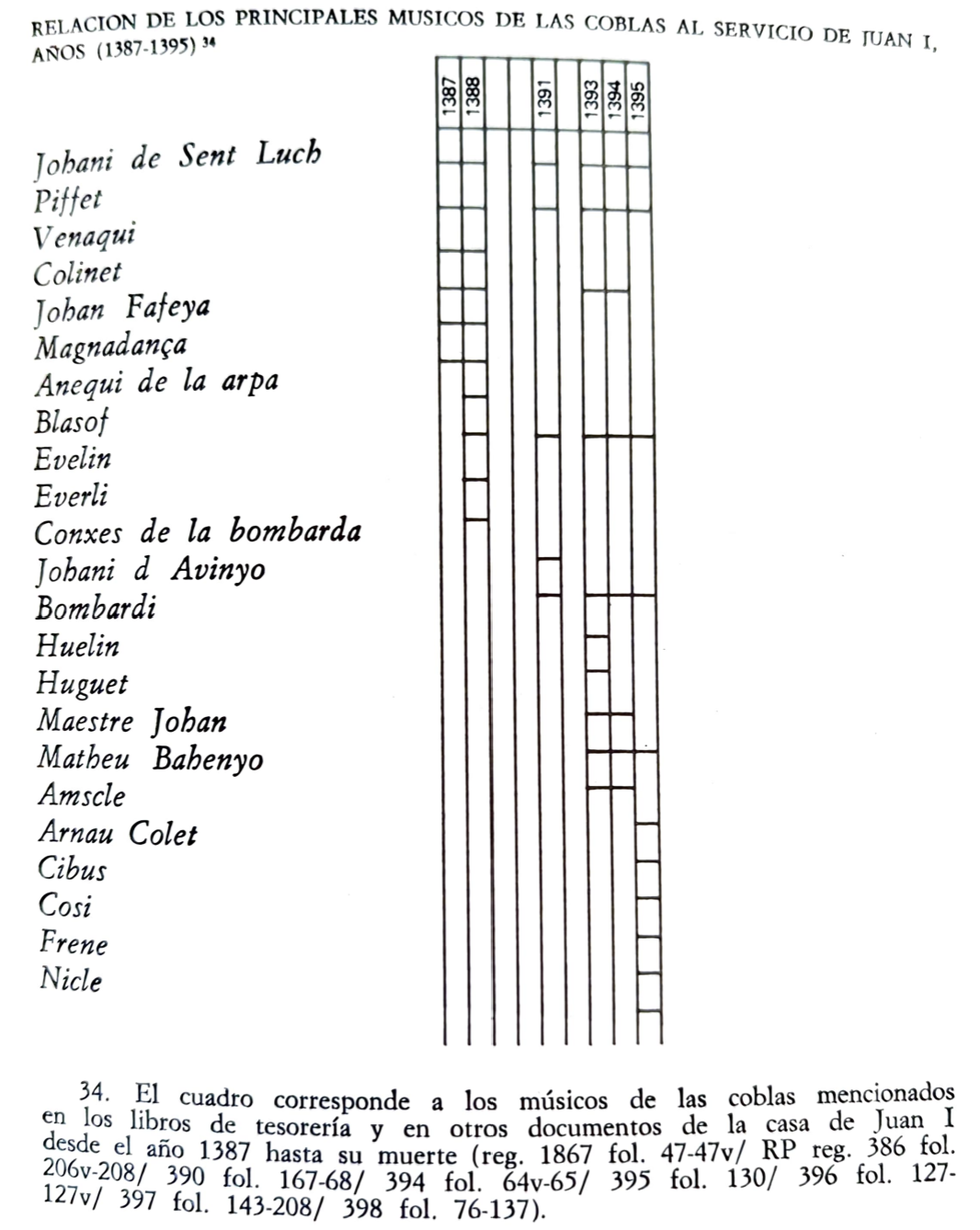
Chart of troubadours employed by Joan and Violant. Source: María del Carmen Gómez Muntané, La música en la Casa Real catalano-aragonesa durante los años 1336-1432, Vol. 1 (Barcelona: A. Bosch, 1979), 43.
-
Sourcing: Joan grew up in an environment that provided him with a lot of resources to explore his musical interests; in addition to assembling a large collection of musical instruments and spending a lot of money on patronage for troubadours, Joan also tried his own hand at music composition (although it is not clear if any of his own compositions survive); the recipients, as extremely wealthy and politically powerful persons, could quite easily facilitate the travel for a troubadour from France to the Crown of Aragon; the Duke of Touraine was Louis, a younger brother of Charles VI
-
Contextualization: large-scale cultural diffusion in Western Europe during the Middle Ages allowed for elites to use their social networks for finding information about troubadours and then arranging for them to travel across far distances to play at their courts; the cultural connections forged between elites also served to reinforce political ties; troubadours also performed at the court of the Pope in Avignon; perhaps this document is one in a long series of exchanged favors and reciprocated cultural gifts
-
Corroboration: another document written on the same day, this time to Ramon de Perellos, the Viscount of Roda, reiterates Joan’s interest in Colinet
-
Close-Reading: perhaps Joan writes to Ramon de Perellos perhaps in an effort to expedite the arrangements for Colinet to travel from France to the Crown of Aragon; the other letter on folio 10r, to Joan’s father-in-law, begins ‘Molt car pare’ and it is doubtful that Joan could have written this without thinking of his own recently deceased father
What is this document doing?
- This document, along with its follow-up to Ramon de Perellos, activates network connections to push for the desired objective, the travel of the troubadour Colinet to Barcelona.
- The document also reinforces the familial ties between Joan and Violant’s relatives.
Questions
- Why was Colinet famous?
- What style of music did Colinet play? Ars nova? Ars subtilior?
- Did Violant know about Colinet? Is there a letter from her about this troubadour?
- Is there documentation from later this year about Colinet’s performances in Barcelona?
- Did Joan feel that he needed the help of Ramon de Perellos to pressure Charles VI and the Duke de Touraine to send Colinet?
Additional Notes
](/historians-notebook-s1-episodes/images/chirimia.jpg)
A chirimia from the sixteenth century. Source: Wikimedia Commons

Other chancery documents identify Colinet’s instrument as a chirimia.2
Bibliography
- Alberni Jordà, Anna. “‘Ioculator Seu Mimus’. Performing Music and Poetry in Medieval Iberia.” Journal of Transcultural Medieval Studies 5, no. 2 (2018): 438–44.
- Boase, Roger. The Troubadour Revival: A Study of Social Change and Traditionalism in Late Medieval Spain. Routledge & K. Paul, 1978.
- Gómez Muntané, María del Carmen. La música en la Casa Real catalano-aragonesa durante los años 1336-1432, Vol. 1. Barcelona: A. Bosch, 1979.
- Gómez Muntané, Maria del Carmen. ‘Minstrel Schools in the Late Middle Ages.’ Translated by Barbara Haggh. Early Music 18, no. 2 (1990): 213–16.
- Stone, Anne. “Ars Subtilior.” In The Cambridge History of Medieval Music, edited by Mark Everist and Thomas Forrest Kelly, 1125–46. Cambridge University Press, 2018.
- Trenchs Odena, José, and Ignasi J. Baiges i Jardí. “Documents sobre música, músics i instruments musicals a la casa reial catalano-aragonesa (segles XIV-XV): el regnat de Joan I.” Estudis castellonencs, no. 9 (2000): 135–318.
-
transcribed by José Trenchs Odena and Ignasi J. Baiges i Jardí, “Documents sobre música, músics i instruments musicals a la casa reial catalano-aragonesa (segles XIV-XV): el regnat de Joan I,” Estudis Castellonencs, no. 9 (2000): 135–318, at 140-141, Document 5. ↩
-
María del Carmen Gómez Muntané, La música en la Casa Real catalano-aragonesa durante los años 1336-1432, Vol. 1 (Barcelona: A. Bosch, 1979), 41-42. ↩