Season 1, Episode 27
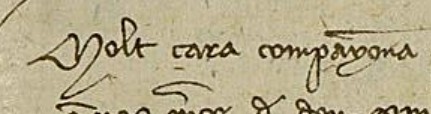
Violant sends an upbeat greeting to the new King of Navarre, a person with whom Violant shares an interesting history.
Episode 27
](/historians-notebook-s1-episodes/images/jan-20-aca-cr-r1819-f74v-violant.JPG)
ACA CR R1819 f74r Source: PARES
Today’s Document
- Subject: Violant sends a greeting to the King of Navarre
- Date: January 20, 1387
- Day of the Week: Sunday
- Language: Catalan
- Archival Reference Number: ACA CR R1819 f74r
- Link to PARES
- Place: Barcelona
- Sender: Violant
- Recipient: Charles III, King of Navarre
Historical Thinking Notes
-
Sourcing: this might be the first letter that Violant wrote to Charles III after each of them ascended to the thrones of their respective countries; Charles III became king on January 1, 1387; the purpose of this letter could be to establish a record of contact for the new year, but also as fellow monarchs
-
Contextualization: other monarchs of the Crown of Aragon had not used the French term ‘dauphin’ either before or since in the centuries surrounding Joan and Violant’s reign; wealthy patrons such as the Duc de Berry, Violant’s uncle, did much to finance the cultural production that made French music, literature, and fashion, the envy of its neighbors in the late fourteenth century
-
Corroboration: plenty of other documents confirm Joan’s francophilia, a topic that has received much attention in modern scholarship as well as contemporary criticisms by figures such as Francesc Eiximenis; in 1391, when Joan imported the troubadour competition of Toulouse, he named it Jocs Florals after its French title, the floral games.
-
Close-Reading: Violant packed this letter with ‘molt car’ and this is highly likely the reflection of a great deal of affinity that she felt for Charles III of Navarre; this is the first documented instance of the term ‘dalfi’ used for Jaume1
What is this document doing?
- This document seeks to naturalize the importation of the French term for the heir to the throne.
- The document also promotes a continuation of high affection between the writer and its recipient.
Questions
- Did Violant and Charles get to know each other when they were both in Paris during the years 1378-1379?
- What would have been Charles’s response to seeing the term ‘dalfi’ in this letter?
- Was there anything in this letter beyond general greetings and salutations?
- What did Joan think of Violant’s closeness to Charles III of Navarre?
- What other ACA registers might have documentation from January 16th, such as the official proclamation of Jaume as dauphin?
- Does this letter provide an indication that Joan was fully recovered from his illness?
Family Tree
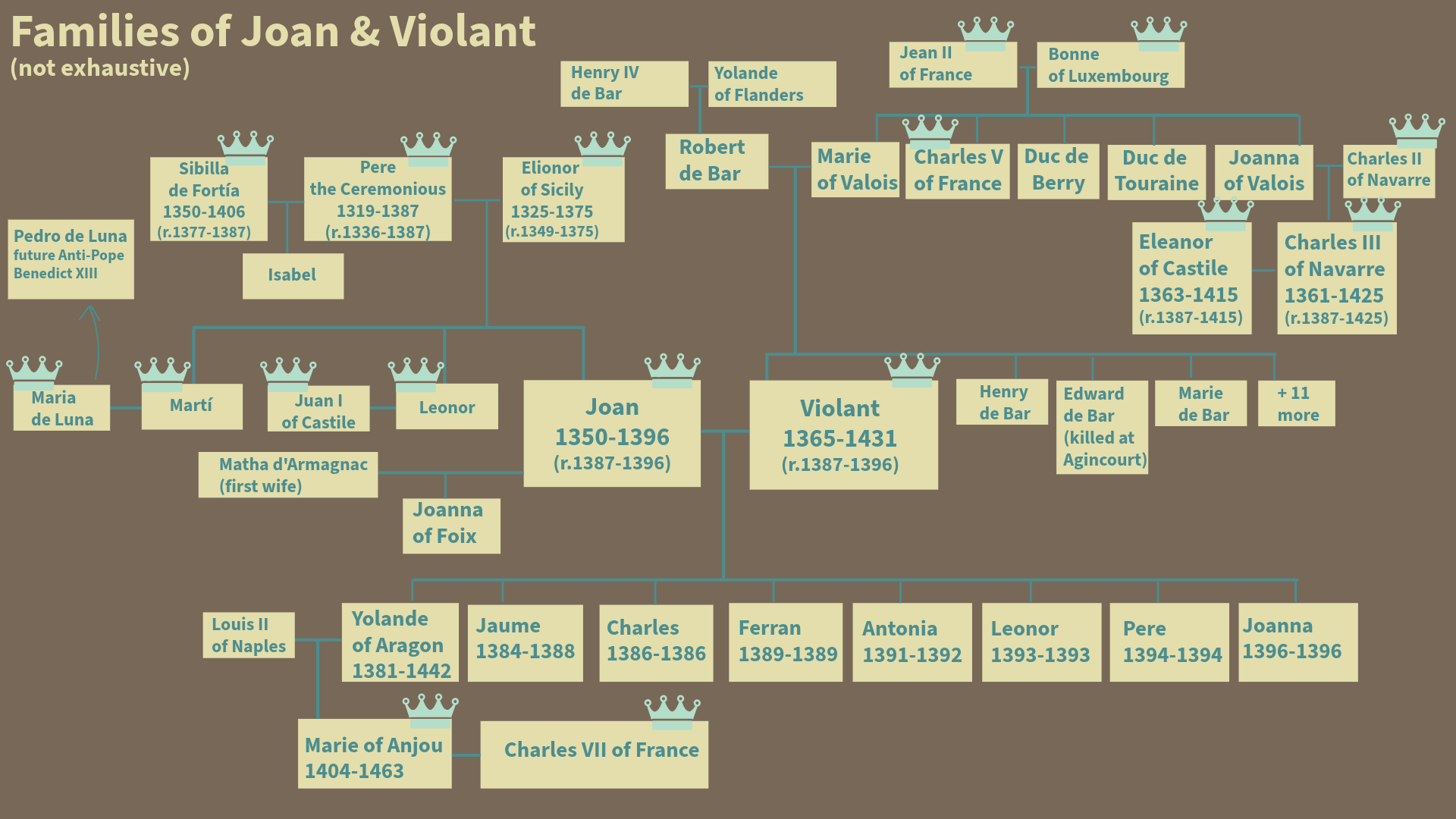
This family tree depicts almost all of the royal family members who will be discussed during Season 1 of The Historian’s Notebook with the notable exception of King Charles VI of France.
Bibliography
- Bratsch-Prince, Dawn. Violante de Bar: 1365-1431. Translated by María Morrás. Ediciones del Orto, 2002.
- Bratsch-Prince, Dawn. “The Politics of Self-Representation in the Letters of Violant de Bar (1365–1431).” Medieval Encounters 12, no. 1 (2006): 2–25.
- Kagay, Donald J. “Poetry in the Dock: The Court Culture of Joan I on Trial (1396-1398).” In Donald J. Kagay, War, Government, and Society in the Medieval Crown of Aragon, XI, 48-99. Variorum Collected Studies Series, CS 861. Ashgate/Variorum, 2007.
- Pagès, Amédée Gilles. La poésie française en Catalogne du XIIIe siècle à la fin du XVe. E. Privat, 1936.
- Riera i Sans, Jaume. “El Dalfinat de Girona (1387-1388).” Annals de l’Institut d’Estudis Gironins 29 (1987): 105–28.
- Rubió y Lluch, Antonio. Joan I, humanista: i el primer perióde de l’humanisme català. Arts Grafiques, S.A., 1919.
- Vielliard, Jeanne. “Nouveaux Documents Sur La Culture Catalane Au Moyen Age.” Estudis Universitaris Catalans. 15, no. Num. I. (Gener-Juny) (1930): 21–40.
-
Jaume Riera i Sans, “El Dalfinat de Girona (1387-1388),” Annals de l’Institut d’Estudis Gironins 29 (1987): 105–28, at 110. ↩