Season 1, Episode 172
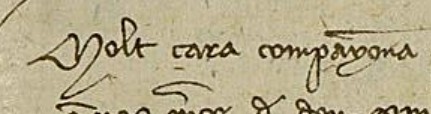
Violant tells the Bailiff of Berga to settle the financial dispute involving the owners of dye-works in Berga.
Episode 172
](/historians-notebook-s1-episodes/images/jun-14-aca-cr-r1822-f152v-violant-img307.jpg)
ACA CR R1822 f152v Source: PARES
](/historians-notebook-s1-episodes/images/jun-14-aca-cr-r1822-f153r-violant-img308.jpg)
ACA CR R1822 f153r Source: PARES
Today’s Document
- Subject: a financial dispute among those involved in the dye-works in Berga
- Date: June 14, 1387
- Day of the Week: Friday
- Language: Catalan
- Archival Reference Number: ACA CR R1822 f152v-153r
- Link to PARES
- Place: Barcelona
- Sender: Violant
- Recipient: Miguel Dardayllo, Bailiff of Berga
Historical Thinking Notes
-
Sourcing: evidently financial disputes and problems with payments in Berga fell under Violant’s purview, but the mention of a ruling by the king in 1381 complicates that picture; the Bailiff might have had a difficult task befor him, given the number of people involved in this situation
-
Contextualization: by the fourteenth century, a strong textile producing sector arose in Catalonia and Cerdanya, fueled in part by the strength of Catalan merchants in Mediterranean trade networks at that time; in addition, the Crown of Aragon encouraged internal textile production through a ban on fabric imports starting in 13421; this shift toward Christian production in the textile economy reflected the increasing political power of Christian forces throughout the Mediterranean, especially in Iberia
-
Corroboration: a few other documents, those examined in Episode 45, Episode 79 and Episode 121, have provided additional glimpses about textiles in the Crown of Aragon at this time
-
Close-Reading: the large number of people named in this document suggests that the tinyaria was a large enterprise
What is this document doing?
- This document connects the authority of the monarch to the complexities of a dispute involving many people in a provincial tonw.
- The document reveals that the dye-works in Berga were large and valuable enough to involve multiple people and generate a financial dispute.
Questions
- What were the details of the problem with the tinyaria in Berga?
- Was Jacme de Puig justified in bringing a complaint to Violant?
- How much involvement did Violant have with the creation and composition of this document?
- Did Miguel Dardayllo see his task of fixing this problem as a particularly difficult one? Why/why not?
- Had the earlier action taken by the king, mentioned in this document, been one carried out by Joan or by Joan’s father?
AI Usage
The transcription and translation of this document was carried out by my OpenClaw pipeline. The output from the OpenClaw pipeline did a better job than I did finding the correct definition of tinyaria.
Bibliography
- Barrigón, María. “Textile Techniques in the Iberian Peninsula (Thirteenth to Fourteenth Centuries).” In Textiles of Medieval Iberia: Cloth and Clothing in a Multi-Cultural Context, edited by Gale Owen-Crocker, María Barrigón, and Nahum Ben-Yahuda, 41–68. Woodbridge, Suffolk: Boydell Press, 2022.
- Diago Hernando, Máximo. “Cloth Trade in the Iberian Kingdoms during the Late Middle Ages.” In Textiles of Medieval Iberia: Cloth and Clothing in a Multi-Cultural Context, edited by Gale Owen-Crocker, María Barrigón, and Nahum Ben-Yahuda, 69–91. Woodbridge, Suffolk: Boydell Press, 2022.
- To Figueras, Lluís. “Drapers and tailors. Fashion and consumption in medieval Catalonia.” In La moda come motore economico: innovazione di processo e prodotto, nuove strategie commerciali, comportamento dei consumatori, edited by Giampiero Nigro, 25–44. Florence: Firenze University Press, 2022.
-
Máximo Diago Hernando, “Cloth Trade in the Iberian Kingdoms during the Late Middle Ages,” in Textiles of Medieval Iberia: Cloth and Clothing in a Multi-Cultural Context, ed. Gale Owen-Crocker, María Barrigón, and Nahum Ben-Yahuda (Woodbridge, Suffolk: Boydell Press, 2022), 78. ↩