Season 1, Episode 121
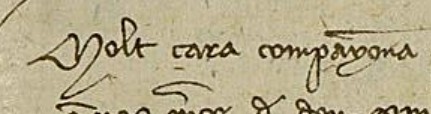
Violant asks the seneschal of Bellcaire to get a confiscated merchant ship released from the custody of a Genoese captain at the port of Tarascon, situated just across the Rhône River.
Episode 121
](/historians-notebook-s1-episodes/images/apr-24-aca-cr-r2053-f7r-violant-img016.jpg)
ACA CR R2053 f7r Source: PARES
Today’s Document
- Subject: confiscated Catalan merchant ship by Genoese authorities
- Date: April 24, 1387
- Day of the Week: Wednesday
- Language: Catalan
- Archival Reference Number: ACA CR R2053 f7r
- Link to PARES
- Place: Barcelona
- Sender: Violant
- Recipient: the seneschal of Bellcaire
Historical Thinking Notes
-
Sourcing: Violant, as the Queen of the Crown of Aragon, knows full well of the long-term rivalry between the Crown of Aragon and Genoa; when Violant mentions Nicola de Spindola, she knows that she is asking the seneschal of Bellcaire to step into the fraught relations between the two larger polities; the location of Tarasco, about 20km south of Avignon explains why Violant heard about the confiscation from her Ambassadors at the Papal Court in Avignon; the fact that Tarasco was in the process of transition from Genoese authority to the rule of the Duke of Anjou raises additional complications due to the betrothal negotiations taking place in Avignon for the marriage of Yolande of Aragon, Violant’s and Joan’s daughter, to the Duke of Anjou, Louis II
-
Contextualization: the Rhône River had divided territories at many points during Antiquity and the Middle Ages; in the decades leading up to 1387, Genoa had been in possession of Tarasco on the west side of the river, and French nobles had held Beaucaire on the opposite bank; the Genoese family of Spinola had been promiment in the governance of Tarasco
-
Corroboration: the document examined in Episode 45 provides an interesting comparison for the use of the word robes because in that context it appears to mean clothing and textiles
-
Close-Reading: the word ‘robes’ means goods in general, not specifically clothing or textiles; Violant uses the phrase ‘senyor nostre molt car’ in much the same way that Joan uses ‘molt cara companyona,’ both as an honorific but also a term of endearment;
What is this document doing?
- This document engages a port official as a proxy for the interests of the Crown of Aragon.
- The document puts blame on a Genoese leader for the predicament.
Questions
- Why did Nicola de Spindola choose this ship to confiscate at this time?
- Would the seneschal of Bellcaire have seen Violant’s demand as an especially challenging one to fulfill?
- What were the characteristics of the ship that got confiscated? Had they been violating any rules?
- How aware was Violant of the involvement of Marie de Blois in the governance of Tarasco at this time? What was the amount of power Marie de Blois had over officials in Tarasco?
- Would the Pope or a Cardinal have gotten involved in this kind of dispute?
Additional Notes
This map of the region south of Avignon shows the location of Bellcaire and Tarascon.
](/historians-notebook-s1-episodes/images/apr-24-tarascon-beaucaire-avignon-map.jpg)
Map of the Rhône river, showing Tarascon and Bellcaire about 22km south of Avignon Source: Google Maps
AI Usage
The transcription and translation of this document was carried out by my OpenClaw pipeline.
Claude gave me a whole etymology of ropa and it appears accurate, although this is far outside my own knowledge base.
I also had Claude search for references to Nicola de Spindola.
Bibliography
- Diccionari català-valencià-balear, s.v. “roba,” accessed April 23, 2026, https://dcvb.iec.cat/.