Season 1, Episode 79
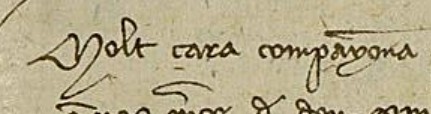
Violant summons skilled textile artisans from Mallorca.
Episode 79
](/historians-notebook-s1-episodes/images/mar-13-aca-cr-r1819-f92r-violant.jpg)
ACA CR R1819 f92r Source: PARES
Today’s Document
- Subject: Violant summons skilled ‘brodaders’ from Mallorca
- Date: March 13, 1387
- Day of the Week: Wednesday
- Language: Catalan
- Archival Reference Number: ACA CR R1819 f92r
- Link to PARES
- Place: Barcelona
- Sender: Violant
- Recipient: textile artisans of Mallorca
Historical Thinking Notes
-
Sourcing: as queen, part of the way that Violant establishes her authority and anchors her legitimacy is through the acquisition of luxury items and patronage of highly skilled artisans
-
Contextualization: this one moment of conspicuous consumption illustrates the larger background trend of political elites bolstering their authority and engaging in self-fashioning through the acquisition of luxuries; Thomas Allsen’s history of the pearl economy explains this larger context very effectively1
-
Corroboration: other documents relating to textiles were examined in Episode 45 and Episode 69; the documents relating to textiles corroborate the high value accorded to luxury textile items in royal households
-
Close-Reading: Violant’s use of the phrase ‘molt desplahens’ when speaking about what would happen if the textile artisans don’t come to Barcelona might convey that the force of the state makes refusal impossible, or it could simply be a courtesy to let the artisans know that they are valued
What is this document doing?
- This document invokes royal authority to initiate the travel of textile artisans from Mallorca to Barcelona.
- The document presumes that artisans are at the beckon call of the queen.
Questions
- Would the textile artisans in Mallorca see this as a stroke of luck or a burden?
- Was there a strategy to inform the governor of Mallorca ahead of time about the summons? Would that help to make it more difficult for the artisans to refuse?
- What kinds of textiles did Violant have in mind?
- Were there locations in addition to Mallorca that Violant wanted textiles and textile artisans from?
- How did Violant hear about these particular textile artisans?
- Did Joan also purchase textiles from this particular source in Mallorca?
AI Usage
I used Gemini for an initial transcription, which I then had Claude reconcile with its own initial transcription. Claude then produced a translation into English with footnotes.
Bibliography
- Allsen, Thomas T. The Steppe and the Sea: Pearls in the Mongol Empire. University of Pennsylvania Press, 2019.
- Burns, E. Jane. Sea of Silk: A Textile Geography of Women’s Work in Medieval French Literature. University of Pennsylvania Press, 2009.
- McCash, June Hall. The Cultural Patronage of Medieval Women. University of Georgia Press, 1996.
- Navarro Espinach, Germán. “Textiles in the Crown of Aragon: Production, Commerce, Consumption.” In Textiles of Medieval Iberia: Cloth and Clothing in a Multi-Cultural Context, edited by Gale Owen-Crocker, María Barrigón, and Nahum Ben-Yahuda. Boydell Press, 2022.
-
Thomas T. Allsen, The Steppe and the Sea: Pearls in the Mongol Empire (University of Pennsylvania Press, 2019), 57. ↩