Season 1, Episode 45
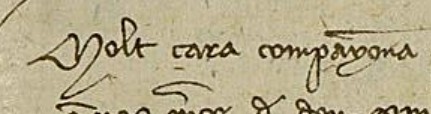
Joan confirms receipt of a big shipment of jewels and luxury items.
Episode 45
](/historians-notebook-s1-episodes/images/feb-7-aca-cr-r1751-f15v-joan.JPG)
ACA CR R1751 f15v Source: PARES
](/historians-notebook-s1-episodes/images/feb-7-aca-cr-r1751-f16r-joan.JPG)
ACA CR R1751 f16r Source: PARES
Today’s Document
- Subject: Joan’s shipment of treasures from Mallorca
- Date: February 7, 1387
- Day of the Week: Thursday
- Language: Catalan
- Archival Reference Number: ACA CR R1751 f15v-16r
- Link to PARES
- Place: Barcelona
- Sender: Joan
- Recipients: Berenguer Lobet
Historical Thinking Notes
- Sourcing: Berenguer Lobet was a long-serving procurator for Joan, the person who handed out the actual payments for the items purchased by the king1; although this is much like an inventory or shipping manifest, Joan wants details included in this letter and that leads me to think his purpose is to celebrate the level of luxury in these items
- Contextualization: the royal family of the Crown of Aragon had been big spenders on luxuries and one exmaple mentioned in the episode is Pere the Ceremonious ordering gold pillows for his bed2; in The Steppe and the Sea, a book about pearls in the Middle Ages, Thomas Allsen provides an excellent demonstration of the conceptual connection between conspicuous consumption of luxuries and the bolstering of political legitimacy3
-
Corroboration: this document corroborates interpretations of Joan as a big spender; the mention of a French style also corroborates reports of his Francophilia
-
Close-Reading: this document abounds with names and descriptions for luxury items; Joan appears to enjoy the details in the long list of items in this shipment; the description of certain designs as ‘barbarian’ might indicate something from as far away as India or China but it is also possible that this is another product from within Islamic culture but far enough away as to appear from outside Dar al Islam
What is this document doing?
- This document indulges in the ornamentation of political rule.
- The document furthers the project of legitimizing the king as worthy of the power of his rule.
Questions
- How expensive were all these items individually?
- Did Berenguer Lobet make the payment in cash or in a bill of exchange?
- Did Joan plan to give any of these luxurious items to Violant or others?
- Where did the sapphires and emeralds come from originally?
- Are notably French styles visible in the design of the textiles?
- How many peacock feathers were typically reqjuired for one of the big fans?
- Do any of the scepters still exist in museum collections?
Additional Notes
I first read about Joan’s penchant for eating peacock in an article by Claire Ponsich.4
AI Usage
I did not use AI for my work on this document. Instead, I relied heavily on the online dictionary at the Institut d’Estudis Catalans, the DCVB.
Bibliography
- Allsen, Thomas T. The Steppe and the Sea: Pearls in the Mongol Empire. University of Pennsylvania Press, 2019.
- Gampel, Benjamin R. Anti-Jewish Riots in the Crown of Aragon and the Royal Response, 1391-1392. Cambridge University Press, 2016.
- Navarro Espinach, Germán. “Textiles in the Crown of Aragon: Production, Commerce, Consumption.” In Textiles of Medieval Iberia: Cloth and Clothing in a Multi-Cultural Context, edited by Gale Owen-Crocker, María Barrigón, and Nahum Ben-Yahuda. Boydell Press, 2022.
- Ponsich, Claire. “Perpignan au féminin, 1380-1431. Quand une femme de pouvoir codifie l’espace, maîtrise l’émotion politique mais libère le sentiment familial.” In Perpignan une et plurielle, edited by Raymond Sala and Michelle Ros, 177–203. Trabucaire, 2004.
-
as demonstrated by the sources from later in Joan’s reign by Benjamin R. Gampel, Anti-Jewish Riots in the Crown of Aragon and the Royal Response, 1391-1392 (Cambridge University Press, 2016), 78 and 83. ↩
-
Germán Navarro Espinach, “Textiles in the Crown of Aragon: Production, Commerce, Consumption,” in Textiles of Medieval Iberia: Cloth and Clothing in a Multi-Cultural Context, ed. Gale Owen-Crocker et al., (Boydell Press, 2022), 111. ↩
-
Thomas T. Allsen, The Steppe and the Sea: Pearls in the Mongol Empire (University of Pennsylvania Press, 2019), 57. ↩
-
Claire Ponsich, “Perpignan au féminin, 1380-1431. Quand une femme de pouvoir codifie l’espace, maîtrise l’émotion politique mais libère le sentiment familial,” in Perpignan une et plurielle, ed. Raymond Sala and Michelle Ros (Trabucaire, 2004), 187. ↩