Season 1, Episode 85
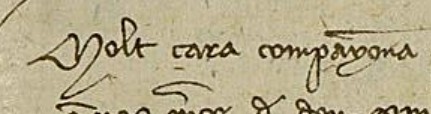
Violant clarifies jurisdictions in Valencia to the governor.
Episode 85
](/historians-notebook-s1-episodes/images/mar-19-aca-cr-r2053-f3r-violant.jpg)
ACA CR R2053 f3r Source: PARES
Today’s Document
- Subject: tax collection procedures and differences in jurisdiction for Jewish and Muslim aljamas
- Date: March 19, 1387
- Day of the Week: Tuesday
- Language: Catalan
- Archival Reference Number: ACA CR R2053 f3r
- Link to PARES
- Place: Barcelona
- Sender: Violant
- Recipients: Mossen Aznar, Governor of Valencia
Historical Thinking Notes
-
Sourcing: although she occupied a position of great power, Violant might not have immediately had full exercise of power in all the disparate jurisdictions within her portfolio; the dispatching of a treasury official to review the accounts in the Valencia might be seen as a way for Violant to ensure that the officials in this faraway region are loyal and trustworthy; Violant also likely was motivated by the desire to increase revenue streams for all of her queenship projects
-
Contextualization: medieval Iberian queen lieutenants had, for over a century, held their own portfolios and had separate treasury officials; at this time, Valencia had been firmly within the Crown of Aragon as a constituent territory for centuries, since the middle of the thirteenth century
-
Corroboration: the document examined in Episode 53 was another letter from Violant to Mossen Aznar; just a few days earlier Joan had written to the portantveurs of Valencia about a financial crime, discussed in Episode 81, so here we can see Violant’s jurisdiction of the religious minority communities in the same city as Joan’s jurisdiction over some other treasury-related matter; previous documents involving the aljamas under Violant’s purview include those examined in Episode 29 and Episode 59, but some aljamas fell in Joan’s jurisdiction as seen in Episode 75; Anthony Rosar appeared in Episode 82, receiving an open credential letter from Violant which at the time I thought might have been for Aragon but now it looks like Valencia was his destination
-
Close-Reading: the phrase ‘qui aura present’ means that Anthony Rosar was present at the time of the writing of this letter; the word ‘empero’ (however) introduces the exception for the religious minority communities, the Jewish and Muslim aljamas, in Valencia
What is this document doing?
- This document puts legal force behind the actions of the queen’s treasury official, bolstering his efforts to supervise revenue collection in a faraway territory.
- The document attempts to strengthen the queen’s control over the financial processes that provide her with revenue.
Questions
- Why were open credential documents drafted three days before this more specific credential for Anthony Rosar? Was he expected to visit an assortment of towns on treasury business before arriving to Valencia?
- Was Anthony Rosar’s assigned task an indication that Violant distrusted her Valencian officials?
- Would the recipient of this letter, the governor of Valencia, have seen this as routine?
- What additional financial benefit did Violant hope to achieve? Did she have an estimate of how much additional money might come from Rosar’s visit to Valencia?
- How long was Rosar expected to remain in Valencia?
- What does this document indicate about the overlap between Violant’s and Joan’s portfolios?
AI Usage
I used Gemini for an initial transcription, which I then had Claude reconcile with its oWn initial transcription. Claude then produced a translation into English with footnotes. I was not originally alert to the significance of the phrase ‘qui aura present’ and it was Claude that drew my attention to how it was a clue to Anthony Rosar’s location at the time of this document
Bibliography
- Ruiz Domingo, Lledó. El tresor de la reina: recursos i gestió econòmica de les reines consorts a la Corona d’Aragó, segles XIV-XV. Consejo Superior de Investigaciones Científicas, 2022.
- Ruiz Domingo, Lledó. “Surrounding the Future Queen of the Crown of Aragon: Violant of Bar’s Household as Duchess of Girona (1384–1386).” Royal Studies Journal 10, no. 1 (2023): 96-135.
- Morelló Baget, Jordi, Pere Orti Gost, and Pere Verdés Pijuan, eds. Renda feudal i fiscalitat a la Catalunya baixmedieval: estudis dedicats a Manuel Sánchez Martínez. Consejo Superior de Investigaciones Científicas, 2018.
- Orti Gost, Pere, and Pere Verdés Pijuan, eds. El sistema financiero a finales de la Edad Media: agentes, instrumentos y métodos. Universitat de València, 2020.
- Sánchez, Manuel, Ángel Sesma Muñoz, and Antoni Furió. “Old and New Forms of Taxation in the Crown of Aragon (13th-14th Centuries).” In La fiscalità nell’economia Europea secc. XIII-XVIII, edited by Simonetta Cavaciocchi. Firenze University Press, 2008. Available for free at CSIC
- Tello Hernández, Esther. “Auditing of Accounts as an Instrument of Royal Power in Catalonia (1318-1419).” In Accounts and Accountability in Late Medieval Europe: Records, Procedures, and Socio-Political Impact. Brepols, 2020.