Season 1, Episode 82
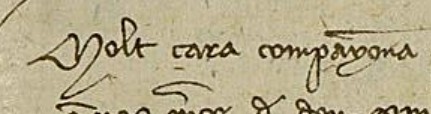
Violant provided open credential letters, with no addressees, for two treasury officials.
Episode 82
](/historians-notebook-s1-episodes/images/mar-16-aca-cr-r2053-f3v-violant.jpg)
ACA CR R2053 f3v Source: PARES
Today’s Document
- Subject: Violant provides credential letters for treasury officials
- Date: March 16, 1387
- Day of the Week: Saturday
- Language: Catalan
- Archival Reference Number: ACA CR R2053 f3v
- Link to PARES
- Place: Barcelona
- Sender: Violant
- Recipients: open credential letters
Historical Thinking Notes
-
Sourcing: Violant received revenue from her own portfolio of rents and taxes; her desire to spend on her queenly self-fashioning projects probably made up the bulk of her motivation to push for this effort to secure the authority for the officials mentioned in this letter
-
Contextualization: medieval Iberian queen lieutenants had, for over a century, held their own portfolios and had separate treasury officials
-
Corroboration: the document examined in Episode 66 also had no addressee, but that was specifically for the task of negotiating terms for a marriage and the credential in this letter appears much more open-ended
-
Close-Reading: the addition of ‘sine suprascripcione’ explains the lack of addressee, but it is perplexing that not even a particular constituent realm gets mentioned explicitly, although it does seem that Aragon is implied; the words ‘emoluments’ and ‘cumbra’ might suggest a particular type of revenue beyond general taxes; this letter contains the stock phrase ‘pregam, volem, manam’ (we request, we will, and we command) which often appears in the documents of medieval monarchs for their commands
What is this document doing?
- This document assures any reader that the named individuals hold the authority of the queen.
- The document facilitates the collection of revenue for the state.
Questions
- Where were the treasury officials, Jacme Estiua and Antony Rosar, planning to visit?
- Why is this document in the secret seal register and not a curia or commune register?
- Why are three letters necessary?
- What kinds of revenue stream does the money collected from the ‘emoluments’ get put into?
AI Usage
I used Gemini for an initial transcription, which I then had Claude reconcile with its own initial transcription. Claude then produced a translation into English with footnotes.
Bibliography
- Ruiz Domingo, Lledó. El tresor de la reina: recursos i gestió econòmica de les reines consorts a la Corona d’Aragó, segles XIV-XV. Consejo Superior de Investigaciones Científicas, 2022.
- Ruiz Domingo, Lledó. “Surrounding the Future Queen of the Crown of Aragon: Violant of Bar’s Household as Duchess of Girona (1384–1386).” Royal Studies Journal 10, no. 1 (2023): 96-135.
- Morelló Baget, Jordi, Pere Orti Gost, and Pere Verdés Pijuan, eds. Renda feudal i fiscalitat a la Catalunya baixmedieval: estudis dedicats a Manuel Sánchez Martínez. Consejo Superior de Investigaciones Científicas, 2018.
- Orti Gost, Pere, and Pere Verdés Pijuan, eds. El sistema financiero a finales de la Edad Media: agentes, instrumentos y métodos. Universitat de València, 2020.
- Sánchez, Manuel, Ángel Sesma Muñoz, and Antoni Furió. “Old and New Forms of Taxation in the Crown of Aragon (13th-14th Centuries).” In La fiscalità nell’economia Europea secc. XIII-XVIII, edited by Simonetta Cavaciocchi. Firenze University Press, 2008. Available for free at CSIC
- Tello Hernández, Esther. “Auditing of Accounts as an Instrument of Royal Power in Catalonia (1318-1419).” In Accounts and Accountability in Late Medieval Europe: Records, Procedures, and Socio-Political Impact. Brepols, 2020.