Season 1, Episode 77
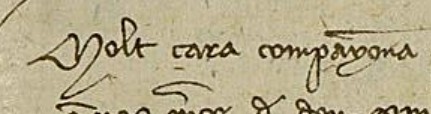
Violant also castigates the Governor of Aragon.
Episode 77
](/historians-notebook-s1-episodes/images/mar-11-aca-cr-r1819-f90v-violant.jpg)
ACA CR R1819 f90v Source: PARES
](/historians-notebook-s1-episodes/images/mar-11-aca-cr-r1819-f91r-violant.jpg)
ACA CR R1819 f91r Source: PARES
Today’s Document
- Subject: great displeasure with the governor’s refusal to confiscate properties of Bernat de Fortia
- Date: March 11, 1387
- Day of the Week: Monday
- Language: Catalan
- Archival Reference Number: ACA CR R1819 f90v-91r
- Link to PARES
- Place: Barcelona
- Sender: Violant
- Recipient: Sanxo/Sancho Martinez, Governor of Aragon
Historical Thinking Notes
-
Sourcing: Violant almost certainly knew that Joan had written a highly scolding letter to Sanxo Martinez dated one day prior, so her letter might be an attempt to present a less severe approach with the insubordinate governor; Violant’s decision to write a follow up letter might be explained by the growing habit of co-rule established between her and Joan, or there might be a particular reason for her to write an additional letter to Martinez
-
Contextualization: the secondary literature on Iberian queen lieutenancy contextualizes Violant’s authority over Sanxo Martinez; at the same time, the scholarship on queen lieutenancy frequently characterizes the queen’s role as a separate sphere without much overlap with the portfolios of other members of the royal family
-
Corroboration: other instances of Violant and Joan writing echoing letters have been examined in examined in Episode 3, Episode 9 and Episode 72
-
Close-Reading: Violant demands that the governor makes a ‘greu correctio’ to his course of action but unlike Joan does not threaten to make him into an example that will cause terror to others; Violant spends several sentences appealing to the governor’s sense of reason and the lack of reasoning for continuing to defy orders from the king; in this letter, Violant casts herself as a fellow sovereign with the same status as the king, who must be obeyed in the name of justice; the use of the first person plural, while obviously a convention for a monarch referring to herself, has an additional effect of joining Martinez in with her as someone who sees the importance of what the king wants
What is this document doing?
- This document presumes that the governor should obey the queen in a fashion that matches his obedience to the king.
- The document lays out a scheme of political authority that invokes co-rule but also the importance of obedience to the queen as a distinct sovereign entity to the king.
Questions
- Was this letter an example of co-rule or did Violant have another, more particular reason for adding to Joan’s letter a follow-up document of her own?
- Was this another instance of Joan and Violant working together to pursue vengeance against the de Fortiàs or was one of them taking the lead?
- How would Sanxo Martinez have responded to the letter from Violant compared to his response to the letter from Joan? Did Martinez see the two of them as one corporate monarchy?
- Why did Violant choose to adopt a more conciliatory tone with Martinez compared to Joan? Had she read Joan’s letter before composing hers?
- Joan had transferred all of Siblla’s property to Violant on December 30th, as discussed in Episode 6. Was Violant missing out on significant revenue due to the governor’s slow-walking on this confiscation?
AI Usage
I had Gemini produce a transcript, which then I gave to Claude for an initial reconciliation. Then Claude came up with a translation into English with footnotes.
Bibliography
- Earenfight, Theresa. “Absent Kings: Queens as Political Partners in the Medieval Crown of Aragon.” In Queenship and Political Power in Medieval and Early Modern Spain, edited by Theresa Earenfight. Ashgate, 2005.
- Earenfight, Theresa. “A Lifetime of Power, Beyond Binaries of Gender.” In Medieval Elite Women and the Exercise of Power, 1100–1400: Moving beyond the Exceptionalist Debate, edited by Heather J. Tanner, 271-293. Palgrave Macmillan, 2019.
- Kelleher, Marie A. “What Do We Mean by” Women and Power”?” Medieval Feminist Forum: A Journal of Gender and Sexuality 51, no. 2 (2016): 104–15.
- Ponsich, Claire. ‘De la parole d’apaisement au reproche: un glissement rhétorique du conseil ou l’engagement politique d’une reine d’Aragon?,’ Cahiers d’études Hispaniques Medievales 31 (2008): 81–117.
- Tanner, Heather J., ed. Medieval Elite Women and the Exercise of Power, 1100–1400: Moving beyond the Exceptionalist Debate. Palgrave Macmillan, 2019.