Season 1, Episode 9
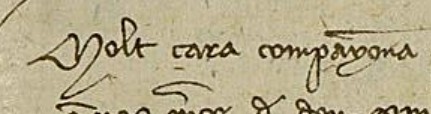
Joan informs the Duc de Berry about the troublesome students in Montpellier. In this letter we find out that the students are accused of sexual assault.
Episode 9
](/historians-notebook-s1-episodes/images/jan-2-aca-cr-r1648-f109r-joan.JPG)
ACA CR R1648 f109r Source: PARES
](/historians-notebook-s1-episodes/images/jan-2-aca-cr-r1648-f109v-joan.JPG)
ACA CR R1648 f109v Source: PARES
Today’s Document
- Subject: Joan asks the Duc de Berry to influence the treatment of the Catalan students
- Date: January 2, 1387
- Day of the Week: Wednesday
- Language: Catalan
- Archival Reference Number: ACA CR R1648 f109r
- Link to PARES
- Place: Girona
- Sender: Joan
- Recipient: Duc de Berry
Historical Thinking Notes
-
Sourcing: at this time, the Duc de Berry was the ruler of France as Charles VI came of age; perhaps Joan himself wrote a letter to the officials of Montpellier before December 25, but as far as I currently know it is only Violant who has intervened in this matter; evidently, Joan feels that the influence of the most powerful man in France will help the accused students, either because he would in any situation like this to do everything he can or the students really will need all the influence they can get; if Joan has concerns about the victim’s wellbeing, he only expresses it as a recognition that, in a general sense, justice is a good thing to pursue
-
Contextualization: in the patriarchy that developed in Western Civilization, sexual assault appears constantly (for example, just look at its prevalence in Greek myths); in ancient times, the Middle Ages, and in our modern era, powerful men use their influence to protect perpetrators and the rapists benefit from a default characterization of being ‘young men with a bright future ahead of them’; in an excellent recent monograph, Carissa Harris has exposed the cultural underpinnings of sexual assault for England in the Middle Ages 1; I think that this is an instance when continuity surfaces, but at the same time it’s important to understand that patriarchy and sexual assault are not inevitable or a natural background feature of human societies - both are defined within the boundaries of gender rules of the time
-
Corroboration: Violant’s letter lacks any detail about the crime the students committed; both Joan and Violant wrote to the Duc de Berry regularly and the secondary literature that I’ve encountered focuses on their correspondence regarding cultural pursuits; I would really like to find other instances when Joan asks for the Duc de Berry’s influence in a criminal matter and I wonder if it is rare for him to do so
-
Close-Reading: Joan makes a point of saying that the victim of the crime was ‘a woman of good standing’ who had a legitimate reason for being out a night and this puts the accused students in a worse light; Violant’s letter is to the officials in Montpellier who would already know this information; in an interesting comparison to the letter he wrote to Martí the day before, Joan also calls the Duc de Berry ‘molt car frare’ in the address line at the end, but within the letter only ‘car frare’
What is this document doing?
- This document re-enacts the power of elite men to protect perpetrators of sexual assault from facing criminal consequences of rape.
- The document mostly silences the harm done to the victim.
Questions
- Did Violant know the crime the students were accused of when she wrote her letter on December 25th? It’s hard to imagine she did not, but it would be helpful to see if Joan had written an earlier to Montpellier officials.
- Did the fact that Joan’s two eldest children were daughters cause him to feel any hesitation in writing to the Duc de Berry? Is social class so powerful that Joan, and Violant as well, consider the status of women in their own family in a way that puts vast distances between them and the woman in this case?
- How frequently was sexual assault reported in Montpellier, or in the Crown of Aragon, at this time?
- How did the social class of the victim affect the development of events? In a city, would rapists even get arrested in the case of a woman of lower class standing?
- What happened next? Did the students escape punishment?
- Does the archive, possibly in court records from Montpellier, include the voice of the woman or is her voice silenced?
AI Usage
The difficulty I had with a phrase in the third line led me to put my transcription of this document into ChatGPT. As you can see in the transcript, it took me a while to get to the meaning of that phrase as terms for young men, possibly with class valences along the lines of modern term hooligans or bullies. However, in tandem with the ChatGPT conversation, I was working with the glossary at the end of Mediaeval Catalan Linguistic Texts by Paul Russell-Gebbett. This book’s glossary had entries close to ‘veylets’ and ‘masips’ and helped me to push back on ChatGPT’s initial ideas about these words. I only became aware of this extremely helpful glossary because I browsed the shelf of Catalan language and literature books at Zimmerman Library at the University of New Mexico. The online catalog record for the book does not mention its glossary, so without being physically present in the library, I would not have had a resource that in this moment proved extremely helpful to building my understanding of this document.
An important note about my own positionality: the interpretation from ChatGPT helped me to overcome my own blindspot, which was on display in Episode 1 when I didn’t think of rape as a possible crime being discussed. In hindsight, it is clear to me that if there are is a group of students accused of a serious crime, sexual assault should be in my mind as a likely possibility.
Bibliography
- Block, Sharon. Rape and Sexual Power in Early America. University of North Carolina Press, 2006.
- Harris, Carissa M. Obscene Pedagogies: Transgressive Talk and Sexual Education in Late Medieval Britain. Cornell University Press, 2018.
- Russell-Gebbett, Paul. Mediaeval Catalan Linguistic Texts. Dolphin Book Co., 1965.
-
Carissa M. Harris, Obscene Pedagogies: Transgressive Talk and Sexual Education in Late Medieval Britain (Cornell University Press, 2018) ↩