Season 1, Episode 56
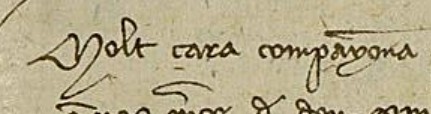
Violant writes to her father, assuring him that Joan has recovered from his illness.
Episode 56
](/historians-notebook-s1-episodes/images/feb-18-aca-cr-r1819-f86v.JPG)
ACA CR R1819 f86v Source: PARES
](/historians-notebook-s1-episodes/images/feb-18-aca-cr-r1819-f87r.JPG)
ACA CR R1819 f87r Source: PARES
Today’s Document
- Subject: Joan’s illness
- Date: February 18, 1387
- Day of the Week: Monday
- Language: Catalan
- Archival Reference Number: ACA CR R1819 f86v-87r
- Link to PARES
- Place: Barcelona
- Sender: Violant
- Recipient: her father, Robert de Bar
Transcription
Molt car pare e senyor, sapia vostra senyoria que lo senyor Rey e marit meu es estat distrasiat de malaltia de febre e d’altres accidents e es vuy perla qual distresio. Io son estada e no sens raho torbada pero merced de deu lo dit senyor es fora de perill segons que tots los metges dihen perque ho notifich a nos senyor qui si alscunes noves contraries haviets hoydes sapiats la veritat e que haiats consolacio de les males noves qu’en pens vos han dites. E si del meu senyor vos plau saber certifich vostra senyoria que lo jorn de la datum de les presents yo e mos fills estavem be supplicants vos que al pus sovin ques pora fer del estament vostre me certifiquets car serva cosa de que havre subiran plaer. Et si algunes coses car pare e senyor valets que faça manats me lo sant spirit sia vostra guarda…
Historical Thinking Notes
-
Sourcing: certainly the intended audience of this letter contributes to its candor, as Violant decides to reveal to her father, who she evidently trusts with this information, that Joan had been in peril in January; as queen, Violant would see her own power and status greatly diminished if people started to think that Joan would soon die
-
Contextualization: this document certainly evokes the insights of Ernst Kantorowicz’s foundational work, The King’s Two Bodies, in that the strength of the king’s body is closely tied symbolically to the strength of the kingdom and the exercise of power available to the monarchs1
-
Corroboration: in the document examined in Episode 43 Violant uses the word ‘malalties’ but did not convey nearly the amount of peril as in today’s document; to make an inferences when comparing this letter to the one examined in Episode 41, Violant might have sent similar information to Charles III of Navarre on February 3rd, but through a messenger, and the fact that she wrote down the sensitive information in this letter to her father might indicate that a written letter could arrive to her father significantly faster, through multiple horses on relay, versus the travel time required by a messenger
-
Close-Reading: ‘distrasiat’ in line 2 of the letter, at the bottom of folio 86v, could mean simply distracted, as in off-course, or it could have a more perilous connotation; in line 2 of folio 87r, Violant’s assertion that ‘tots los metges,’ all the doctors, agree that Joan is out of peril, reveals that Joan’s illness required the consultation of multiple doctors; the ‘noves contraries’ in line 3 of folio 87r reveals that Violant is concerned about reports of Joan’s illness spreading through France
What is this document doing?
- This document attempts to reduce the damage done to royal authority.
- The document activates kinship ties to aid in the bolstering of royal legitimacy.
Questions
- What had Violant heard about the awareness of others regarding Joan’s illness?
- How honest is Violant in this letter? What has she omitted?
- Had Joan’s adversaries been trying to fan the rumors and reports of his illness?
- How long did Joan’s illness last? Have there been lingering symptoms since January 19th?
- Where was Robert de Bar residing at this time?
- Why did Violant decide to commit this information to writing at this time? Does this indicate urgency or security?
Additional Notes
](/historians-notebook-s1-episodes/images/feb-18-aca-cr-r1819-f86r.JPG)
ACA CR R1819 f86r Source: PARES
In this letter, on folio 86r of Register 1819, Violant wrote to her brothers about Joan’s illness far less directly than what we see in today’s document.
AI Usage
ChatGPT helped me identify some subtleties in the translation from medieval Catalan to English. However, I also consulted the DCVB in my investigation of the definition and possible translations of the word ‘distrasiat.’
Claude wrote me a report on the historiography of The Kings’s Two Bodies in relation to Disability Studies.
Bibliography
- Dubourg, Ninon, Sara Scalenghe, and Pieter Verstraete. “Medieval Histories of Disability and Emotions: An Introduction.” Journal of Medieval History 51, no. 2 (2025): 149–61.
- Kantorowicz, Ernst H. The King’s Two Bodies: A Study in Mediaeval Political Theology. Princeton University Press, 1957.
- Girona y Llagostera, Daniel. “Itinerari de l’Infant En Joan, Fill Del Rei En Pere III. 1350-1387.” III Congreso de Historia de La Corona de Aragón (Valencia), Hijo de F. Vives Mora, 1923, 169–592. Available on Google Books, accessed December 26, 2025.
- Riera i Sans, Jaume. ‘El Dalfinat de Girona (1387-1388).’ Annals de l’Institut d’Estudis Gironins 29 (1987): 105–28.
- Roca, Josep M. Johan I d’Aragó. Barcelona: Institució Patxot, 1929.
- Tasis i Marca, Rafael. Joan I: el rei caçador i músic. Editorial Aedos, 1959.
-
Ernst H. Kantorowicz, The King’s Two Bodies: A Study in Mediaeval Political Theology (Princeton University Press, 1957). ↩