Season 1, Episode 43
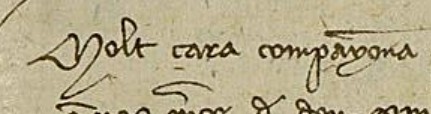
Violant sends a letter of thanks to several monasteries whose monks prayed for Joan to recover from illness.
Episode 43
](/historians-notebook-s1-episodes/images/feb-5-aca-cr-r1819-f79v-violant.JPG)
ACA CR R1819 f79v Source: PARES
Today’s Document
- Subject: Violant thanks several monasteries for their prayers
- Date: February 5, 1387
- Day of the Week: Tuesday
- Language: Catalan
- Archival Reference Number: ACA CR R1819 f79v
- Link to PARES
- Place: Barcelona
- Sender: Violant
- Recipients: several monasteries in the Crown of Aragon
Historical Thinking Notes
-
Sourcing: as queen, Violant can send substantial resources to this monastery, ensuring its continuity; the purpose is not only to express gratitude and to foster a network connection, but is also transactional in the sense that the monks’ prayers are most likely interpreted by Violant as having real-world effects for Joan’s health (see Contextualization directly below)
-
Contextualization: this document reflects the larger context of how people in the Middle Ages in Western Europe believed in a direct connection between the divine and the events that happened in their lives; when Violant thanks the Carthusian monks for their prayers, she invokes a knowledge of the world and human existence in which the intercession between humans and the divine is a feature of reality; this differs from how we consider the influence of prayer in curing illness in modern society, where the connection is seen as a feature of an individual’s belief system and not a shared reality; saints’ relics commonly provided an intercessory role along with prayers
-
Corroboration: several other charters and documents examined in this podcast have demonstrated the connection between the monarchs and religious institutions; here, though, is a personal touch that is largely absent from the documents that recommended people to fill vacancies
-
Close-Reading: Violant uses the word ‘malalties’ to describe what has happened to Joan at the outset of their reign; in other letters Joan’s illness was referred to as misfortune or difficulties
What is this document doing?
- This document reinforces, and operates within, a discourse of intercession between the divine and the mundane world.
- The document also asserts Violant’s active response to Joan’s illness, managing the spiritual aspects of his recovery.
Questions
- What kind of information did Violant receive about the prayers that the monks made for Joan? Their frequency? Their content?
- Did Violant see the monks’ prayers as directly counteracting a curse or act of evil sorcery that had been directed at Joan?
- How would the monasteries react to the gratitude expressed in this letter?
- Was this letter pro forma, something they were used to getting from monarchs and other elites or was it unusual to get a letter like this?
- Did Violant use ‘malalties’ in any correspondence before February 5th to refer to Joan’s impairment?
- Are there any monasteries absent from this list that would normally have been included?
- Did Joan ever write to the monasteries thanking them for their prayers? Would there have been a gendered aspect to that?
Additional Notes
In this episode I mention a letter from April 29, 1387, transcribed in an article by Dawn Bratsch-Prince in which Violant again thanks a long list of monasteries for praying for Joan.1
The monasteries listed as recipients of this letter include Scala Dei, a Carthusian monastery in the southwest of Catalonia, and Porta Coeli, a Carthusian monastery near Valencia.
AI Usage
I input my transcription of this letter into ChatGPT and got help with several of the tricky phrases. Weirdly, ChatGPT has developed a fondness for commenting on the letter according to its own perplexing emotional registers, appearing to think that I want it to make me feel good about finding particular documents. For example, ChatGPT called this letter ‘very Violant’ and makes a (malformed) argument for its use in a historical narrative.
Bibliography
- Prince, Dawn E. “A Reappraisal of the Correspondence of Violant de Bar (1365-1431).” Catalan Review: International Journal of Catalan Culture 8, nos. 1–2 (1994): 295–312.
- Tester, S. J. A History of Western Astrology. Boydell Press, 1987.
-
Dawn E. Prince, “A Reappraisal of the Correspondence of Violant de Bar (1365-1431),” Catalan Review: International Journal of Catalan Culture 8, nos. 1–2 (1994): 295–312, at 309-310. ↩