Season 1, Episode 181
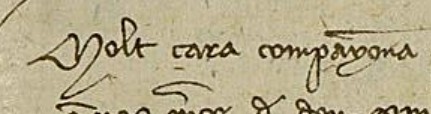
Joan sends to Gaston Fébus two of his favorite troubadours, players of the xalamia and the bombard.1
Episode 181
](/historians-notebook-s1-episodes/images/jun-23-aca-cr-r1751-f70r-joan-img142.jpg)
ACA CR R1751 f70r Source: PARES
Today’s Document
- Subject: sharing of well-regarded minstrels who specialize in the shawm and bombard
- Date: June 23, 1387
- Day of the Week: Sunday
- Language: Catalan
- Archival Reference Number: ACA CR R1751 f70r
- Link to PARES
- Place: Barcelona
- Sender: Joan
- Recipient: Gaston Fébus, Count of Foix-Bearn
Historical Thinking Notes
- Sourcing: Joan spent a lot of time, money, and energy on collecting instruments and having them custom-made2; although this letter does not appear to involve Violant, I argue that over the course of their marriage Joan and Violant worked together in close collaboration on their cultural program3; Gaston Fébus, a prolific consumer of cultural works also wrote a famous treatise on hunting, Le livre de la chasse, which has survived in 64 manuscript copies; scholars have already studied many letters that Joan and Violant sent to Fébus about literature, music, and hunting4
- Contextualization: many medieval elites saw cultural patronage as key to their self-fashioning projects and they also had access to funds to pay musicians, writers, and artists5
- Corroboration: the document examined in Episode 146 offers an opportunity to corroborate today’s document in that Joan, on May 19th, wrote to another medieval elite, Juan Fernandez de Heredia, making the latest trade in an apparently ongoing exchange of hunting animals; the other letter to Gaston Fébus examined in the podcast was in Episode 42 and was about the pursuit of a criminal, not cultural matters; in 2009, Claire Ponsich wrote an article specifically on the correspondence between Violant de Bar and Gaston Fébus6
- Close-Reading: in line 2, Joan states that Henri and Venaqui ‘siens los mellors,’ are the best, at the shawm and bombard, but then on line three he adds the qualifier ‘apres los nostres,’ after our own; it appears that Joan could not resist claiming the superiority of the Aragonese minstrels and this injects a note of competition into the correspondence
What is this document doing?
- This document reinforces the social tie between two medieval elites.
- The document positions Joan as an experienced arbiter of musical taste.
Questions
- Was Violant aware of Joan’s decision to send Henri and Venaqui to Gaston Fébus?
- How long had Henri and Venaqui been in Barcelona?
- Even though Gaton Fébus had been composing Le livre de la chasse in 1387, had Joan read any of it at this time?
- Was the Latin document at the top of this folio also about Henri and Venaqui?
AI Usage
A transcription and translation of this document was also carried out by my OpenClaw pipeline. The resulting output contributed hardly anything to my work on today’s document and indeed the output failed to recognize the document as about music at all. The output claims that the document is about bombards, ‘early artillery pieces.’
Bibliography
- Alberni Jordà, Anna. “‘Ioculator Seu Mimus’. Performing Music and Poetry in Medieval Iberia.” Journal of Transcultural Medieval Studies 5, no. 2 (2018): 438–44.
- Boase, Roger. The Troubadour Revival: A Study of Social Change and Traditionalism in Late Medieval Spain. Routledge & K. Paul, 1978.
- Departament de Filologia Catalana i Linguistica General, Universitat de Barcelona, “Ioculator Seu Mimus. Performing Music and Poetry in Medieval Iberia (MiMus),” accessed January 11, 2026, http://mimus.ub.edu.
- Earp, Lawrence Marshburn. Guillaume de Machaut: A Guide to Research. Garland Pub., 1995.
- Gómez Muntané, Maria del Carmen. ‘Minstrel Schools in the Late Middle Ages.’ Translated by Barbara Haggh. Early Music 18, no. 2 (1990): 213–16.
- Gomez Muntané, María del Carmen. La música medieval en España. Edition Reichenberger, 2001.
- Lasocki, David. “Juan I and His Flahutes: What Really Happened in Medieval Aragon?” American Recorder 58, no. 4 (2017). Also available at the website for the German journal Windkanal.
- Lasocki, David, Robert Ehrlich, Nikolaj Tarasov, and Michala Petri. The Recorder. New Haven: Yale University Press, 2022.
- McCash, June Hall. The Cultural Patronage of Medieval Women. University of Georgia Press, 1996.
- McLean, Paul Douglas. Culture in Networks. Polity, 2017.
- Ponsich, Claire. “Des lettres, le livre et les arts dans les relations, vers 1388-1389, de Violant de Bar et Gaston Fébus, autour de 1388.” In Froissart à la cour de Béarn: l’écrivain, les arts et le pouvoir, edited by Valérie Fasseur, 277–304. Turnhout: Brepols, 2009.
- Riquer, Isabel de. “Los libros de Violante de Bar.” In Las sabias mujeres: educación, saber y autoría (siglos III-XVII), edited by María del Mar Graña Cid, 161–174. Madrid: Asociación Cultural Al-Mudayna, 1994.
- Seyfried, Jonathan. ‘The Social Networks of Violant de Bar,’ Medieval People, Vol. 40 (2025).
- Stone, Anne. “Ars Subtilior.” In The Cambridge History of Medieval Music, edited by Mark Everist and Thomas Forrest Kelly, 1125–46. Cambridge University Press, 2018.
- Trenchs Odena, José, and Ignasi J. Baiges i Jardí. ‘Documents sobre música, músics i instruments musicals a la casa reial catalano-aragonesa (segles XIV-XV): el regnat de Joan I.’ Estudis castellonencs, no. 9 (2000): 135–318.
- Vernier, Richard. Lord of the Pyrenees: Gaston Fébus, Count of Foix (1331-1391). Boydell Press, 2008.
-
This document fully transcribed by José Trenchs Odena and Ignasi J. Baiges i Jardí, “Documents sobre música, músics i instruments musicals a la casa reial catalano-aragonesa (segles XIV-XV): el regnat de Joan I,” Estudis Castellonencs, no. 9 (2000): 135–318, at 144-145. ↩
-
David Lasocki, Robert Ehrlich, Nikolaj Tarasov, and Michala Petri, The Recorder, (New Haven: Yale University Press, 2022), 14-21. ↩
-
Jonathan Seyfried, ‘The Social Networks of Violant de Bar,’ Medieval People, Vol. 40 (2025). ↩
-
Claire Ponsich, “Des lettres, le livre et les arts dans les relations, vers 1388-1389, de Violant de Bar et Gaston Fébus, autour de 1388,” in Froissart à la cour de Béarn: L’écrivain, Les arts et le pouvoir, ed. Valérie Fasseur, 277-304 (Brepols, 2009). ↩
-
June Hall McCash, The Cultural Patronage of Medieval Women, (University of Georgia Press, 1996). ↩
-
Claire Ponsich, “Des lettres, le livre et les arts dans les relations, vers 1388-1389, de Violant de Bar et Gaston Fébus, autour de 1388,” in Froissart à la cour de Béarn: L’écrivain, Les arts et le pouvoir, ed. Valérie Fasseur, 277-304 (Brepols, 2009). ↩