Season 1, Episode 146
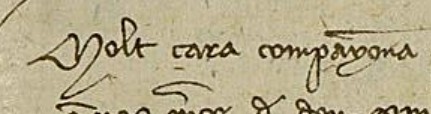
Joan exchanges falcons and hunting dogs with the head of the Knights Hospitallers, Juan Fernández de Heredia.
Episode 19
](/historians-notebook-s1-episodes/images/may-19-aca-cr-r1952-f20r-joan.jpg)
ACA CR R1952 f20r Source: PARES
Today’s Document
- Subject: saker falcons and hunting dogs from Turkey
- Date: May 19, 1387
- Day of the Week: Sunday
- Language: Aragonese
- Archival Reference Number: ACA CR R1952 f20r
- Link to PARES
- Place: Barcelona
- Sender: Joan
- Recipient: Juan Fernández de Heredia, Master of Rhodes
Historical Thinking Notes
-
Sourcing: with three days in a row of Joan writing documents to procure new hunting animals, it appears that he is optimistic about his future prospects as an outdoorsman; as the head of the Knights Hospitallers, the Master of Rhodes would have had helpful contacts in the Eastern Mediterranean for the procurement of luxury items; Joan appears to have been trading hunting animals with Master of Rhodes on previous occasions
-
Contextualization: the podenco is an Iberian hunting dog, a breed of warren hound cultivated in the Middle Ages;
-
Corroboration: this mid-May trio of hunting documents from Joan includes this one and the one in Episode 144 and Episode 145; the Master of Rhodes would probably have had some kind of reaction to being asked by Violant to find counter-spells to save Joan, receiving the letter that we examined in Episode 143 and then just a few days later getting this letter directly from Joan about falcon shopping in Turkey
-
Close-Reading: this document includes some specialized dog breed language, particularly the elusive ‘sorgini’; Joan specifies that he wants at least four of the hunting dogs from Turkey and perhaps this number relates to how they would be used in his next hunting adventure
What is this document doing?
- This document presumes an ongoing willingness to exchange luxury hunting animals.
- The document connects, through exchange, dog breeds in Iberia with dog breeds in Turkey.
Questions
- Was the Master of Rhodes surprised to receive a letter like this from Joan after hearing from the ambassadors that he was at death’s door?
- Did the Master of Rhodes hold the Iberian podenco in high regard?
- How was Joan feeling? More healthy? Stir-crazy from being in a sickbed for so long? Delusional?
- What were Joan’s main information sources about the latest trends in dog breeds and luxury hunting?
AI Usage
I gave an initial transcription by Gemini to Claude for a reconciliation. Claude then produced a translation with footnotes.
Bibliography
- Almond, Richard. Daughters of Artemis: The Huntress in the Middle Ages and Renaissance. D.S. Brewer, 2009.
- Almond, Richard. Medieval Hunting. Sutton, 2003.
- Buquet, Thierry. “Hunting with Cheetahs at European Courts: From the Origins to the End of a Fashion.” In Animals and Courts: Europe, c. 1200-1800, edited by Mark Hengerer and Nadir Weber. De Gruyter Oldenbourg, 2019.
- Cummins, John. The Hound and the Hawk: The Art of Medieval Hunting. Phoenix, 2001.
- Goldberg, Eric Joseph. In the Manner of the Franks: Hunting, Kingship, and Masculinity in Early Medieval Europe. University of Pennsylvania Press, 2020.
- John of Salisbury. Policraticus. edied by Clemens C.I. Webb. Oxford: Clarendon, 1909.
- Karras, Ruth Mazo. “Holy Harlots: Prostitute Saints in Medieval Legend.” Journal of the History of Sexuality 1, no. 1 (1990): 3–32.
- Klemettilä, Hannele. Animals and Hunters in the Late Middle Ages: Evidence from the BnF MS Fr. 616 of the Livre de Chasse by Gaston Fébus. Routledge, Taylor & Francis Group, 2015.