Season 1, Episode 42
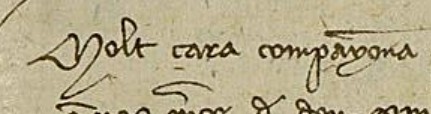
Joan sends Gerau Vullats as a ‘talking telegram’ to Gaston Febus, in pursuit of a criminal.
Episode 42
](/historians-notebook-s1-episodes/images/feb-4-aca-cr-r1751-f11r-joan.JPG)
ACA CR R1751 f11r Source: PARES
Today’s Document
- Subject: Joan sends Gerau Vullats in pursuit of a criminal
- Date: February 4, 1387
- Day of the Week: Monday
- Language: Catalan
- Archival Reference Number: ACA CR R1751 f11r
- Link to PARES
- Place: Barcelona
- Sender: Joan
- Recipient: Gaston Febus
Historical Thinking Notes
-
Sourcing: Joan had spent years nurturing his relationship with Gaston Febus, a statesman and hunter whom Joan admired greatly; somewhat like yesterday’s document, this one authorizes Gerau Vullats to provide Gaston Febus with information, although not with the same level of credence that Violant gave Gerau for Charles III of Navarre
-
Contextualization: Joan and Violant had good reason to fear attacks like attempted assassination or other bodily injuries to the king himself; for example, an English minstrel who performed for Joan in Girona in 1384 was later executed in France for attempting to poison French King Charles VI, the Duc de Berry and all the men of the royal family, a job he was hired to do by Charles II “the Bad” of Navarre1
-
Corroboration: the fact that Violant and Joan both sent Gerau Vullats as a messenger indicates their high trust in him; there is a lack of corroboration for whatever crime Joan mentions
-
Close-Reading: the inclusion of the word ‘propria’ in the phrase ‘crimes cameses contra nostra persona propria’ points to an attack on the physical body of the king as opposed to a figurative interpretation of ‘nostra persona’
What is this document doing?
- This document attempts to enlist the Count of Foix-Bearn in the pursuit of a criminal who escaped from the Crown of Aragon.
- The document reinforces the relationship of trust between Joan and Gaston Febus.
- The document also joins the will of Joan and Violant in the tasks assigned to one man, Gerau Vullats.
Questions
- What was the name of the person who committed crimes against Joan himself? Did they know the name but chose not to write it or was there an assailant whose identity remained hidden to them?
- Does the dual assignment for Gerau Vullats indicate that he was one of their most trusted envoys?
- Did Joan have reason to believe that the assailant had fled to the territory of Gaston Febus?
- Why didn’t Violant mention the assailant in her letter to Charles III of Navarre?
- Did Joan believe that the assailant was connected to Sibilla da Fortía?
AI Usage
ChatGPT might not have been all that necessary for this letter but I wanted to use it anyway in case it would draw my attention to other subtleties in the letter.
Bibliography
- Kantorowicz, Ernst H. The King’s Two Bodies: A Study in Mediaeval Political Theology. Princeton University Press, 1957.
- Roca, Josep M. Johan I d’Aragó. Barcelona: Institució Patxot, 1929.
- Schofield, Bertram. “The Adventures of an English Minstrel and His Varlet.” The Musical Quarterly 35, no. 3 (1949): 361–76.
- Vernier, Richard. Lord of the Pyrenees: Gaston Fébus, Count of Foix (1331-1391). Boydell Press, 2008.
-
Bertram Schofield, “The Adventures of an English Minstrel and His Varlet,” The Musical Quarterly 35, no. 3 (1949): 361–76. ↩