Season 1, Episode 156
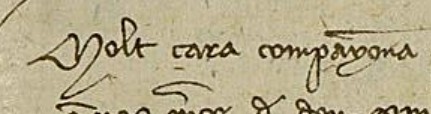
Violant sends out more letters in an effort to get more medical and magical resources to help Joan.
Episode 29
](/historians-notebook-s1-episodes/images/may-29-aca-cr-r2053-f11v-violant-img025.jpg)
ACA CR R2053 f11v Source: PARES
](/historians-notebook-s1-episodes/images/may-29-aca-cr-r2053-f12r-violant-img026.jpg)
ACA CR R2053 f12r Source: PARES
Today’s Document
- Subject: obtaining magical texts and recruiting medical personnel for Joan
- Date: May 29, 1387
- Day of the Week: Wednesday
- Language: Catalan
- Archival Reference Number: ACA CR R2053 f11v-12r
- Link to PARES
- Place: Barcelona
- Sender: Violant
- Recipients: Eximenio de Tovia, royal knight, Jordi de Sobra, doctor of law in Valencia, and the officials of Monistrol de Monserrat
Historical Thinking Notes
-
Sourcing: Violant’s agency shines through brightly in these letters - she does not sit and wait for others to find solutions but actively pursues all available avenues across a wide swath of geography; at first, I found it astonishing that Jordi de Sorba would have refused Violant’s request for the Cigonina but then I concluded that Jordi de Sorba, with his access to powerful magical knowledge, might have a great deal of power in situations like this; evidently, the curandera in Monistrol de Monserrat had built up a significant reputation to the extent that word of her wisdom had reached Violant
-
Contextualization: the mixture of the categories of medical knowledge and magical knowlege demonstrates the overlap between magic, science, and faith in the Middle Ages; there has been a lot of recent scholarship on the medical knowledge of women in the Middle Ages (see bibliography below) that would offer excellent contextualization for Violant’s decision to call in a curandera from Monistrol
-
Corroboration: when comparing this letter to the one Violant sent Jorda de Sobra on May 25th, it seems clear that de Sobra had refused the queen; the urgency visible in today’s documents could very well stem from another serious health attack suffered by Joan, with a severity similar to his near-death moment on April 28th, which we heard Violant describe in detail in Episode 127; there is some interesting irony in the fact that just a few days before the town of Monistrol was sent a punishing letter for cheating the monarchy out of tax revenue and today the queen is asking for the help of the authorities there in seeking out a curandera; the June 4th letter on f12r is a summons for the doctor and has quite an urgent tone; in a letter dated May 29th, Joan also wrote to the Master of Rhodes saying that the knight Eximeno de Tovia could speak on his behalf, R1751 f66r
-
Close-Reading: in the letter to Jordi de Sobra, Violant specifies that the book is needed for ‘la persona del senyor Rey’ and this is further evidence that ‘la persona’ meant the physical body of the king, especially since saying ‘the king himself’ could be done using the word ‘propria’
What are these documents doing?
- These documents presume a certain level of validity to multiple methods of medical treatment.
- The documents exercise wealth and power in pursuit of a range of resources available only to the elite.
Questions
- What was Joan’s health status on May 29th?
- Who or what was the knight Eximeno de Tovia tasked with getting in Avignon?
- Why did Jordi de Sobra initially refuse the queen’s request for the book of magic?
- Was the woman in Monistrol a known curandera?
- Why was the doctor not already with Joan on June 4th?
- Why did the doctor, Raymond Tarol, need a letter and not just a messenger for this summons?
AI Usage
The transcription and translation of this document was carried out by my OpenClaw pipeline.
Bibliography
- Bouras-Vallianatos, Petros. “Medieval Mediterranean Pharmacology.” In Drugs in the Medieval Mediterranean: Transmission and Circulation of Pharmacological Knowledge, edited by Petros Bouras-Vallianatos and Dionysios Stathakopoulos, 1–36. Cambridge: Cambridge University Press, 2024.
- Brévart, Francis B. “Between Medicine, Magic, and Religion: Wonder Drugs in German Medico-Pharmaceutical Treatises of the Thirteenth to the Sixteenth Centuries.” Speculum: A Journal of Medieval Studies 83, no. 1 (2008): 1–57.
- Caballero-Navas, Carmen. “The Care of Women’s Health and Beauty: An Experience Shared by Medieval Jewish and Christian Women.” Journal of Medieval History 34, no. 2 (June 2008): 146–63.
- Green, Monica. The Trotula: An English Translation of the Medieval Compendium of Women’s Medicine. Philadelphia: University of Pennsylvania Press, 2002.
- Green, Monica. Women’s Healthcare in the Medieval West: Texts and Contexts. Burlington, VT: Ashgate/Variorum, 2000.
- Lindberg, David C. The Beginnings of Western Science: The European Scientific Tradition in Philosophical, Religious, and Institutional Context, Prehistory to A.D. 1450. 2nd ed. University of Chicago Press, 2007.
- Ryan, Michael A. “The Horn and the Relic: Mapping the Contours of Authority and Religiosity in the Late Medieval Crown of Aragon.” Preternature: Critical and Historical Studies on the Preternatural 1, no. 1 (2012): 49–71.
- Sweet, Victoria. “Hildegard of Bingen and the Greening of Medieval Medicine.” Bulletin of the History of Medicine 73, no. 3 (1999): 381–403.