Season 1, Episode 127
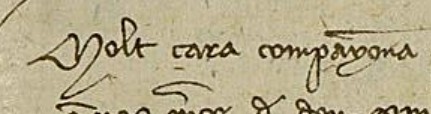
Violant relates the details of how Joan nearly died from an illness that struck him on Sunday evening. The king’s extremities turned cold and he received last rites.
Episode 127
](/historians-notebook-s1-episodes/images/apr-30-aca-cr-r2037-f17r-violant-img036.jpg)
ACA CR R2037 f17r Source: PARES
](/historians-notebook-s1-episodes/images/apr-30-aca-cr-r2037-f17v-violant-img037.jpg)
ACA CR R2037 f17v Source: PARES
Today’s Document
- Subject: a detailed account of Joan’s near death experience on Sunday evening
- Date: April 30, 1387
- Day of the Week: Tuesday
- Language: Catalan
- Archival Reference Number: ACA CR R2037 f17r-v
- Link to PARES
- Place: Barcelona
- Sender: Violant
- Recipients: Crown of Aragon’s ambassadors to the Papal Court in Avignon
Page 100 from Daniel Girona i Llagostera’s Itinerary for Joan
 for a longer explanation of Girona i Llagostera's project. [Source: Daniel Girona i Llagostera, “Itinerari de l’Infant En Joan, Fill Del Rei En Pere III. 1350-1387.”](https://books.google.com/books?id=ntJTOjpltb0C)](/historians-notebook-s1-episodes/images/apr-30-girona-i-llagostera-p100.jpg)
Page 100 of Girona i Llagostera’s Itinerari. Notice how no document could be found dated May 5th, but documents could be found for all the other days around the time of Joan’s severe illness. See Episode 4 for a longer explanation of Girona i Llagostera’s project. Source: Daniel Girona i Llagostera, “Itinerari de l’Infant En Joan, Fill Del Rei En Pere III. 1350-1387.”
Historical Thinking Notes
-
Sourcing: at sunset on April 28th, Violant faced the likely death of her husband; at age 23, and less than five months into her reign as queen, she must contend with not only the emotional impact of Joan’s deathly condition, but also the possibility that she will face persecution on the order of what happened to her step-mother-in-law, Sibilla de Fortià; in the aftermath, when Violant writes this letter, she knows that Joan survived and perhaps she considers this miraculous, a signal of divine intervention in Joan’s favor; if Violant calculated that Joan’s survival would improve their leverage in Avignon, this would reflect how she had been raised to live a life of politics since her childhood which was mostly spent in the court of her uncle, the King of France
-
Contextualization: the experience of a king’s widow varied in the Middle Ages, with some continuing as power players and others being severely marginalized; Dawn Bratsch-Prince has examined Violant’s widowhood in her scholarship1
-
Corroboration: the document examined in Episode 131 corroborates this one closely in the relation of the events of Joan’s near-death moment, but in that later document Violant adds a note about curses and sorcery playing a role in the onset of the illness that struck Joan
-
Close-Reading: Violant specifies the time of day that the illness struck Joan, at the hour of Vespers - this is basically sunset; the form of venir used in the letter, ‘vench,’ increases the pathos of the description of events; the word ‘sincopi’ might mean ‘seizure’; Violant says that on Monday, Joan received the final part of Last Rites called Viaticum, which is the Eucharist to provide nourishment for the soul on its journey to eternity
What is this document doing?
- This document places the progression of a near-death experience within a Christian religious framework.
- The document centers Violant as the authoritative sources for information about the condition of Joan’s body.
Questions
- When had Violant slept in the 48 hours that preceded the writing of this document?
- Who had been in the room with Joan during the moments described in this letter?
- What were Violant’s motivations for revealing this information to the Avignon ambassadors and not others?
- Had the scribe, Bartolomeo Sirvent, been in the room with Joan and Violant?
- The play-by-play narrative in this document increases its credibility, but would Violant have had reasons to alter the story in any way?
- As everyone began to lose hope of Joan’s survival, did Violant take any steps to secure herself politcally?
- How fast did Joan recover the movement of his limbs? How about his ability to speak?
A Note About This Document’s Importance
This document encapsulates my overall argument about Joan and Violant. Their level of co-rule was exceptional. Since his sickliness kept Joan from fully functioning as a monarch, he depended on Violant to fill the gap between his physical capacity and the demands of governance. Violant depended on Joan to stay alive in order to continue the legal functioning of their rule as monarchs.
AI Usage
I gave an initial transcription by Gemini to Claude for a reconciliation. Claude then produced a translation with footnotes.
Bibliography
- Bertelli, Sergio. The King’s Body: Sacred Rituals of Power in Medieval and Early Modern Europe. Revised Edition. Pennsylvania State University Press, 2001.
- Bratsch-Prince, Dawn. “The Politics of Self-Representation in the Letters of Violant de Bar (1365–1431).” Medieval Encounters 12, no. 1 (2006): 2–25.
- Kantorowicz, Ernst H. The King’s Two Bodies: A Study in Mediaeval Political Theology. Princeton University Press, 1957.
- Krötzl, Christian, Katariina Mustakallio, and Jenni Kuuliala, eds. Infirmity in Antiquity and the Middle Ages: Social and Cultural Approaches to Health, Weakness and Care. Ashgate, 2015.
-
Dawn Bratsch-Prince, “The Politics of Self-Representation in the Letters of Violant de Bar (1365–1431),” Medieval Encounters 12, no. 1 (2006): 2–25. ↩