Season 1, Episode 153
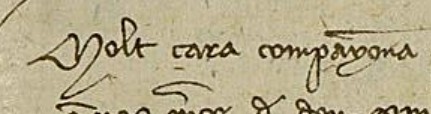
Joan’s treasurer has caught the town of Monistrol de Montserrat hiding revenues from royal authorities for a period of 20 years.
Episode 153
](/historians-notebook-s1-episodes/images/may-26-aca-cr-r1944-f66r-joan-img134.jpg)
ACA CR R1944 f66r Source: PARES
Today’s Document
- Subject: the towm leaders must face the consequence of cheating the royal treasury
- Date: May 26, 1387
- Day of the Week: Sunday
- Language: Latin
- Archival Reference Number: ACA CR R1944 f66r
- Link to PARES
- Place: Barcelona
- Sender: Joan
- Recipients: the officials of the town of Monistrol de Montserrat
Historical Thinking Notes
-
Sourcing: if Joan and Violant inherited a royal treasury in financial crisis, they would have been highly motivated to spend time catching all of the small towns that were cheating the treasury out of a cut of their tolls and taxes; the town of Monistrol de Montserrat might have had the opportunity to get a lot of money from tolls on pilgrims journeying to the Monserrat Monastery
-
Contextualization: the fact that this document alleges the town has been hiding its revenues from the crown for twenty years places this document into the larger context of the financial practices of the royal treasury over a period of many decades; it is possible that the long-term practices of the state led to a situation in which many towns and cities felt they could get away with hiding some of their revenue
-
Corroboration: although there are key differences in the type of financial misbehavior, the document examined in Episode 48 corroborates this one in that we have the monarch catching another town not paying money that it should have paid
-
Close-Reading: the phrase ‘ant coram nostre Thresaurario’ is key to understanding that the officials of this town are ordered to appear in Barcelona before the royal treasurer to answer for this violation; the last word before the dating clause is ‘contumacio’ which has an English cognate, contumacy, and means a willful disobedience perhaps much like the modern use of the word contempt in legal settings
What is this document doing?
- This document warns the recipients that the state is coming after them.
- The document situates the town as a legal entity subordinate to the royal authority, at the mercy of its judgment.
Questions
- How did the treasury officials find out about what Monistrol de Montserrat had been doing?
- About how much money, in total, had the town kept from the royal treasury?
- Is it likely that many small towns across the realm were doing the same thing? Was there a widespread culture of hiding revenue from the royal treasury officials?
- Realistically speaking, how much additional money was the royal treasury likely to get from the town this year? Would they force the town into paying back the money owed with interest or a fine?
- What was the response of the town officials to receiving this document? Did they consider ignoring it?
AI Usage
I gave an initial transcription by Gemini to Claude for a reconciliation. Claude then produced a translation with footnotes.
Bibliography
- Feliu i Montfort, Gaspar. “Finances, Currency and Taxation in the 14th and 15th Centuries.” Catalan Historical Review, no. 9 (2016): 25–44.
- Girona y Llagostera, Daniel. “Itinerari de l’Infant En Joan, Fill Del Rei En Pere III. 1350-1387.” III Congreso de Historia de La Corona de Aragón (Valencia), Hijo de F. Vives Mora, 1923, 169–592. Available on Google Books, accessed December 26, 2025.
- Sánchez, Manuel, Ángel Sesma Muñoz, and Antoni Furió. “Old and New Forms of Taxation in the Crown of Aragon (13th-14th Centuries).” In La fiscalità nell’economia Europea secc. XIII-XVIII, edited by Simonetta Cavaciocchi. Firenze University Press, 2008. Available for free at CSIC
- Tello Hernández, Esther. “Auditing of Accounts as an Instrument of Royal Power in Catalonia (1318-1419).” In Accounts and Accountability in Late Medieval Europe: Records, Procedures, and Socio-Political Impact. Brepols, 2020.