Season 1, Episode 149
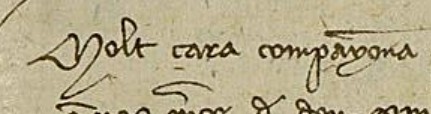
Joan orders a merchant in Zaragoza to pay money to Johan de Muntros, citing an authorization from the Pope on February 23rd.
Episode 149
](/historians-notebook-s1-episodes/images/may-22-aca-cr-r1751-f60v-joan-img123.jpg)
ACA CR R1751 f60v Source: PARES
Today’s Document
- Subject: addressing a lack of compliance with the new tax collection in Aragon
- Date: May 22, 1387
- Day of the Week: Wednesday
- Language: Catalan
- Archival Reference Number: ACA CR R1751 f60v
- Link to PARES
- Place: Barcelona
- Sender: Joan
- Recipients: Berengario de Corrilles, a merchant of Zaragoza
Historical Thinking Notes
-
Sourcing: Joan’s authority as king should have an impact on all on its own, but it is telling that he invokes the authority of the Pope in his justification for the levy of funds from Berengario de Corrilles; this document also reveals that the letter furnished to Johan de Muntros was not quite enough to obtain compliance in some cases
-
Contextualization: the modern historian Esther Tello Hernández has argued that some of the practices Joan’s and Violant’s antagonists called corrupt instead constituted justifiable fiscal management in the context of state-building in the late thirteenth century1
-
Corroboration: the previous documents about Johan Muntros were examined in Episode 137, Episode 138, and Episode 139; for all the episodes on the finances of Joan and Violant with that tag on the Browse by Tags page
-
Close-Reading: when faced with a refusal from this merchant, the document threatens additional financial penalty but does not use any emotional terms like ‘indignacio’ or ‘ira’
What is this document doing?
- This document offers the ruling by the Pope as a justification of the financial levy.
- The document presents a picture of revenue streams as a product of a very intertwined relationship between secular and ecclesiastical authorities.
Questions
- What were Berengario de Corrilles’s motivations for refusing to pay this levy?
- How involved was Joan in the authorship of this document?
- Was de Corrilles’s refusal an affront to Joan’s authority or something more akin to grumbling about taxes?
- Was the Pope’s authorization of additional levies being applied here in a way that the Pope would have been surprised to see?
- Was Johan de Muntros running into a lot of problems like this or was this a rare case?
- What exactly was the connection between the rents collected by the Bishop of Huesca and the funds being sought by Berengario de Corrilles?
AI Usage
The transcription and translation of this document was carried out by my OpenClaw pipeline.
Bibliography
- Feliu i Montfort, Gaspar. “Finances, Currency and Taxation in the 14th and 15th Centuries.” Catalan Historical Review, no. 9 (2016): 25–44.
- Sánchez, Manuel, Ángel Sesma Muñoz, and Antoni Furió. “Old and New Forms of Taxation in the Crown of Aragon (13th-14th Centuries).” In La fiscalità nell’economia Europea secc. XIII-XVIII, edited by Simonetta Cavaciocchi. Firenze University Press, 2008. Available for free at CSIC
- Tello Hernández, Esther. “‘Era Tingut e Reputat per Bon Hom’: El Proceso Contra El Mercader Luchino Scarampi En La Curia de Aviñón a Finales Del Siglo XIV.” Studia Historica. Historia Medieval 40, no. 2 (2022): 193–211.
-
Esther Tello Hernández, “‘Era Tingut e Reputat per Bon Hom’: El Proceso Contra El Mercader Luchino Scarampi En La Curia de Aviñón a Finales Del Siglo XIV,” Studia Historica. Historia Medieval 40, no. 2 (2022): 193–211 at 207 ↩