Season 1, Episode 137
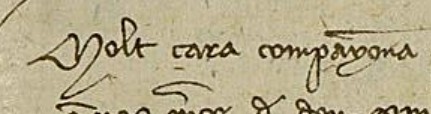
Joan grants Johan de Muntros the right to collect tithe payments from churches to the state.
Episode 137
](/historians-notebook-s1-episodes/images/may-10-aca-cr-r1751-f61r-joan-img124.jpg)
ACA CR R1751 f61r Source: PARES
](/historians-notebook-s1-episodes/images/may-10-aca-cr-r1751-f61v-joan-img125.jpg)
ACA CR R1751 f61v Source: PARES
Today’s Document
- Subject: as a consequence of the Pope’s recent bull, an authorization to collect taxes from churches
- Date: May 10, 1387
- Day of the Week: Friday
- Language: Latin
- Archival Reference Number: ACA CR R1751 f61r-v
- Link to PARES
- Place: Barcelona
- Sender: Joan
- Recipient: Johan de Muntros
Corrections to the Podcast Episode
After recording this podcast I realized that I had mis-transcribed the last name of the merchant, Johan de Muntros. I erroneously ignored the macron and the clearly shaped letter ‘r’ coming after the ‘c’ or ‘t.’
As for the mysterious abbreviation in the probata, I think that there is a good chance the word is ‘presente’ (not ‘praeterea’). ‘Presente’ would also indicate some level of involvement from Violant, maybe even moreso than ‘praeterea.’
Historical Thinking Notes
-
Sourcing: it was certainly within the great interest of Joan and his court officials to get the process moving for collecting taxes recently authorized by the papal bull; perhaps Johan de Muntros had experience with tax farming, but is in this document identified as a a loyal servant of the royal household; the presence of both ‘dominus rex’ and ‘domina regina’ in the probata indicates that this document originated as a collaborative one between the king and queen themselves or at least of a mixture of officials from each of their courts
-
Contextualization: in the fourteenth century, tithes knowns as ‘decimas’ were paid to the state by various ecclesiastical institutions within the realm1
-
Corroboration: the document examined in Episode 72, was a long list of requests or demands that Joan sent to Avignon Pope Clement VII, and it is highly possible that the authorization mentioned in today’s document was in that list; for the Muntros family of merchants, the documents examined in Episode 138, Episode 139, and Episode 149 involve either Pere or Johan de Muntros
-
Close-Reading: Pere de Beniure appears within the text of the document and as the scribe in the probata, raising questions about how the chancery officials might also become involved in the processes of revenue collection; the mention of mogubells raises alarm since these were infamous financial instruments due to their exhorbitant interest rates
What is this document doing?
- This document provides political legitimacy for a representative of the state to collect money from ecclesiastical organizations.
- The document’s probata represents a level of collaboration between the king and the queen, or at least shows overlap in their corporate monarchical institutions.
Questions
- Did Violant and Joan work on this document together, or was it only an effort of their chancellors working together?
- How did they choose Johan de Muntros for this job?
- When would mogubells be required in connection with the financial processes mentioned in this document?
- Does this document represent a bold new taxation practice or would it have fit in with established traditions and expectations?
AI Usage
The transcription and translation of this document was carried out by my OpenClaw pipeline.
Bibliography
- Trenchs i Odena, Josep, and Antonio María Aragó. Las cancillerías de la Corona de Aragón y Mallorca desde Jaime I a la muerte de Juan II. Cátedra Zurita, Institución Fernando el Católico, 1983.
- VanLandingham, Marta. Transforming the State: King, Court and Political Culture in the Realms of Aragon (1213-1387). Brill, 2002.
-
Marta VanLandingham, Transforming the State: King, Court and Political Culture in the Realms of Aragon (1213-1387), (Brill, 2002), 122. ↩