Season 1, Episode 114
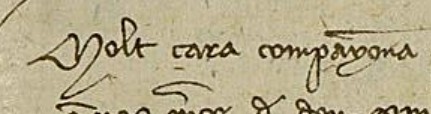
Violant orders that the belongings and property of Mossen Pelegri de Montagut and Bernat Abello, two advisers of the former Queen Sibilla de Fortià, get transferred to Jacme Scrivus and Antoni Rosar.
Episode 114
](/historians-notebook-s1-episodes/images/apr-17-aca-cr-r1819-f96v-violant-img195.jpg)
ACA CR R1819 f96v Source: PARES
Today’s Document
- Subject: confiscation of property from an adversary’s companions
- Date: April 17, 1387
- Day of the Week: Wednesday
- Language: Catalan
- Archival Reference Number: ACA CR R1819 f96v
- Link to PARES
- Place: Barcelona
- Sender: Violant
- Recipients: Treasury officials Jacme Scriva and Anthoni Rosar
Historical Thinking Notes
- Sourcing: this might be the moment when Joan falls dangerously ill and that would motivate Violant to move swiftly on the punishment of Sibilla’s advisors; in initiating this punishment Violant would have been at least partially motivated by fears of Sibilla directing malevolent sorcery toward her and Joan, since the belief in the power of the sidereal was widespread at this time1; it is not clear why Violant targeted these particular officials and why one of those named in this document, Bernat Abella, was subsequently executed; the recipients, two of Violant’s treasury officials, would likely have carried out these orders very quickly as word of Violant’s fear of Sibilla’s forces had probably spread throughout the bureaucracy
- Contextualization: there were other widows of kings in the fourteenth century who suffered vengeance from newly ascendant monarchs, and Núria Silleras Fernández points out that what happened with Sibilla has a parallel in the episode of Pere’s ascension to the thone in 1336, when Pere’s stepmother Elionor de Castilla fled with her sons and then fostered a rebellion2; consider the gender dynamics involved, as Sibilla’s flight from Barcelona before the king’s death triggered the misogynist trope of the coniving faithless woman who betrays her husband and cannot be trusted - this trope is found in a great many cultural products of the time, such as the Arthurian legends and La Roman de la Rose
-
Corroboration: this document continues the thread of Violant appropriating the former queen’s property, as has been examined in the episodes tagged with Sibilla de Fortià; among those, some noteworthy episodes include Episode 5, Episode 6, Episode 37, and Episode 94
-
Close-Reading: Violant does not refer to Sibilla as a former queen but insted ‘the wife of the king our father’ and this likely reflects her disdain for her adversary
What is this document doing?
- This document activates the machinery of the state to confiscate property from political adversaries.
- The document perpetuates the adversarial relationship between the king’s widow and the current queen.
Questions
- Was Joan seriously ill at the time of this document (April 17th)?
- Is this document part of a series of punishments directly connected to the death sentence for Bernat Abello? Or had the death sentence not yet been issued?
- Was Sibilla, or any of her advisers, actually tortured during April 1387?
- How quickly would the possessions mentioned in this document actually get confiscated?
- How did the treasury officials Rosar and Scrivia react to this order? With what level of urgency?
- In the 1580s, what documents did Jerónimo Zurita consult when writing about this episode?
Pages from a 1668 edition of Jerónimo Zurita’s Anales de la Corona de Aragón
In the podcast, I said the incorrect date of Zurita’s initial writing. He wrote this work in the 1570s, not in 1600. The following pages contain the passages that I quoted in the episode. Jerónimo Zurita lived from 1512-1580. The information in Zurita’s text about an unnamed Jew playing a role in identifying Sibilla’s sorcery brings up a larger context of anti-semitism in early modern Spain, an era subsequent to the Expulsion of 1492.
](/historians-notebook-s1-episodes/images/apr-17-e114-zurita-p390r.jpg)
Folio 390r from Volume 2 of Zurita’s Anales de la Corona de Aragón Source: Google Books
](/historians-notebook-s1-episodes/images/apr-17-e114-zurita-p390v.jpg)
Folio 390v from Volume 2 of Zurita’s Anales de la Corona de Aragón Source: Google Books
](/historians-notebook-s1-episodes/images/apr-17-e114-zurita-p391r.jpg)
Folio 391r from Volume 2 of Zurita’s Anales de la Corona de Aragón Source: Google Books
AI Usage
Today’s document is within a register that I put through my OpenClaw agentic AI pipeline. This was the first register that I used OpenClaw with and a problem occurred with Gemini, so the output is from Claude only. For more information about this workflow and my use of AI see the Season 1 FAQs.
In this episode, I describe how I keyword searched the CSV file that OpenClaw put together for Register 1819 in order to find a clue to the paleography and Latin rendering of the name of Pelegri Montagut.
Bibliography
- Bratsch-Prince, Dawn. “The Politics of Self-Representation in the Letters of Violant de Bar (1365–1431).” Medieval Encounters 12, no. 1 (2006): 2–25.
- Ponsich, Claire. “De la parole d’apaisement au reproche. Un glissement rhétorique du conseil ou l’engagement politique d’une reine d’Aragon?” Cahiers d’études Hispaniques Medievales 31 (2008): 81–117.
- Roca, Josep M. Johan I d’Aragó. Barcelona: Institució Patxot, 1929.
- Rohr, Zita. “Lessons for My Daughter: Self-Fashioning Stateswomanship in the Late Medieval Crown of Aragon.” In Self-Fashioning and Assumptions of Identity in Medieval and Early Modern Iberia, edited by Laura Delbrugge. Brill, 2015.
- Ruiz Domingo, Lledó. El tresor de la reina: recursos i gestió econòmica de les reines consorts a la Corona d’Aragó, segles XIV-XV. Consejo Superior de Investigaciones Científicas, 2022.
- Ruiz Domingo, Lledó. “Surrounding the Future Queen of the Crown of Aragon: Violant of Bar’s Household as Duchess of Girona (1384–1386).” Royal Studies Journal 10, no. 1 (2023): 96-135.
- Ruiz Domingo, Lledó. “Queenship, Wealth and Material Culture in Late Medieval Iberia: Sibila de Fortià’s Evolution from Royal Mistress to Dowager Queen of the Crown of Aragon (1375–1387).” Journal of Medieval History 50, no. 5 (2024): 615–36.
- Ryan, Michael A. A Kingdom of Stargazers: Astrology and Authority in the Late Medieval Crown of Aragon. Ithaca: Cornell University Press, 2011.
- Silleras Fernández, Núria. “Money Isn’t Everything: Concubinage, Class, and the Rise and Fall of Sibil.La de Fortià, Queen of Aragon (1377-87).” In Women and Wealth in Late Medieval Europe, edited by Theresa Earenfight. Palgrave Macmillan, 2010.
- Zurita, Jerónimo. Los cinco libros postreros de la primera parte de los Anales de la Corona de Aragon. Vol. 2. Zaragoza: Pedro Lanaja y Lamarca, 1668. available on Google Books. Accessed April 17, 2026.
- Zurita, Jerónimo. Anales de la Corona de Aragón. Edited by A. Canellas López. Digital edition coordinated by J. Iso. Vol. 4. Saragossa: Institución Fernando el Católico, 2003. available at the website of the Institución Fernando el Católico. Accessed October 18, 2024.
-
Michael A. Ryan, A Kingdom of Stargazers: Astrology and Authority in the Late Medieval Crown of Aragon (Ithaca: Cornell University Press, 2011). ↩
-
Núria Silleras Fernández, “Money Isn’t Everything: Concubinage, Class, and the Rise and Fall of Sibil.La de Fortià, Queen of Aragon (1377-87),” in Women and Wealth in Late Medieval Europe, ed. Theresa Earenfight (Palgrave Macmillan, 2010), 67-88, at 80. ↩