Season 1, Episode 90
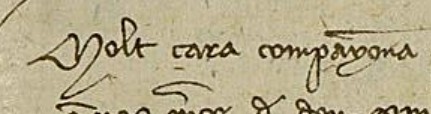
Joan orders the Archbishop of Zaragoza to start collecting tithe money so that he can pay soldiers to quell resistance in Sardinia.
Episode 90
](/historians-notebook-s1-episodes/images/mar-24-aca-cr-r1751-f29r-joan.jpg)
ACA CR R1751 f29r Source: PARES
](/historians-notebook-s1-episodes/images/mar-24-aca-cr-r1751-f29v-joan.jpg)
ACA CR R1751 f29v Source: PARES
Today’s Document
- Subject: urgent need for funds to pay soldiers for quelling resistance in Sardinia
- Date: March 24, 1387
- Day of the Week: Sunday
- Language: Catalan
- Archival Reference Number: ACA CR R1751 f29r-v
- Link to PARES
- Place: Barcelona
- Sender: Joan
- Recipients: Archbishop of Zaragoza and two officials
Historical Thinking Notes
-
Sourcing: as king, Joan must have seen putting down rebellions as an urgent priority, maybe even the most important things about being the monarch; the financial situation remains obscure and the power dynamic between the king and the pope appears insecure; the recipient, as a subordinate of the pope and a subject of the king, must have felt torn between these two authority figures
-
Contextualization: as Catalan merchant activity increased during the thirteenth and fourteenth centuries, the Crown of Aragon wrested control of Sardinia away from Genoa1; the Sardinians, such as Eleanor of Arboria, rebelled against the Crown of Aragon throughout the fourteenth century; by the mid-thirteenth century, though, Sardinia had become one of the main breadbaskets for the Crown of Aragon and so holding on to it became an economic necessity, especially in the context of food shortages and famine2
-
Corroboration: it is striking that Joan identifies a severe shortage of funds in this document when he offered 100,000 florins for his daughter’s dowry on March 6th, as examined in Episode 72, and also had funds to pay for his Mallorcan treasures in February, as examined in Episode 45
-
Close-Reading: the document employs very strong language about the urgency of the Sardinia, with Joan using terms such as ‘gran peril’ and ‘irreperabla damptnatge’ to describe what would happen if he could not get money to pay for soldiers to be sent to Sardinia; Joan says that he wants ‘diverse quantities of money’ and that phrase seems to indicate some kind of variety or possibly it just means a large amount
What is this document doing?
- This document reinforces a financial connection between secular interests and ecclesiastical administration in the Crown of Aragon.
- The document asserts the king’s dominance over a significant flow of revenue collected through church activities.
Questions
- What was the exact process that had established a connection between the Pope’s tithing instructions and the funding of soldiers in Sardinia?
- Why was the funding for the Sardinia force coming from tithes administered by the Archbishop of Zaragoza?
- What was the severity of the trouble with Joan’s revenue streams at this time?
- Was Joan correct that the Crown of Aragon was on the verge of losing territorial control over Sardinia?
Additional Notes
The spelling and paleographical distinctions between Sardinia and Cerdanya are very subtle in medieval Catalan. The difference between the two comes down to the letter following the d, so that in this case Cerdenya means Sardinia. If an a had followed the d, then it would be Cerdanya, the inland region near the Pyrenees.
AI Usage
I used Gemini for an initial transcription, which I then had Claude reconcile with its own initial transcription. Claude then produced a translation into English with footnotes. Both Gemini and Claude messed up the ‘petit anell’ at the end of the document because that phrase’s location in the document is usually where the name of a person gets placed. The pattern-recognition aspect of the LLM regarding the structure of the document seems to have overridden its pattern-matching for the paleographic letter forms. This is a good example of hwo sometimes what is easy for the human eye is here very difficult for the AI chatbot.
I also used ChatGPT to reach more certainty about the place name of Sardinia in this document.
Bibliography
- Bisson, Thomas N. Medieval Crown of Aragon: A Short History. Clarendon Press, 1986.
- Franklin-Lyons, Adam. Shortage and Famine in the Late Medieval Crown of Aragon. The Pennsylvania State University Press, 2022.