Season 1, Episode 84
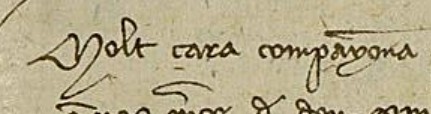
Violant instructed a bailiff in Sant Marti de Saroca to apprehend a criminal.
Episode 84
](/historians-notebook-s1-episodes/images/mar-18-aca-cr-r1819-f93r-violant.jpg)
ACA CR R1819 f93r Source: PARES
Today’s Document
- Subject: instructions to apprehend a criminal named Ferriol Forner
- Date: March 18, 1387
- Day of the Week: Monday
- Language: Catalan
- Archival Reference Number: ACA CR R1819 f93r
- Link to PARES
- Place: Barcelona
- Sender: Violant
- Recipient: Bailiff of Sant Marti de Saroca
Historical Thinking Notes
-
Sourcing: as queen, Violant would have considered herself the chief law enforcement officer for the territories in her portfolio; the bailiffs, like the recipient of this letter, were in charge of financial administrative tasks for the royal family in various towns and so Ferriol Forner’s crime might have been a financial one
-
Contextualization: medieval Iberian queen lieutenants possessed law enforcement authority for the jurisdictions designated as under their purview
-
Corroboration: the document examined in Episode 81 offers an interesting comparison to this one in that they are both about financial crimes; by contrast it seems that the crime discussed in Episode 42 is one that is not financial but an attack on the king himself
-
Close-Reading: the amount of the penalty, 500 florins, is a huge amount of money, equivalent to fifteen times the amount of money Violant paid her baker for three months of work; the presence of the word ‘sciencia’ (wisdom) in this document remains mysterious to me, but it possibly means that Violant wants the bailiff to obtain particularly high quality information about this criminal’s whereabouts
What is this document doing?
- This document places specific conditions of compliance onto a subordinate.
- The document, by involving the monarch, increases the level of urgency associated with the case.
Questions
- What kind of crime had Ferriol Forner committed?
- What about Ferriol Forner’s crime had made it worthy of Violant’s attention?
- What motivated Violant to attach a strict timeline to these instructions for the bailiff of Sant Marti de Saroca?
- Would the bailiff have considered the strict and tight timeline reasonable?
- Is Ferriol Forner’s crime connected to any of the other crimes mentioned in documents previously examined in the podcast?
AI Usage
I used Gemini for an initial transcription, which I then had Claude reconcile with its own initial transcription. Claude then produced a translation into English with footnotes. This episode’s document contains a good example of how AI struggles with certain capital letter forms in these documents, in this case the capital A.
Bibliography
- Earenfight, Theresa. “Absent Kings: Queens as Political Partners in the Medieval Crown of Aragon.” In Queenship and Political Power in Medieval and Early Modern Spain, edited by Theresa Earenfight. Ashgate, 2005.
- Earenfight, Theresa. “A Lifetime of Power, Beyond Binaries of Gender.” In Medieval Elite Women and the Exercise of Power, 1100–1400: Moving beyond the Exceptionalist Debate, edited by Heather J. Tanner, 271-293. Palgrave Macmillan, 2019.
- Kelleher, Marie A. “What Do We Mean by” Women and Power”?” Medieval Feminist Forum: A Journal of Gender and Sexuality 51, no. 2 (2016): 104–15.
- Ponsich, Claire. ‘De la parole d’apaisement au reproche: un glissement rhétorique du conseil ou l’engagement politique d’une reine d’Aragon?,’ Cahiers d’études Hispaniques Medievales 31 (2008): 81–117.
- Tanner, Heather J., ed. Medieval Elite Women and the Exercise of Power, 1100–1400: Moving beyond the Exceptionalist Debate. Palgrave Macmillan, 2019.