Season 1, Episode 66
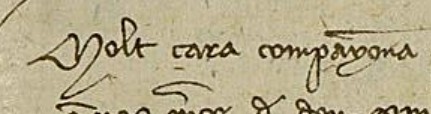
Violant composes authorizations for Luchino Scarampi to carry out negotiations in Avignon for the marriage of her daughter.
Episode 66
](/historians-notebook-s1-episodes/images/feb-28-aca-cr-r2056-f95r-violant.jpg)
ACA CR R2056 f95r Source: PARES
](/historians-notebook-s1-episodes/images/feb-28-aca-cr-r2056-f95v-violant.jpg)
ACA CR R2056 f95v Source: PARES
Today’s Document
- Subject: marriage negotiations for Violant’s daughter, Yolande of Aragon
- Date: February , 1387
- Day of the Week: Thursday
- Language: Latin
- Archival Reference Number: ACA CR R2056 f95r-v
- Link to PARES
- Place: Barcelona
- Sender: Violant
- Recipients: Avignon Pope Clement VII and assorted ecclesiastical officials
Historical Thinking Notes
-
Sourcing: the intended recipients of each of these three letters shaped how Violant phrased them, not just in honorifics but in the explanation of the matter at hand and Luchino Scarampi’s authority; Violant puts into action the cultivation of her social network, as a marriage negotiation merits all the forces she can muster as a newly ascended queen and as a member of the royal family of France
-
Contextualization: medieval elite marriages were highly complex negotiations, and the consequence of a marriage deal affected not just the immediate fates of the two people being married but also the future stability of the realms involved
-
Corroboration: this document corroborates interpretations of the papal court in Avignon as a nerve center of diplomacy; the active working relationship between Violant and Avignon Pope Clement VII also appears in the documents examined in Episode 31 and Episode 65
-
Close-Reading: the levels of honorifics used for the different recipients provides clues to the various levels in the hierarchy of the papal court; the Pope gets the honorific ‘Sanctitatis Vestrae’ with the abbreviation in capital letters S.V., while the recipients of the other two letters get the honorific ‘Paternitatem’ with a capital P.
What is this document doing?
- This document imbues Luchino Scarampi with a level of power and authority to deliver informatino from the queen and king about their position on matters up for negotiation in the marriage contract of their daughter.
- The document calibrates its authority based on the hierarchical position of the recipient.
Questions
- Were these letters made for Scarampi’s initial travel to Avignon or had he been there already?
- What exactly was the role of the Pope and various ecclesiastical officials in marriage negotiations for royal families?
- Why were two, or multiple, blanket letters necessary for Scarampi to present to other ecclesiastical officials?
- In this assignment, was Scarampi being entrusted with a task of higher status than his role in peace negotiations?
- Did Scarampi have something to gain financially from his role as a negotiator of the marriage of Violant and Joan’s daughter?
AI Usage
The close attention to transcription and translation from the UNM Latin Group allowed me to test the ability ofGemini to transcribe and translate. Gemini performed quite well, but made some very consequential errors, such as mistaking ‘parentalae’ for ‘pretacto.’
Acknowledgments
The Latin Group led by Dr. Timothy Graham at the University of New Mexico worked together to transcribe and translate the three letters on f95r-v of Register 2056. I am very grateful to all the members of the group, and to Dr. Graham, for their hard work on these documents.
Bibliography
- D’Avray, D. L. Papacy, Monarchy and Marriage, 860-1600. Cambridge University Press, 2015.
- Ferrer Mallol, Maria Teresa, and Carles Vela Aulesa. “Un mercader italià a la cort catalanoaragonesa: Luchino Scarampi.” Acta historica et archaeologica mediaevalia 32 (2015): 301–478.
- Mitjà, Marina. “Procés contra els consellers domèstics i curials de Joan I, entre ells Bernat Metge.” Butlletí de la Reial Acadèmia de Bones Lletres de Barcelona, 1958, 375–417.
- Pistarino, Geo. “Luchino Scarampi tra Genova e Barcellona per la Pace del 1386.” Medioevo: Saggi e rassegne 1 (1975): 33–47.
- Tello Hernández, Esther. “‘Era tingut e reputat per bon hom’: el proceso contra el mercader Luchino Scarampi en la curia de Aviñón a finales del siglo XIV.” Studia historica. Historia medieval 40, no. 2 (2022): 193–211.