Season 1, Episode 31
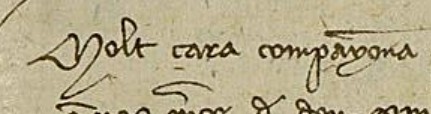
Violant recommends Johan Fernando Aranda, a bachelor of law, for an ecclesiastical post in Barcelona.
Episode 31
](/historians-notebook-s1-episodes/images/jan-24-aca-cr-r1819-f76v-violant.JPG)
ACA CR R1819 f76v Source: PARES
Today’s Document
- Subject: Violant’s recommends Aranda for an ecclesiastical post
- Date: January 24, 1387
- Day of the Week: Thursday
- Language: Latin
- Archival Reference Number: ACA CR R1819 f76v
- Link to PARES
- Place: Barcelona
- Sender: Violant
- Recipient: Pope Clement VII
Historical Thinking Notes
-
Sourcing: Violant, with her close familial connections to the Valois royal family, might have had more clout than Joan in the eyes of the Avignon Pope and those in the papal bureaucracy; Joan Ferran de Aranda’s brother, Francisco, was a longtime ally of Martí and had been a key soldier aiding in the apprehension of Sibilla de Fortia; later, in 1390, Violant tried to get Joan Ferran de Aranda promoted to higher ecclesiastical office in Tarragon
-
Contextualization: this letter, like many others, demonstrates the multilingual context of much of Europe during the Middle Ages, and the regular usage of Latin and several vernaculars within the Crown of Aragon; I argue that social networks were not a byproduct or sideshow of the politics and culture of the Middle Ages but rather the driving force for establishing authority and diffusing of culture 1; the ripple effects, in terms of organizational cohesiveness, of the Great Western Schism might have produced the effect of increasing the role of secular authorities in the appointments for ecclesiastical posts
-
Corroboration: this letter resembles several other recommendations from Violant for what seem like lower-level ecclesiastical offices, including ones discussed in Episode 2, Episode 3, and Episode 4
-
Close-Reading: the reference to Aranda’s university degree, ‘bacallario de legibus,’ indicates something lower-level compared to other titles applied to the learned such as ‘maestre’ and ‘doctor’; perhaps we can call Joan Ferran Aranda an early career professional and surmise that he is under the age of 30
What is this document doing?
- This document presumes secular authority over ecclesiastical appointments in the late fourteenth-century Crown of Aragon.
- The document strengthens social network ties between the Aranda family and the House of Barcelona.
Questions
- Did Violant make this recommendation for Aranda as a direct result of his brother’s assistance to Martí?
- Was Joan Ferran Aranda in Barcelona at this time and perhaps meeting with Violant in person?
- Does the recommendation for an ecclesiastical post imply that Aranda’s law degree was in canon law?
- Was this ecclesiastical post in the Barcelona see one that we might today call entry-level?
Additional Note about Violant’s familial relation to the King of France
Violant married Joan in early 1380, and later that year her uncle, King Charles V of France died. Charles VI, Violant’s cousin, was too young to inherit the throne and the country was ruled as regent by Charles V’s younger brother, the Duc de Berry (who of course was another of Violant’s uncles). In this episode I referred to Violant as the niece of the French king, and this is based on her childhood, much of which was spent in the Parisian court of Charles V. At the time of this letter, though, Violant was cousin to the French King Charles VI, who still had not emerged from his regency and into rulership. Another of Violant’s uncles, the Duc de Berry, still ruled the country as regent throughout 1387. Charles VI finally, at age 20, wrested control from his uncle in 1388.
AI Usage
The use of ChatGPT to help me locate information about this letter proved quite beneficial. In fact, this is one of the best use cases thus far in the podcast for AI chatbots augmenting the research process. Once again, I am indebted to the prolific scholar Maria Teresa Ferrer Mallol for the connections I was able to make in this episode. Without Ferrer Mallol’s 1999 article on Joan Ferran Aranda’s brother, I would not have been able to connect this document to my ‘team next gen’ framework for the way Joan, Violnt, and Martí worked together to establish the new government in 1387.
Bibliography
- Ferrer Mallol, María Teresa. “Un Aragonés consejero de Juan I y de Martín El Humano: Francisco de Aranda.” Aragón en la Edad Media, no. 14 (1999): 531–62. Available for free on Dialnet
- Livingstone, Amy. Out of Love for My Kin: Aristocratic Family Life in the Lands of the Loire, 1000-1200. Cornell University Press, 2010.
- McLean, Paul Douglas. Culture in Networks. Polity, 2017.
- Rollo-Koster, Joëlle, and Thomas M. Izbicki, eds. A Companion to the Great Western Schism (1378-1417). Brill, 2009.
- Seyfried, Jonathan. ‘The Social Networks of Violant de Bar,’ Medieval People, Vol. 40 (2025).
-
Jonathan Seyfried, ‘The Social Networks of Violant de Bar,’ Medieval People, Vol. 40 (2025). ↩