Season 1, Episode 24
Joan writes to Violant about a petition from some Barcelona city councilors to revoke a recent election. This episode also examines how historians write about gender.
Episode 24
](/historians-notebook-s1-episodes/images/jan-17-aca-cr-r1952-f19v-joan.jpg)
ACA CR R1952 f19v Source: PARES
Today’s Document
- Subject: Joan informs Violant of a request about privileges from some Barcelona Councilors
- Date: January 17, 1387
- Day of the Week: Thursday
- Language: Catalan
- Archival Reference Number: ACA CR R1952 f19v
- Link to PARES
- Place: Granollers
- Sender: Joan
- Recipient: Violant
Historical Thinking Notes
-
Sourcing: as king, Joan would have some level of power to intervene in disputes among the Barcelona city councilors, but it’s not clear how much; possibly Joan’s decision in this dispute will have long-lasting ramifications for his relationship with the city council at the outset of his reign; Joan’s appeal to Violant, and by implication Martí, for advisement; the timing of this letter coincides with Joan approaching the day when he has recovered enough from his illness to make the journey to Barcelona - when he will be able to talk with the powerful members of the Barcelona city council in person
-
Contextualization: the Barcelona city council, known as the Council of One Hundred, held a lot of power in the late fourteenth century; later in Joan’s reign, a lot of tension and animosity developed between the bourgeois leadership of the city and the monarchs; the Barcelona city council controlled a larger proportion of the flow of funds to the state treasury, but I am still figuring out the broad outlines of their role in the finances of the monarchs
-
Corroboration: having been in Barcelona for several days, Violant likely knows about the situation arleady; in the fifth line from the bottom, this document mirrors the instruction that Violant gave to Joan on January 6th to hold off on decisions until he, Violant, and Martí are together; we are getting one side of the story in this letter about the reasoning for ‘revoking’ certain privileges or selections of officials to the city council - certainly there are councilors who have reasons for not wanting any revocation of the recent ‘electio’
-
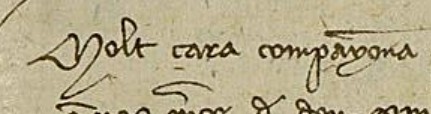
Close-Reading: the word that looks like ‘playues’ at the end of the fifth line might have a large effect on the meaning of the document, but the meaning of this word eludes me; Joan refers to Martí by name instead of saying ‘molt car frare’ - contrast this with Joan’s tendency to use ‘molt cara companyona’ for Violant in correspondence with others
What is this document doing?
- This document provides another indication that Joan intends to rule as a team with Violant and Martí.
Questions
- If Violant was already aware of this dispute, what was her opinion of it?
- How did this issue line up with existing factional divides in the Barcelona city council?
- To what extent does Joan intend to rule as a team with Violant and Martí?
- Does Joan’s unusual deference to Violant already appear in this letter or is this level of consultation still quite within the typical pattern of coporporate monarchy?
Additional Notes about Gender in Premodern Societies
I mentioned in today’s episode that in the Western European Middle Ages there was not a lot of recognition of anything other than man and woman as gender categories. One thing that’s important to clarify, building on what I said about cultural products in the episode, is that gender plurality existed in the Middle Ages. An excellent illustrative example see M.W. Bychowski’s book chapter about Eleanor Rykener in the collection Trans Historical: Gender Plurality before the Modern.1
Bibliography
- Betancourt, Roland. Byzantine Intersectionality: Sexuality, Gender, and Race in the Middle Ages. Princeton University Press, 2020.
- Butler, Judith. Gender Trouble: Feminism and the Subversion of Identity. Routledge, 1990.
- Bychowski, M. W. “The Transgender Turn: Eleanor Rykener Speaks Back.” In Trans Historical: Gender Plurality before the Modern, edited by Greta LaFleur, Masha Raskolnikov, and Anna Kłosowska, 95-113. Cornell University Press, 2021.
- DeVun, Leah. The Shape of Sex: Nonbinary Gender from Genesis to the Renaissance. Columbia University Press, 2021.
- Earenfight, Theresa. “Absent Kings: Queens as Political Partners in the Medieval Crown of Aragon.” In Queenship and Political Power in Medieval and Early Modern Spain, edited by Theresa Earenfight, 33-51. Ashgate, 2005.
- Goldberg, Eric Joseph. In the Manner of the Franks: Hunting, Kingship, and Masculinity in Early Medieval Europe. University of Pennsylvania Press, 2020.
- Karras, Ruth Mazo. “Holy Harlots: Prostitute Saints in Medieval Legend.” Journal of the History of Sexuality 1, no. 1 (1990): 3–32.
- Ryan, Michael A. A Kingdom of Stargazers: Astrology and Authority in the Late Medieval Crown of Aragon. Cornell University Press, 2011.
- Scott, Joan W. “Gender: A Useful Category of Historical Analysis.” The American Historical Review 91, no. 5 (1986): 1053–75.
- Wade, Lisa, and Myra Marx Ferree. Gender: Ideas, Interactions, Institutions. Second Edition. W. W. Norton & Company, 2019.
-
M. W. Bychowski, “The Transgender Turn: Eleanor Rykener Speaks Back,” in Trans Historical: Gender Plurality before the Modern, ed. Greta LaFleur et al. (Cornell University Press, 2021), 95-113. ↩