Season 1, Episode 175
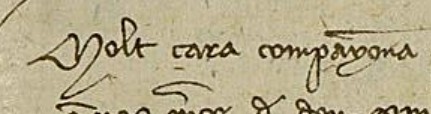
Joan urges the bailiff of Berga to apprehend a thief, Bernardo Rull, who stole a treasure trove from the Cistercian monastery in Zaragoza.1
Episode 175
](/historians-notebook-s1-episodes/images/jun-17-aca-cr-r1867-f6r-joan.jpg)
ACA CR R1867 f6r Source: PARES
](/historians-notebook-s1-episodes/images/jun-17-aca-cr-r1867-f6v-joan.jpg)
ACA CR R1867 f6v Source: PARES
](/historians-notebook-s1-episodes/images/jun-17-aca-cr-r1867-f7r-joan.jpg)
ACA CR R1867 f7r Source: PARES
Today’s Document
- Subject: the theft of a treasure trove from a monastery
- Date: June 17, 1387
- Day of the Week: Monday
- Language: Latin
- Archival Reference Number: ACA CR R1867 f6r-7r
- Link to PARES
- Place: Barcelona
- Sender: Joan
- Recipient: the bailiff of Berga
Historical Thinking Notes
-
Sourcing: it is unlikely that thefts like this happened frequently and so Joan, or his councilors, probably saw this a flagrant affront to law and order; to allow the culprit to make a clean getaway could be seen as a sign of general weakness in the administration of justice in the realm, and in the symbolically important former capital city of Zaragoza no less; this immediate context provided the motivation for the imposition of royal authority and monitoring onto this law enforcement action by the bailiff of Berga
-
Contextualization: the Cistercians had been active in Iberia since the mid-twelfth century and their monasteries prospered across Western Europe particularly in the fourteenth century before a decline in the fifteenth century
-
Corroboration: the crime in this document is quite different from the financial crimes explored in earlier episodes, which tended to be more like tax dodges or embezzlement; there are plenty of other instances in which Joan or Violant demanded that the local law enforcement authorities pick up the pace of their pursuit of criminals, such as in the documents examined in Episode 81, Episode 84, and Episode 105
-
Close-Reading: the list of stolen items reveals that the monastery possessed quite a lot of economic vitality, if not luxury; the London cloth might have actually been produced in London but oftentimes textiles were named after places even though they were actually produced elsewhere2; I am quite certain that the mule mentioned in line 18 and 19 is in the singular form, implying that the Bernardo Rull loaded up all the loot onto just one pack animal
What is this document doing?
- This document injects royal authority into local law enforcement’s response to a theft.
- The document, in listing the inventory of the stolen items, emphasizes the scale of the crime and also lays groundwork for restitution.
Questions
- Did the bailiff of Berga face a difficult task as he sought to apprehend Bernardo Rull?
- What were Bernardo Rull’s motivations for carrying out this theft?
- Had Bernardo and his brother, the abbot of the monastery, been engaged in criminal activity?
- Would the list of stolen items have been seen as a normal amount of luxury for a monastery at this time or excessive?
- What kinds of effects would this document have on the administration of law enforcement in Zaragoza? Any?
AI Usage
](/historians-notebook-s1-episodes/images/e175-rubio-lluch-vol2-303.jpg)
The first part of Rubió i Lluch’s transcription of ACA CR R1867 f6r-7r, Antonio Rubió y Lluch, Documents per l’historia de la cultura catalana mig-eval, Vol 2 (Barcelona: Institut d’Estudis Catalans, 1921), 303. Source:Google Books
](/historians-notebook-s1-episodes/images/e175-rubio-lluch-vol2-304.jpg)
The second part of Rubió i Lluch’s transcription of ACA CR R1867 f6r-7r, Antonio Rubió y Lluch, Documents per l’historia de la cultura catalana mig-eval, Vol 2 (Barcelona: Institut d’Estudis Catalans, 1921), 304. Source:Google Books
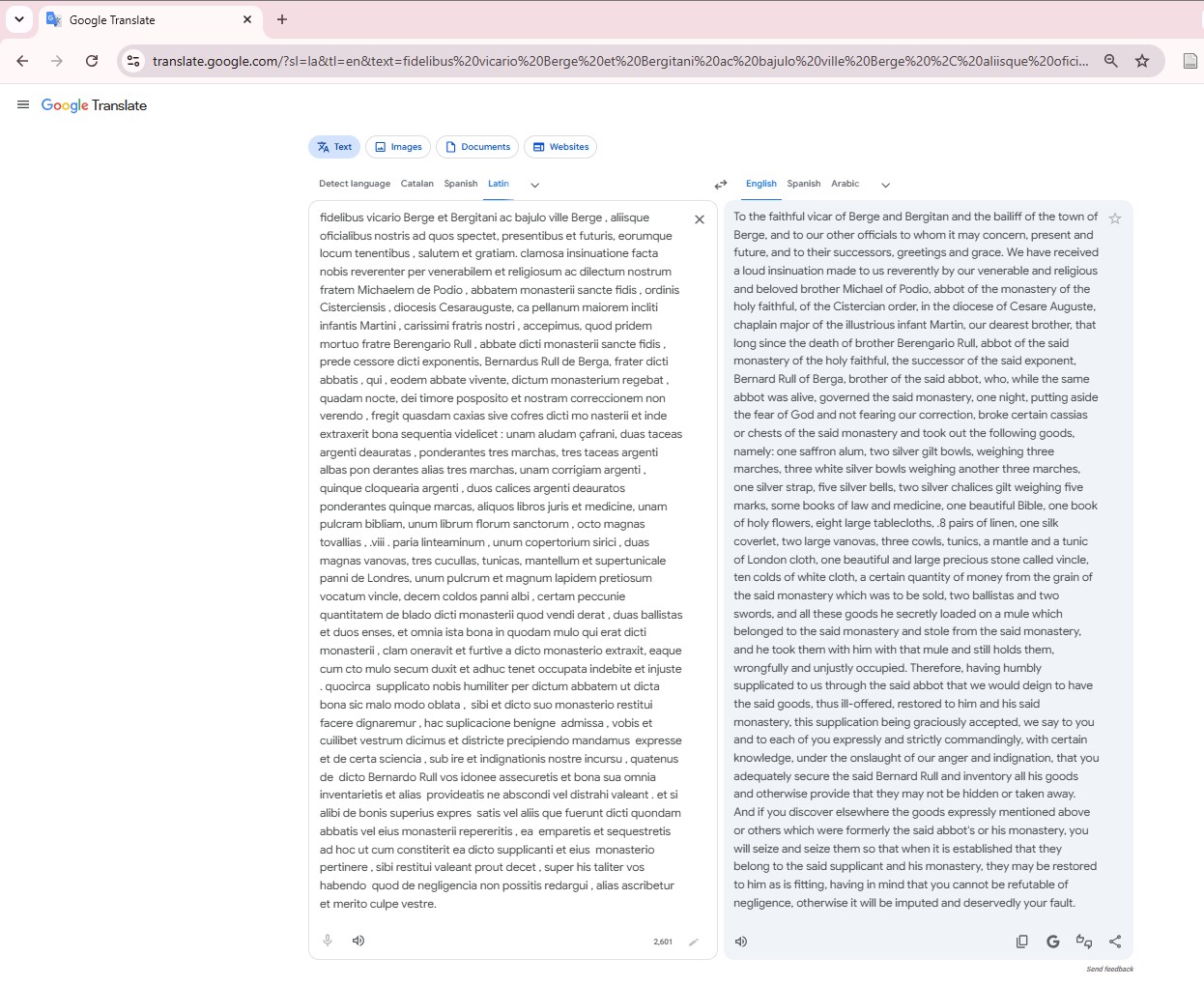
I pasted Rubió i Lluch’s transcription into Google Translate
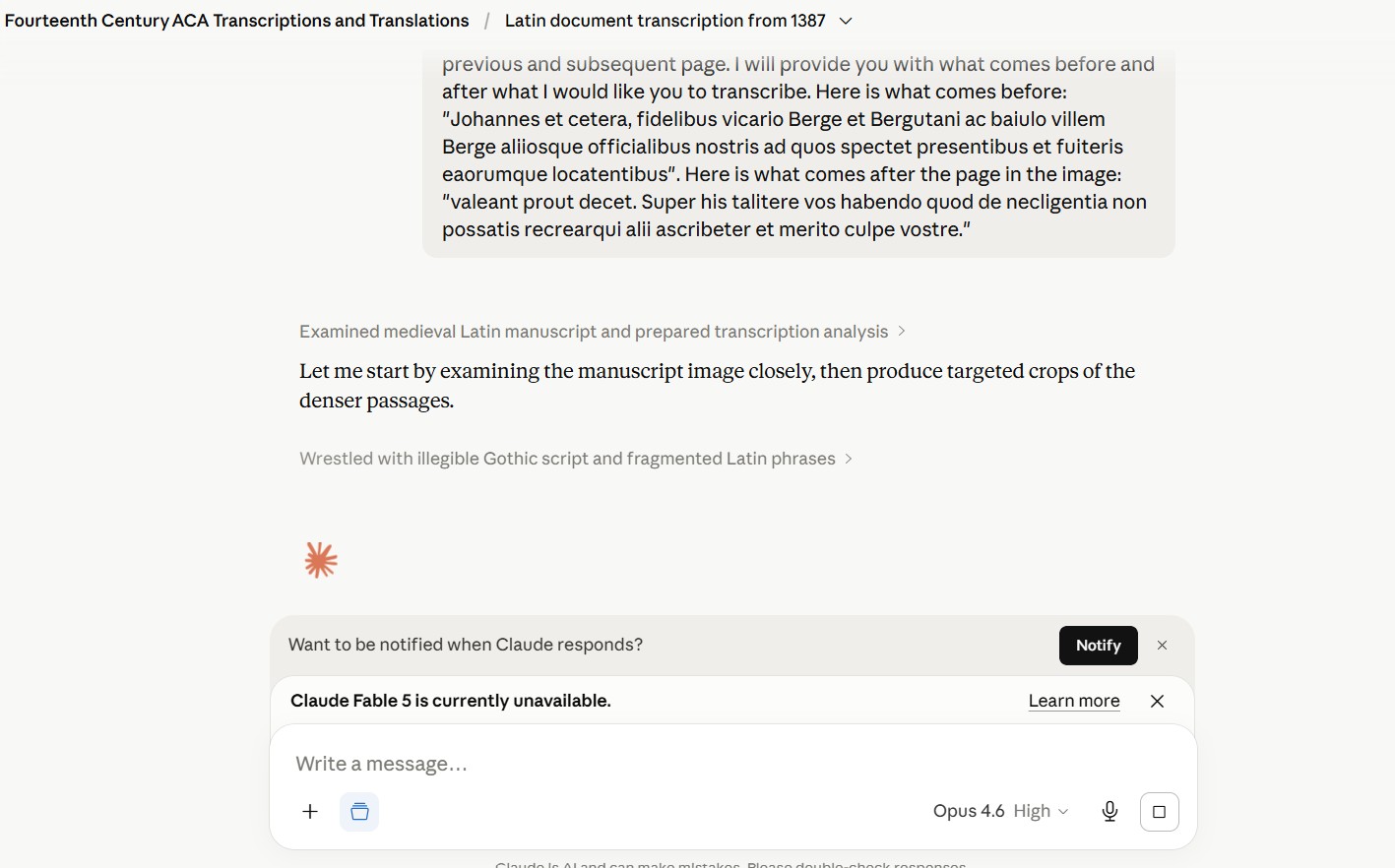
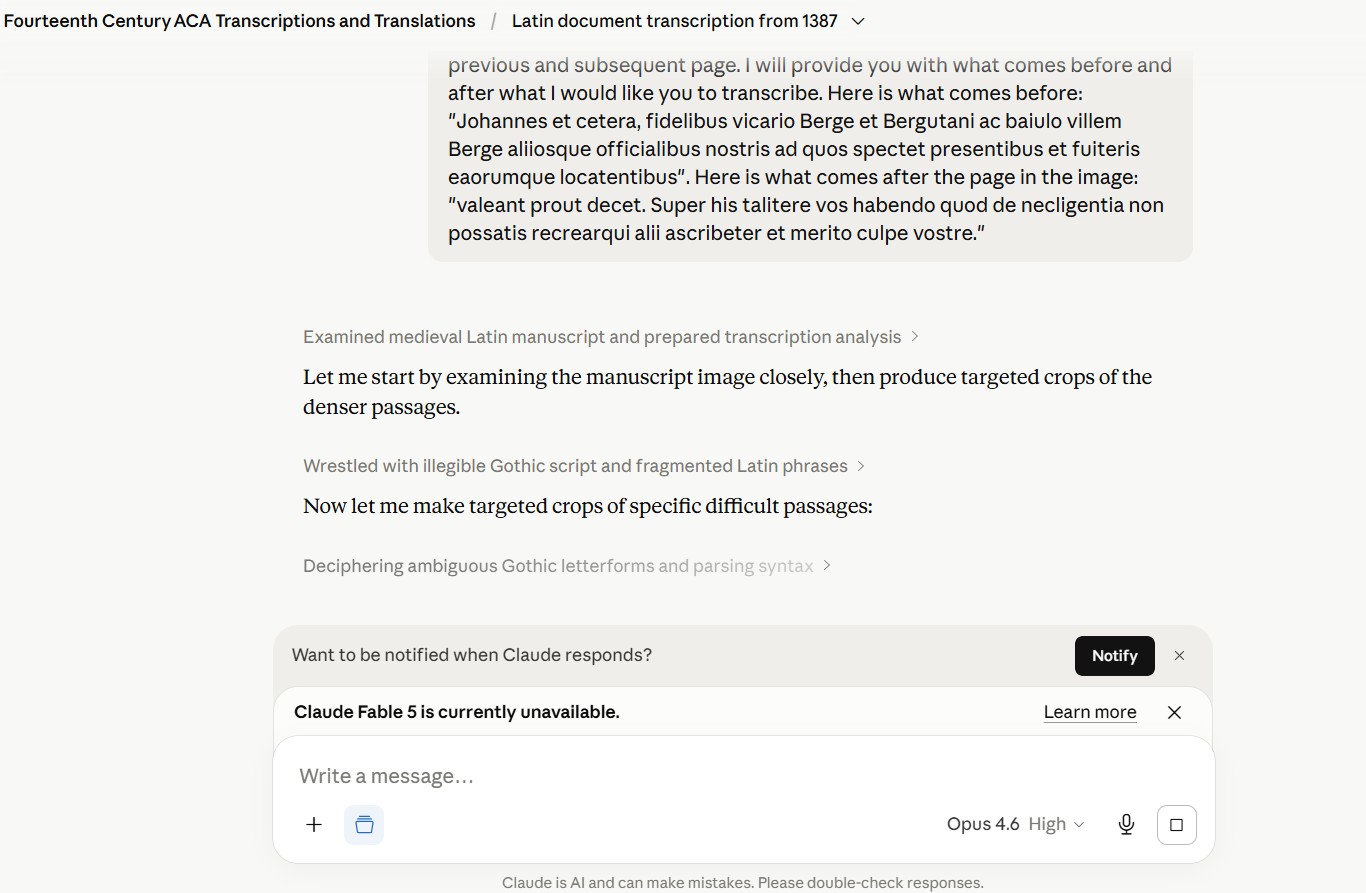
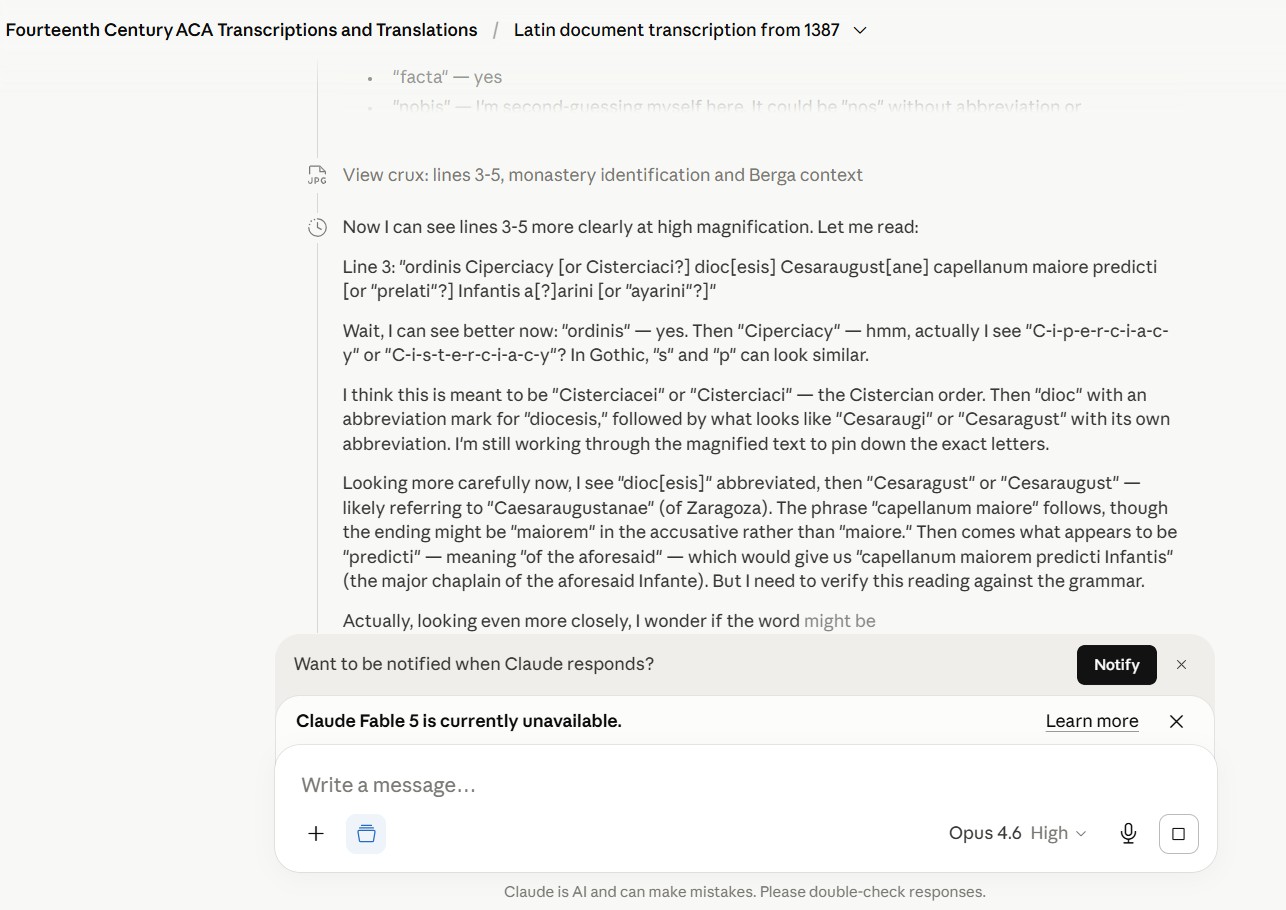
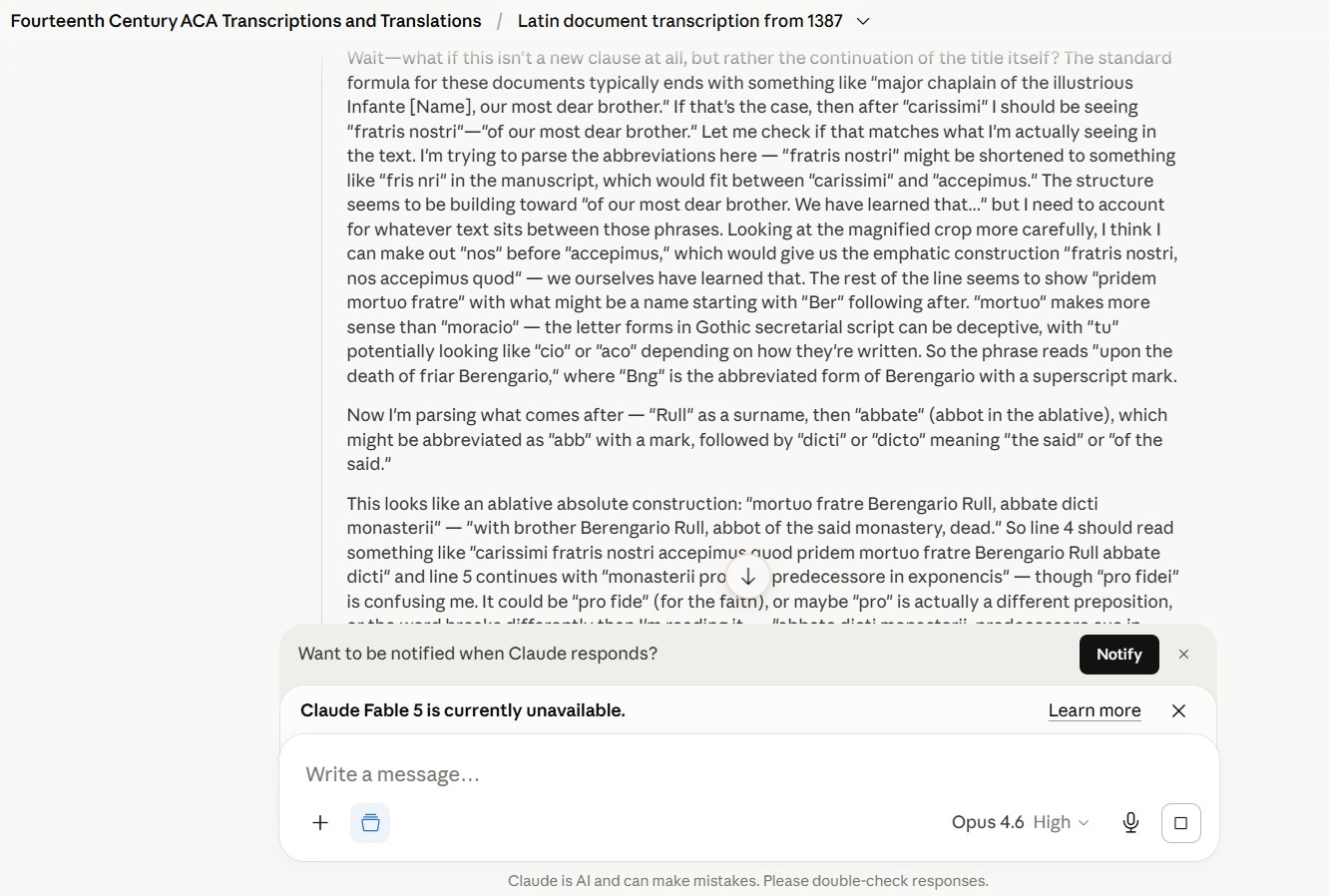
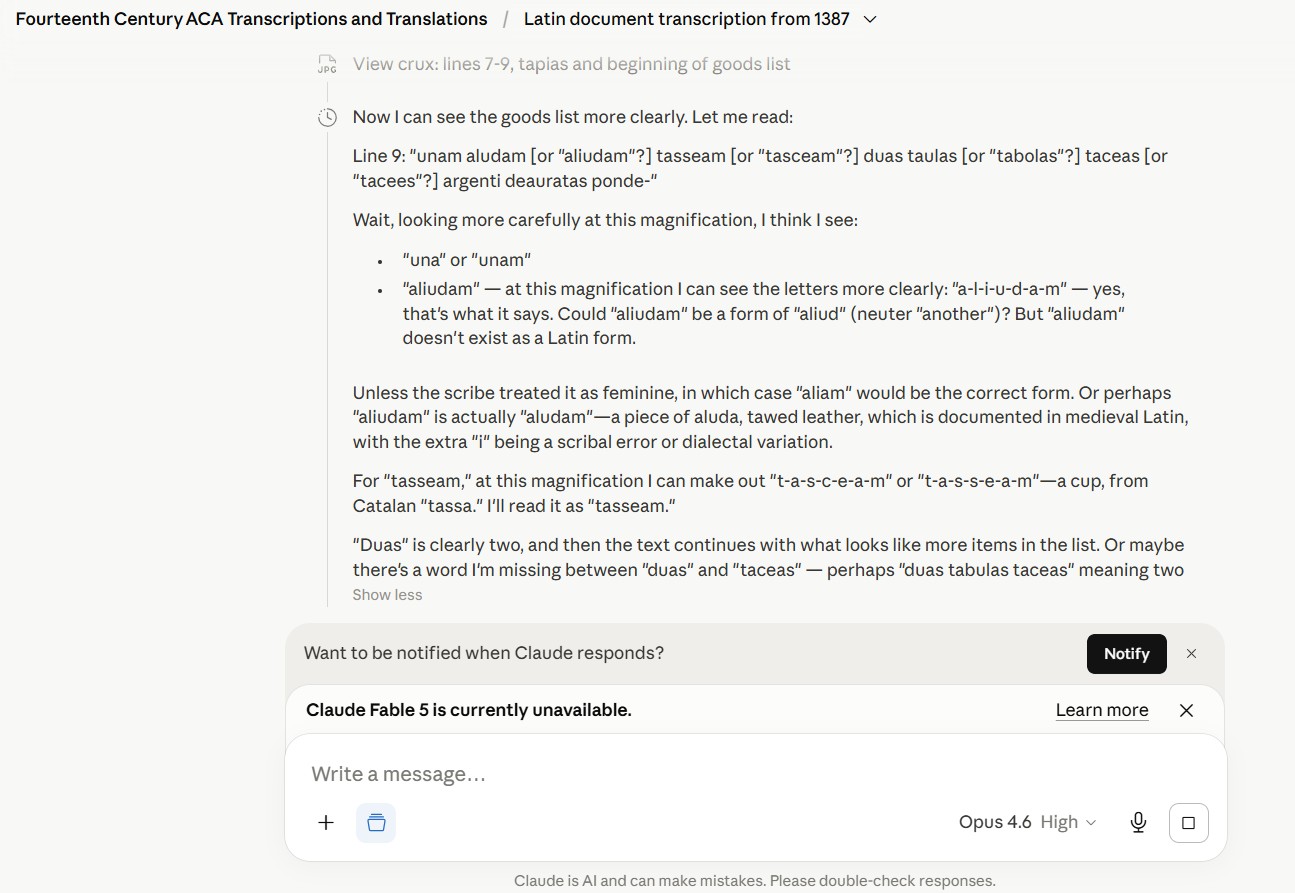
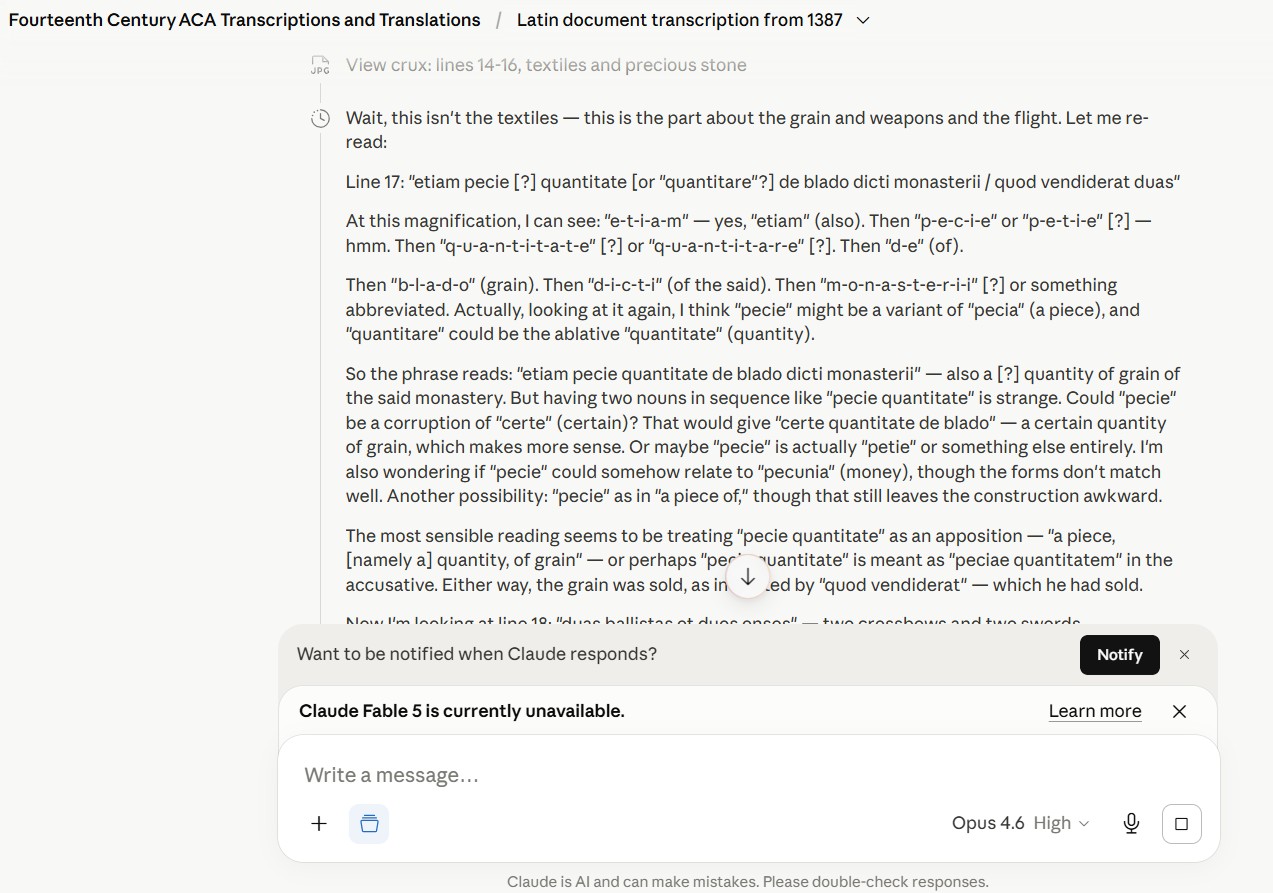
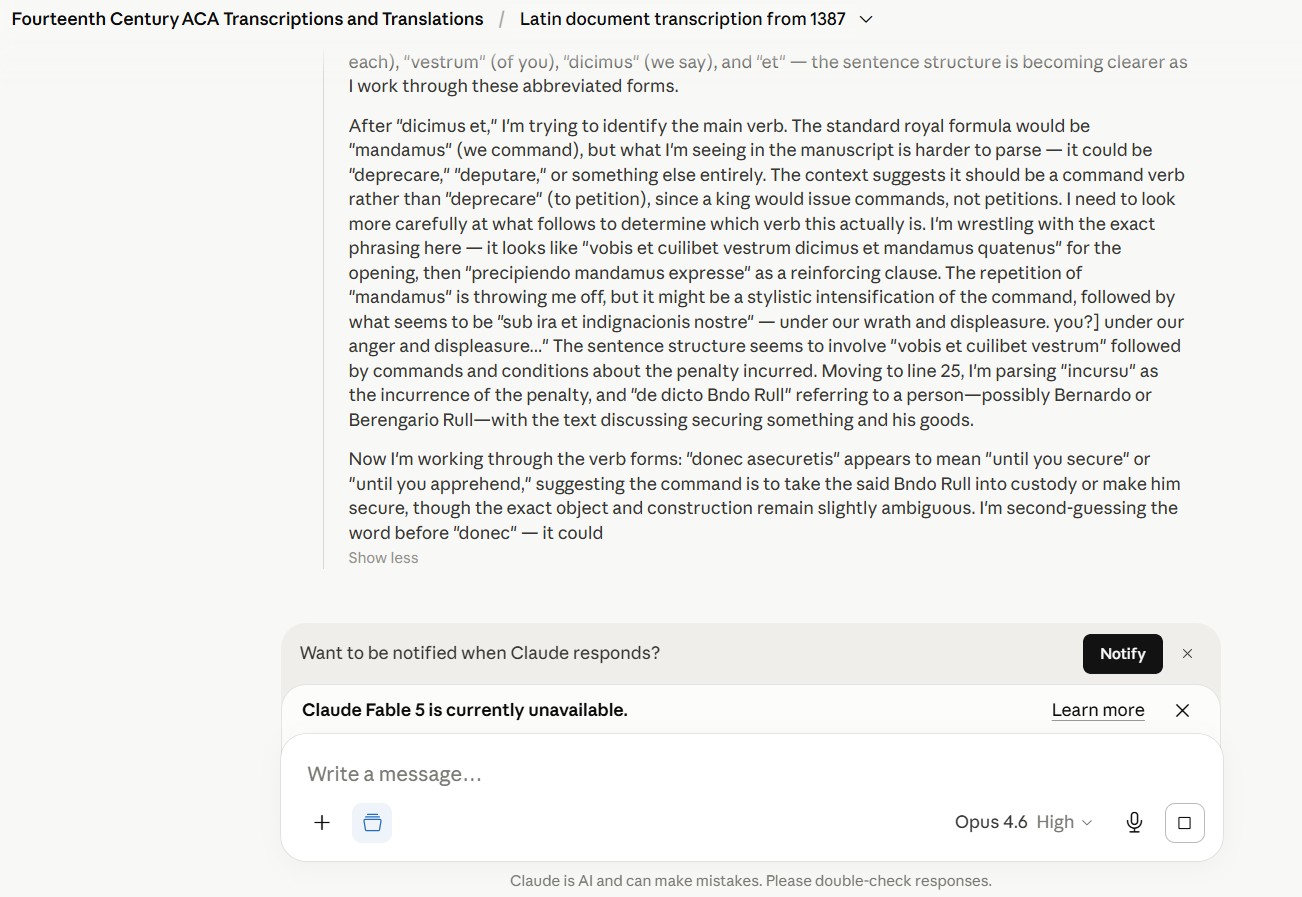
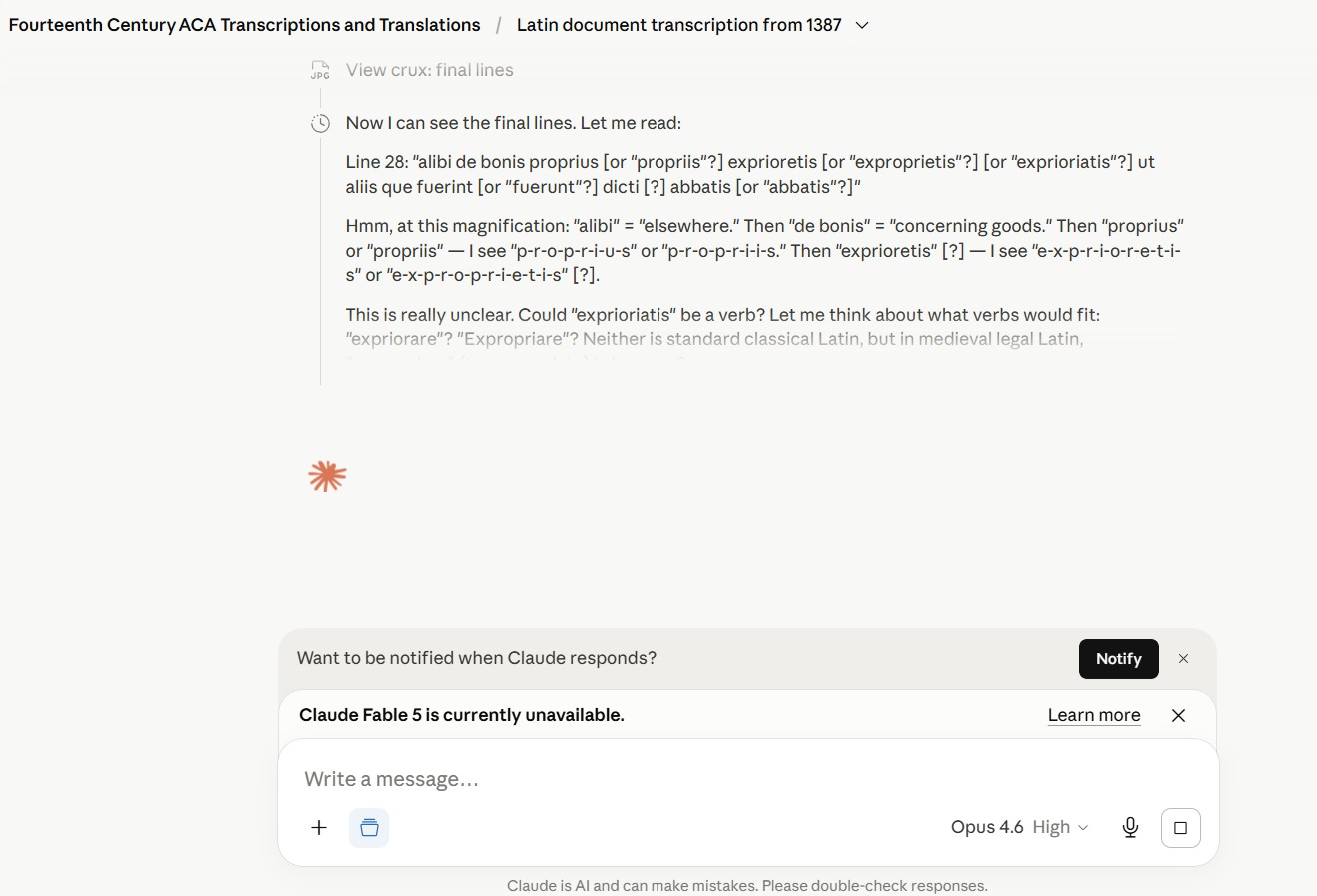
Since I had a full transcription from Antonio Rubió i Lluch, I wanted to test out Gemini and Claude to see how their output would compare to that of an expert paleographer of Gothic secretarial hand. As expected, the transcription by Gemini missed quite a lot. When I tried to use Claude in my usual process from the last few months, it hit my usage limit after about 20 minutes of work. I took some screenshots of the ‘thinking’ that usually disappears after the response is fully generated, and you can see them in the image carousel below. Then, since the usage limit halted the process, I was able to copy it into one PDF.
Bibliography
- Burns, E. Jane. Sea of Silk: A Textile Geography of Women’s Work in Medieval French Literature. Philadelphia: University of Pennsylvania Press, 2009.
- Olson, Sherri. Daily Life in a Medieval Monastery. Santa Barbara: Greenwood, 2013.
- Rubió y Lluch, Antonio. Documents per l’historia de la cultura catalana mig-eval. Vol. 1. Barcelona: Institut d’Estudis Catalans, 1908. Full text available on Hathi Trust
- Rubió y Lluch, Antonio. Documents per l’historia de la cultura catalana mig-eval. Vol. 2. Barcelona: Institut d’Estudis Catalans, 1921. Full text available on Google Books
- Rubió y Lluch, Antonio. Joan I, humanista: i el primer perióde de l’humanisme català. Barcelona: Arts Grafiques, S.A., 1919.
- Tobin, Stephen. The Cistercians : Monks and Monasteries of Europe. Woodstock, NY: Overlook Press, 1996.
-
This document was fully transcribed by Antonio Rubió i Lluch. Antonio Rubió y Lluch, Documents per l’historia de la cultura catalana mig-eval, Vol 2 (Barcelona: Institut d’Estudis Catalans, 1921), 303-304. ↩
-
E. Jane Burns, Sea of Silk: A Textile Geography of Women’s Work in Medieval French Literature (Philadelphia: University of Pennsylvania Press, 2009), 31. ↩