Season 1, Episode 150
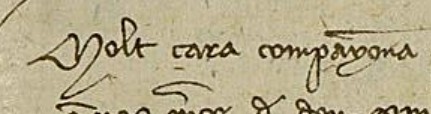
Violant exchanges pleasantries with her daughter’s future groom, Louis II of Anjou, and his mother, Marie de Blois.
Episode 150
](/historians-notebook-s1-episodes/images/may-23-aca-cr-r2053-f9v-violant-img021.jpg)
ACA CR R2053 f9v Source: PARES
](/historians-notebook-s1-episodes/images/may-23-aca-cr-r2053-f10r-violant-img022.jpg)
ACA CR R2053 f10r Source: PARES
Today’s Document
- Subject: another avenue of influence in the marriage negotiation process
- Date: May 23, 1387
- Day of the Week: Thursday
- Language: Catalan
- Archival Reference Number: ACA CR R2053 f9v-10r
- Link to PARES
- Place: Barcelona
- Sender: Violant
- Recipients: Louis II of Anjou and his mother Marie de Blois
Historical Thinking Notes
-
Sourcing: at this time Violant and Joan’s daughter, Yolande of Aragon, was six, and Louis II of Anjou was ten; the real decider for this marriage on the groom’s side was Marie de Blois; the reference to verbally delivered information from messengers indicates that substantial parts of the marriage negotiation were being handled directly between the parents in addition to whatever talks were happening in Avignon; Violant had a huge interest in assuring Marie de Blois that Joan would remain alive, and in good health, so that they would maintain Yolande’s value in the eyes of her future mother-in-law; this marriage negotiation, in 1387, was far from a done deal
-
Contextualization: in future years, both parties would explore other options and the marriage was only settled on paper in 1392 and the wedding took place in 14001; medieval elite marriage negotiations were more analogous to the kinds of deals made in modern times when two countries hammer out a comprehensive trade deal - long, multivariant, and contingent;
-
Corroboration: the documents examined in the episodes tagged with marriage negotiations corroborate this one, with hints at the full picture of the process perhaps centered in Avignon; for other correspondents who have gotten the line that Joan is convalescing well, see Episode 71, Episode 88, and Episode 118
-
Close-Reading: the phrase ‘son mal’ is used here to describes Joan’s illness and I would very much like to know if this is a diminuitive form of ‘malaltia’ or if this would convey just as much severity
What is this document doing?
- This document asserts a picture of normalcy in the royal household of the Crown of Aragon.
- The document maintains a line of communication as an additional avenue for marriage negotiations.
Questions
- In what ways were these marriage negotiations proceeding according to established traditions and in what ways were these negotiations atypical?
- How likely was it that rumors of the severity of Joan’s illness had reached Marie de Blois at this time?
- Did Violant expect that ten year-old Louis would read this letter?
- What had Marie’s messengers said to Violant and what were Violant’s messengers going to say to Marie?
- Are there any subtleties in these letters that would hint at something beyond the boilerplate pleasantries?
Additional Notes
For one of my graduate school independent studies, I created a wesite on medieval marriages as seen through a collection of material objects.
AI Usage
The transcription and translation of this document was carried out by my OpenClaw pipeline.
Bibliography
- Butler, Sara M. Divorce in Medieval England. Taylor and Francis, 2013.
- Casteen, Elizabeth. From She-Wolf to Martyr: The Reign and Disputed Reputation of Johanna I of Naples. Cornell University Press, 2015.
- D’Avray, D. L. Dissolving Royal Marriages: A Documentary History, 860-1600. Cambridge University Press, 2014.
- D’Avray, D. L.. Papacy, Monarchy and Marriage, 860-1600.Cambridge University Press, 2015.
- Delameillieure, Chanelle. Abduction, Marriage, and Consent in the Late Medieval Low Countries. Amsterdam University Press, 2024.
- Duby, Georges. Love and Marriage in the Middle Ages. University of Chicago Press, 1994.
- Karras, Ruth Mazo. “Papacy, Monarchy and Marriage, 860-1600 D. L. D’Avray.” The Catholic Historical Review 102, no. 2 (2016): 382–83.
- Karras, Ruth Mazo. “The Christianization of Medieval Marriage.” In Christianity and Culture in the Middle Ages: Essays to Honor John Van Engen. University of Notre Dame Press, 2015.
- Karras, Ruth Mazo. Unmarriages: Women, Men, and Sexual Unions in the Middle Ages. University of Pennsylvania Press, 2012.
- Karras, Ruth Mazo. “Women’s Labors: Reproduction and Sex Work in Medieval Europe.” Journal of Women’s History 15, no. 4 (2004): 153–58.
- Kelleher, Marie A. “What Do We Mean by” Women and Power”?” Medieval Feminist Forum: A Journal of Gender and Sexuality 51, no. 2 (2016): 104–15.
- Kirshner, Julius. Marriage, Dowry, and Citizenship in Late Medieval and Renaissance Italy. University of Toronto Press, 2015.
- Lacarra Lanz, Eukene. Marriage and Sexuality in Medieval and Early Modern Iberia. Routledge, 2016.
- Lightfoot, Dana Wessell. Women, Dowries and Agency: Marriage in Fifteenth-Century Valencia. Manchester University Press, 2013.
- McSheffrey, Shannon. Marriage, Sex and Civic Culture in Late Medieval London. University of Pennsylvania Press, 2006.
- Rohr, Zita Eva. Yolande of Aragon (1381-1442) Family and Power: The Reverse of the Tapestry. Palgrave Macmillan, 2016.
- Trouillot, Michel-Rolph. Silencing the Past: Power and the Production of History. Beacon Press, 2015.
- Tortorici, Zeb. Sins against Nature: Sex and Archives in Colonial New Spain. Duke University Press, 2018.
-
Zita Eva Rohr, Yolande of Aragon (1381-1442) Family and Power: The Reverse of the Tapestry, (Palgrave Macmillan, 2016), Chapter 1. ↩