Season 1, Episode 148
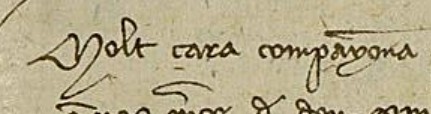
Joan writes to the Bishop of Elne to release a prisoner who Joan says is one of his domestics, in the service of the Crown of Aragon.
Episode 148
](/historians-notebook-s1-episodes/images/may-21-aca-cr-r1825-f146r-joan-img302.jpg)
ACA CR R1825 f146r Source: PARES
Today’s Document
- Subject: claim that Guillem Ribes was imprisoned wrongfully
- Date: May 21, 1387
- Day of the Week: Tuesday
- Language: Catalan
- Archival Reference Number: ACA CR R1825 f146r
- Link to PARES
- Place: Barcelona
- Sender: Joan
- Recipient: the Bishop of Elne
Historical Thinking Notes
-
Sourcing: as king, or in the king’s name, Joan had significant political authority over criminal jurisdictions throughout the Crown of Aragon; at the same time, it is possible that due to this being an ecclesiastical jurisdiction, the Bishop of Elne might have felt he had the authority to reject Joan’s demand to release Guillem de Ribes
-
Contextualization: at this time Elne was the regional political center, not Perpignan; there were two court systems, ecclesiastical and secular, and the two systems did not always have clearly differentiated jurisdictions; the growth of state apparatus in the Crown of Aragon over the course of the fourteenth century provides much of the context for the governance questions arising from this document
-
Corroboration: the document examined in Episode 135 offers a useful comparison to this one, since the earlier document expressed a desire to have a pirate transferred to Barcelona to face justice and this document asks a distant authority to excuse someone from facing criminal charges; a comparable request was made in January for the release of Aragonese students accused of sexual assault in Montpellier, as examined in Episode 9 and Episode 49
-
Close-Reading: the word ‘pres’ in Catalan almost always means imprisoned, not some variaton of present; the document is silent about what crime Guillem de Ribes is accused of; the use of the word ‘maravellam’ might be a choice that an official would be hesistant to make without the king’s consent, but it also might have become standard chancery language by this time; with its clunky repetition, the letter reads as possibly composed by an inexperienced scribe
What is this document doing?
- This document puts pressure on an ecclesiastical official to abandon a criminal case.
- The document assumes that the ecclesiastical courts of Elne could be tricked into pursuing a fraudulent charge based on a personal grudge.
Questions
- How much involvement did Joan have in the creation of this document?
- Did Joan have good reason to be astonished at the accusation against Guillem de Ribes?
- What was Guillem de Ribes accused of?
- What was the job that Guillem de Ribes did for the royal household?
- Would the Bishop of Elne have felt compelled to accede to this demand? Why/why not?
The Perpignan Palace
The royal palace at Perpignan was evidently quite spectacular. An article by Claire Ponsich describes many of the luxuries and the large zoo.1
AI Usage
I gave an initial transcription by Gemini to Claude for a reconciliation. Claude then produced a translation with footnotes.
Bibliography
- Ponsich, Claire. “Perpignan au féminin, 1380-1431. Quand une femme de pouvoir codifie l’espace, maîtrise l’émotion politique mais libère le sentiment familial.” In Perpignan une et plurielle, edited by Raymond Sala and Michelle Ros, 177–203. Canet: Trabucaire, 2004.
- VanLandingham, Marta. Transforming the State: King, Court and Political Culture in the Realms of Aragon (1213-1387). Brill, 2002.
-
Claire Ponsich, “Perpignan au féminin, 1380-1431. Quand une femme de pouvoir codifie l’espace, maîtrise l’émotion politique mais libère le sentiment familial,” in Perpignan une et plurielle, ed. Raymond Sala and Michelle Ros (Canet: Trabucaire, 2004): 177–203. ↩