Season 1, Episode 145
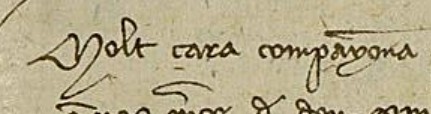
Joan instructs his chamberlain to purchase at least five hunting dogs from Savoy.
Episode 145
](/historians-notebook-s1-episodes/images/may-18-aca-cr-r1751-f57v-joan-img117.jpg)
ACA CR R1751 f57v Source: PARES
](/historians-notebook-s1-episodes/images/may-18-aca-cr-r1751-f58r-joan-img118.jpg)
ACA CR R1751 f58r Source: PARES
Today’s Document
- Subject: procurement of hunting dogs from Savoy
- Date: May 18, 1387
- Day of the Week: Saturday
- Language: Catalan
- Archival Reference Number: ACA CR R1751 f57v-58r
- Link to PARES
- Place: Barcelona
- Sender: Joan
- Recipient: Pere d’Artes, a royal chamberlain
Historical Thinking Notes
-
Sourcing: this document reveals that Joan has sources of information about where the best huntings dogs are from and possibly an ongoing network of contacts that keep him up to date about the latest fashions in hunting animals; in this document, the role of the chamberlain overlaps with the role of the procurador
-
Contextualization: Savoy does not come up often in documents from Joan and Violant; Violant’s home duchy of Bar was relatively close to Savoy; however, Savoy at this time was very much under the influence of Genoa, one of the main rivals to the Crown of Aragon; luxurious hunting practices were key in self-fashioning projects for medieval elite men in Western Europe during the Middle Ages (see the bibliography below); at the same time, hunting was not always seen as purely masculine, since excessive hunting was a trait of feminity in some medieval representations1
-
Corroboration: this mid-May trio of hunting documents from Joan includes this one and the one in Episode 144 and Episode 146
-
Close-Reading: the term used for the dogs, ‘masti’, is probably related to the English word mastiff
What is this document doing?
- This document reflects specialized knowledge of elite hunting animals in distant regions.
- The document initiates spending on luxury items.
Questions
- Why is a chamberlain tasked with procuring these hunting dogs?
- How had Joan heard about these dogs?
- How might the request be impacted by the rivalry with Genoa?
AI Usage
The transcription and translation of this document was carried out by my OpenClaw pipeline.
I could not locate a Carthusian monastery named Noresmenis through searching on Google or the Wikipedia page that lists Carthusian monasteries. I had ChatGPT do a search, but this did not result in any success. It is possible that the capital N in Noresmenys is not a proper name but a scribal tic, making the word function in the sentence as ‘likewise’
Bibliography
- Almond, Richard. Daughters of Artemis: The Huntress in the Middle Ages and Renaissance. D.S. Brewer, 2009.
- Almond, Richard. Medieval Hunting. Sutton, 2003.
- Buquet, Thierry. “Hunting with Cheetahs at European Courts: From the Origins to the End of a Fashion.” In Animals and Courts: Europe, c. 1200-1800, edited by Mark Hengerer and Nadir Weber. De Gruyter Oldenbourg, 2019.
- Cummins, John. The Hound and the Hawk: The Art of Medieval Hunting. Phoenix, 2001.
- Goldberg, Eric Joseph. In the Manner of the Franks: Hunting, Kingship, and Masculinity in Early Medieval Europe. University of Pennsylvania Press, 2020.
- John of Salisbury. Policraticus. edied by Clemens C.I. Webb. Oxford: Clarendon, 1909.
- Karras, Ruth Mazo. “Holy Harlots: Prostitute Saints in Medieval Legend.” Journal of the History of Sexuality 1, no. 1 (1990): 3–32.
- Klemettilä, Hannele. Animals and Hunters in the Late Middle Ages: Evidence from the BnF MS Fr. 616 of the Livre de Chasse by Gaston Fébus. Routledge, Taylor & Francis Group, 2015.
-
Ruth Mazo Karras, “Holy Harlots: Prostitute Saints in Medieval Legend,” Journal of the History of Sexuality 1, no. 1 (1990): 3–32, at 26-27; for excessive hunting as a reflection of a lack of manhood, see John of Salisbury, Policraticus, Book VIII, ed. Clemens C.I. Webb (Oxford: Clarendon, 1909), 390-398 (Cap.4). ↩