Season 1, Episode 119
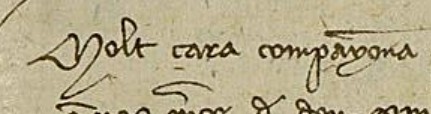
Violant reminds the Governor of Aragon to carry out the confiscation of Bernat de Fortià’s properties in Borja.
Episode 119
](/historians-notebook-s1-episodes/images/apr-22-aca-cr-r2053-f5v-violant-img013.jpg)
ACA CR R2053 f5v Source: PARES
Today’s Document
- Subject: ongoing effort to get compliance to previous orders for confiscation of property in Borja
- Date: April 22, 1387
- Day of the Week: Monday
- Language: Catalan
- Archival Reference Number: ACA CR R2053 f5v
- Link to PARES
- Place: Barcelona
- Sender: Violant
- Recipient: Sancho Martinez, Governor of Aragon
Historical Thinking Notes
-
Sourcing: the recipient of this letter, the highest governing authority in the province of Aragon, has been previously chastised by Joan in the strongest terms; now, Violant appears to have taken a conciliatory approach and might perceive a limit to the king’s authority in Aragon; Violant assumes power over this matter, perhaps taking it over entirely from Joan
-
Contextualization: apparently the de Fortiàs have significant allies in Aragon, partnerships which must have been cultivated in the ten years of Sibilla’s stature as the consort and then wife of King Pere the Ceremonious
-
Corroboration: the previous episodes about Joan’s and Violant’s attempts to get the confiscation of these Aragonese properties carried out were Episode 76, Episode 77, and Episode 94; this challenge to the monarchs’ authority benefits from a comparison to what his happening with Berenguer de Vilaragut in Valencia, discussed in Episode 51, Episode 105, and Episode 111
-
Close-Reading: the way this document begins, ‘rebuda havem vostra letra,’ confirms that there has been a back-and-forth correspondence between the monarchs and the Governor of Aragon; we can infer that the Governor of Aragon has attempted to explain his delay and that at least some information about the difficulties has been communicated to Violant; the word ‘bandos’ at the end of the document might indicate that in the province of Aragon there are armed forces that are resisting the authority of the king
What is this document doing?
- This document asserts a managerial status over a provincial governor.
- The document pushes back against the claims of difficulty in previous correspondence.
Questions
- What does this letter further reveal about the development of Violant’s power in the last month?
- What excuses or reasons had the Governor of Aragon provided in his most recent correspondence?
- How much defiance to the king’s will existed in the province of Aragon? How strong were the ‘bandos’?
- Did Violant, at this point, agree with the Governor of Aragon that confiscating these properties was a very difficult task?
- What was Joan’s awareness of how this situation was progressing?
- Was Joan’s health declining at this time?
AI Usage
The transcription and translation of this document was carried out by my OpenClaw pipeline.
Bibliography
- Earenfight, Theresa. “Absent Kings: Queens as Political Partners in the Medieval Crown of Aragon.” In Queenship and Political Power in Medieval and Early Modern Spain, edited by Theresa Earenfight. Ashgate, 2005.
- Earenfight, Theresa. “A Lifetime of Power, Beyond Binaries of Gender.” In Medieval Elite Women and the Exercise of Power, 1100–1400: Moving beyond the Exceptionalist Debate, edited by Heather J. Tanner, 271-293. Palgrave Macmillan, 2019.
- Kelleher, Marie A. “What Do We Mean by” Women and Power”?” Medieval Feminist Forum: A Journal of Gender and Sexuality 51, no. 2 (2016): 104–15.
- Ponsich, Claire. ‘De la parole d’apaisement au reproche: un glissement rhétorique du conseil ou l’engagement politique d’une reine d’Aragon?,’ Cahiers d’études Hispaniques Medievales 31 (2008): 81–117.
- Tanner, Heather J., ed. Medieval Elite Women and the Exercise of Power, 1100–1400: Moving beyond the Exceptionalist Debate. Palgrave Macmillan, 2019.