Season 1, Episode 117
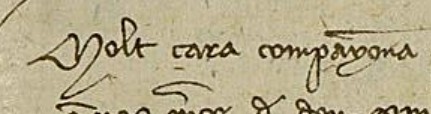
Joan orders the bailiff of Girona to prosecute a group of young men who kidnapped a Jewish boy and performed a forced baptism on him.1
Episode 117
](/historians-notebook-s1-episodes/images/apr-20-aca-cr-r1828-f14v-joan.jpg)
ACA CR R1828 f14v Source: PARES
Today’s Document
- Subject: legal action against Christian persecution of Jews in Girona
- Date: April 20, 1387
- Day of the Week: Saturday
- Language: Latin
- Archival Reference Number: ACA CR R1828 f14v
- Link to PARES
- Place: Barcelona
- Sender: Joan
- Recipient: Bailiff of Girona
Historical Thinking Notes
-
Sourcing: Joan’s insistence that the perpetrators face justice indicates both that he felt a duty to protect Jews but also that he considered attacks on Jews an affront to his own authority as king
-
Contextualization: the Jewish community of Girona had struggled since the devastation of the Bubonic Plague in 1348 and persistent in-fighting about leadership persisted through the 1380s2; Gampel also explains how social class tension among Christians, particularly peasant hatred of rentiers, in Girona fueled the violence against Jews3
- Corroboration: the document examined in Episode 96, a document from Violant, corroborates the existence of Christian violence against Jews discussed in today’s document and also establishes that Joan and Violant co-ruled when it came to administration of justice in Girona; several of the episodes tagged with Jewish History further corroborate the ill-treatment perpetrated by Christians against Jews in the Crown of Aragon in 1387, but some demonstrate peaceful collaborations between Jews and Christians; further regarding Christians kidnapping and forcibly converting a Jewish child, Guerson found that this is the only instance of that happening in the 3,000 documents that she looked at in her dissertation4
- Close-Reading: the word ‘presencia’ in the second line of the letter indicates that the boy’s father was there at the court in Barcelona, possibly in conversation with Joan himself; the word ‘lacrimabilis,’ weeping, indicates a level of pathos in the father’s petition to the royal court; Joan did not believe in the validity of forced baptisms, however many people of the Jewish and Christian communities considered the boy no longer Jewish after this incident; this led Joan to provide the solution in the document of finding the boy a Christian family to adopt him
What is this document doing?
- This document presumes that the forced baptism of a Jewish boy is an illegal act.
- The document recognizes that the boy has crossed a point of no return and employs the authority of the king to re-settle the boy in a Christian household.
Questions
- Was this act of violence against a Jewish boy connected to the increased religious fervor around the Easter holiday?
- Would the boy’s father, Solomon Scaleta, still speak to his son after this or would he be shunned?
- What constituencies in Girona would have protected the kidnappers in this situation? Did they have a lot of support among the Christians of Girona?
- Did Joan meet Solomon Scaleta? Did Joan empathize with Solomon as a father?
AI Usage
I gave an initial transcription by Gemini to Claude for a reconciliation. Claude then produced a translation with footnotes.
Bibliography
- Baer, Yitzhak. A History of the Jews in Christian Spain. Jewish Publication Society of America, 1961.
- Gampel, Benjamin R. Anti-Jewish Riots in the Crown of Aragon and the Royal Response, 1391-1392. Cambridge University Press, 2016.
- Guerson de Oliveira, Alexandra. “Coping with Crises: Christian-Jewish Relations in Catalonia and Aragon, 1380–1391.” Ph.D. dissertation, University of Toronto, 2012.
- Nirenberg, David. Communities of Violence: Persecution of Minorities in the Middle Ages. Princeton University Press, 1996.
-
Benjamin R. Gampel, Anti-Jewish Riots in the Crown of Aragon and the Royal Response, 1391-1392 (Cambridge University Press, 2016), 202-203, footnote 15. ↩
-
Yitzhak Baer, A History of the Jews in Christian Spain (Jewish Publication Society of America, 1961), Vol. 2, 44-46. ↩
-
Benjamin R. Gampel, Anti-Jewish Riots in the Crown of Aragon and the Royal Response, 1391-1392 (Cambridge University Press, 2016), fn27 on 127-128. ↩
-
Alexandra Guerson de Oliveira, “Coping with Crises: Christian-Jewish Relations in Catalonia and Aragon, 1380–1391” (Ph.D., University of Toronto, 2012), 150. ↩