Season 1, Episode 116
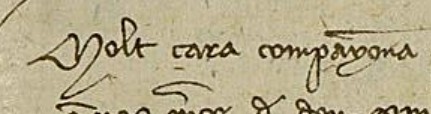
Joan tells the Count of Empúries to stop letting pirates load up supplies in the ports of Roses and Cadaqués
Episode 116
](/historians-notebook-s1-episodes/images/apr-19-aca-cr-r1825-f121r-joan-img252.jpg)
ACA CR R1825 f121r Source: PARES
Today’s Document
- Subject: the threat of pirate ships getting outfitted in nearby ports in Empuries
- Date: April 19, 1387
- Day of the Week: Friday
- Language: Latin
- Archival Reference Number: ACA CR R1825 f121r
- Link to PARES
- Place: Barcelona
- Sender: Joan
- Recipient: Count of Empúries
Historical Thinking Notes
-
Sourcing: The Count of Empúries, who resented Joan’s father and had become enemies with a close ally of Sibilla de Fortià, supported Joan against his father; in return, it seems that Joan had made a deal with the Count of Empúries to have more autonomy over the Empúries region, which he granted about a month ago, on February 20th; Joan would probably have expected good will from the Count of Empúries
-
Contextualization: by this time, Empúries had been affiliated or inside the Crown of Aragon for centuries; during the last years of the reign of Pere the Ceremonious, the Count of Empúries attempted to break away from the sovereignty of the Crown of Aragon; that effort was defeated militarily, but in the leadup to that fight, King Pere slapped his daughter Joana, the wife of the Count of Empúries, in response to her attempt at a reconciliation1; for context about piracy on the Mediterranean, a great place to start is Fernand Braudel’s The Mediterranean and the Mediterranean World in the Age of Philip II2
-
Corroboration: the documents examined in Episode 13 and Episode 15 corroborate this one in that early in their reign Violant is concerned about trouble from the Count of Empúries; also see the several episodes tagged with Sibilla de Fortià
-
Close-Reading: the fact that this document is written in Latin makes it difficult to detect tone and whether or not Joan considers this a betrayal from the Count of Empúries; the document does mention that anger, indignation, and monetary fines could be imposed on the Count of Empúries if the pirates continue to receive hospitality; this could indicate some level of control that Joan expects exists over the Count of Empúries
What is this document doing?
- This document threatens a regional noble.
- The document presumes the outlaw status of the particular vessels in the ports.
Questions
- How had Joan heard about the pirates in the ports of Empúries?
- Would the Count of Empúries have taken this letter seriously or ignored it?
- At this time did Joan consider the Count of Empúries a loyal friend? When he heard about these pirates, did Joan feel betrayed?
- Who were the pirates discussed in this letter? Were they actually planning to target Catalan merchant ships?
- From the pirates’ point of view, what other options did they have for safe ports in this area?
AI Usage
I gave an initial transcription by Gemini to Claude for a reconciliation. Claude then produced a translation with footnotes.
Bibliography
- Braudel, Fernand. The Mediterranean and the Mediterranean World in the Age of Philip II. Vol 1. [print. of the ed. of 1972] Harper & Row, 1990.
- Silleras Fernández, Núria. “Money Isn’t Everything: Concubinage, Class, and the Rise and Fall of Sibil.La de Fortià, Queen of Aragon (1377-87).” In Women and Wealth in Late Medieval Europe, edited by Theresa Earenfight. Palgrave Macmillan, 2010.
-
Núria Silleras Fernández, “Money Isn’t Everything: Concubinage, Class, and the Rise and Fall of Sibil.La de Fortià, Queen of Aragon (1377-87),” in Women and Wealth in Late Medieval Europe, ed. Theresa Earenfight (Palgrave Macmillan, 2010), 67-88, at 78. ↩
-
Fernand Braudel, The Mediterranean and the Mediterranean World in the Age of Philip II. Volume 1, [print. of the ed. of 1972] (New York: Harper & Row, 1990), 117, 121, 129-131, 134, 138, 151, 155, 234, 244, 278, 291-292, 315, 467, 566, 601, 610, 629, 635, and 641. ↩