Season 1, Episode 113
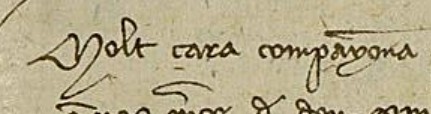
Joan writes to the governor of Ibiza to wait for reinforcements and not abandon the island.
Episode 113
](/historians-notebook-s1-episodes/images/apr-16-aca-cr-r1751-f44v-joan-img91.jpg)
ACA CR R1751 f44v Source: PARES
Today’s Document
- Subject: fears of attack on Ibiza by ‘Barbary’ forces
- Date: April 16, 1387
- Day of the Week: Tuesday
- Language: Catalan
- Archival Reference Number: ACA CR R1751 f44v
- Link to PARES
- Place: Barcelona
- Sender: Joan
- Recipient: Orimano de Campartells, Governor of Ibiza
Historical Thinking Notes
-
Sourcing: as a Christian and a king of a realm within Christendom, Joan likely considered the various polities of North Africa as a monolithic non-Christian entity that he called ‘Barberia’; the recipient, facing the consequences of invasion much more immediately, would have a different response to the order to remain on the island if facing a deadly threat
-
Contextualization: during the Late Middle Ages, the Muslim-ruled states along the coast of North Africa heavily influenced Mediterranean trade, especially from the Zayyanid Kingdom of Tlemcen and the Hafsid territories centered in Tunis;
-
Corroboration: the documents examined in Episode 90 and Episode 109 demonstrates the difficulties of maintaining political control over Mediterranean islands, but in that case the trouble comes from the island’s population instead of an invasion
-
Close-Reading: Joan never threatens de Campartells with his displeasure or any severe penalty but instead repeats all of the provisions that are on the way to Ibiza; perhaps this soft tone reflects Joan’s sympathy with the governor or an overall estimation that the governor truly wants to avoid abandoning the island
What is this document doing?
- This document invokes the cultural border zone between Christendom and Dar al-Islam
- The document reveals the difficulties in maintaining control over distant territories.
Questions
- What information did Orimano de Compartells receive about the approaching invaders?
- Was the most likely outcome in this situation that the Catalan forces would be outnumbered?
- When Joan wrote this document, did he believe that he would be able to muster enough soldiers and ships to save Ibiza?
- How often had Ibiza come under threats like this in the recent past?
AI Usage
This document demonstrates the major challenges facing an automated agentic AI pipeline and the quality of the big data that it produces. The addressee line for this document was beyond the capabilities of the LLMs without human intervention. The LLMs also mis-interpreted the grammar so that the meaning got erroneously generated as Joan telling the governor of Ibiza to go to Barberia. At the same time, working on the document on my own before using Gemini and Claude, I was not able to quickly arrive at a general understanding of what was happening in the document. This was truly an experience in co-intelligence, as Ethan Mollick describes in his book by that title.1
I used Gemini for an initial transcription, which I then had Claude reconcile with its own initial transcription. Claude then produced a translation into English with footnotes.
Bibliography
- Bisson, Thomas N. Medieval Crown of Aragon: A Short History. Clarendon Press, 1986.
- Mollick, Ethan. Co-Intelligence: Living and Working with AI. Portfolio/Penguin, 2024.
-
Ethan Mollick, Co-Intelligence: Living and Working with AI, (Portfolio/Penguin, 2024). ↩