Season 1, Episode 8
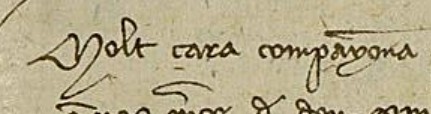
In a move that appears rather vulturous, Joan asks his brother to secure some of their dying father’s precious possessions. 1
Episode 8
](/historians-notebook-s1-episodes/images/jan-1-aca-cr-r1952-f5r-joan.jpg)
ACA CR R1952 f5r Source: PARES
](/historians-notebook-s1-episodes/images/jan-1-aca-cr-r1952-f5v-joan.jpg)
ACA CR R1952 f5v Source: PARES
Today’s Document
- Subject: Joan asks Martí to secure items as Pere is dying 2
- Date: January 1, 1387 3
- Day of the Week: Tuesday
- Language: Catalan
- Archival Reference Number: ACA CR R1952 f5r-v
- Link to PARES
- Place: Girona
- Sender: Joan
- Recipient: Martí
Historical Thinking Notes
](/historians-notebook-s1-episodes/images/astrolabe.jpg)
An astrolabe from the fourteenth century, of Iberian origin Source: The Aga Khan Museum, AKM611, Planispheric Astrolabe
-
Sourcing: I think Joan lets loose here since he’s writing to his brother, who he apparently trusts to secure these items; possibly this does not come across as callous or uncaring about their father’s impending death but also it might be a reflection of how angry Joan has become with Pere; Joan doesn’t seem to care what the scribes think or how it’s going to be copied into the register of his letters for posterity as he has been getting his letters recorded since before he could write them himself; also Joan assumes that Martí can walk around the royal palace like he owns the place, which maybe is an accurate view of things
-
Contextualization: this letter fits the pattern of self-fashioning projects of elites in Western Europe of the Late Middle Ages as most sought out valuable possessions and indulged in conspicuous consumption; to my mind, though, Joan is different and really seeks out the cultural items with more assiduousness than most; I think Joan is quite comparable to the Duc de Berri in this respect; Valerius Maximus was a very frequently copied text at this time
](/historians-notebook-s1-episodes/images/quadrant.jpg)
An astronomical quadrant from the fourteenth century, of Iberian origin Source: The British Museum, The Trustees of the British Museum. Shared under a Creative Commons Attribution-NonCommercial-ShareAlike 4.0 International (CC BY-NC-SA 4.0) licence
-
Corroboration: Rubio i Lluch found a later document, from November 1387, in which Joan discusses the Valerius Maximus text with another correspondent so it looks like Joan did gets his hands on this book; in the other document Joan identifies the book as made with paper, implying that some might assume it is parchment; Violant will certainly partake in the conspicuous consumption of cultural items and so I’ll be interested to see how many letters of hers I find that corroborate this one from Joan
-
Close-Reading: in all fairness, Joan does begin the letter by saying that the news of his father’s worsening illness causes him ‘desplau fort’; Joan calls Martí ‘molt car frare’ even though he has only one brother;
What is this document doing?
- This document swoops in to take ownership of royal possessions, even Cordero the dog!
- The document also cements the trust between the two brothers.
Questions
- What is Joan’s connection to Cordero the dog? Is it a famous hunting dog or one that Joan has an emotional connection to?
- Why were the two books mentioned in the letter particularly sought after by Joan?
- Is there any sign of Joan’s impending illness in this letter? It appears not.
- Can Pere talk anymore? It seems like this kind of action would not be possible if the king was still concious.
- How will Martí receive this request? Is it reasonable and easy or is Martí going to be annoyed about this?
- Why does Joan know about Sibilla’s brother’s falcons?
- Does Joan already have knowledge of bezoar stones? Has he seen one before?
- Was Violant involved in the creation of this list of desired possessions from Pere?
AI Usage
I asked ChatGPT to confirm that ‘los stalabres e quadrans’ referred to astrolabes and astronomical quadrants. Then I asked it to provide some museum websites to link to object records with photographs. ChatGPT’s search probably missed some additional good examples, but the ones it found are also good examples.
Bibliography
- Ponsich, Claire. “Des lettres, le livre et les arts dans les relations, vers 1388-1389, de Violant de Bar et Gaston Fébus, autour de 1388.” In Froissart à la cour de Béarn: l’écrivain, les arts et le pouvoir, edited by Valérie Fasseur, 277–304. Turnhout: Brepols, 2009.
- Rubió y Lluch, Antonio. Documents per l’historia de la cultura catalana mig-eval. Vol. 1. Barcelona: Institut d’Estudis Catalans, 1908. Full text available on Hathi Trust
- Rubió y Lluch, Antonio. Joan I, humanista: i el primer perióde de l’humanisme català. Barcelona: Arts Grafiques, S.A., 1919.
- Ryan, Michael A. A Kingdom of Stargazers: Astrology and Authority in the Late Medieval Crown of Aragon. Ithaca: Cornell University Press, 2011.
- Seyfried, Jonathan. “Medieval Hypebeast: The Conspicuous Consumption of Joan I of Aragon.” Quidditas 45, no. 1 (2024): 4.
-
This document was partially transcribed by Antonio Rubió i Lluch and cited by Claire Ponsich. Antonio Rubió y Lluch, Documents per l’historia de la cultura catalana mig-eval (Barcelona: Institut d’Estudis Catalans, 1908), 349 fn1; Claire Ponsich, “Des Lettres, Le Livre et Les Arts Dans Les Relations, Vers 1388-1389, de Violant de Bar et Gaston Fébus, Autour de 1388,” in Froissart à La Cour de Béarn: L’écrivain, Les Arts et Le Pouvoir, ed. Valérie Fasseur, 277-304 (Brepols, 2009), 290 fn48. ↩
-
This document was partially transcribed by Antonio Rubió i Lluch and cited by Claire Ponsich. Antonio Rubió y Lluch, Documents per l’historia de la cultura catalana mig-eval (Barcelona: Institut d’Estudis Catalans, 1908), 349 fn1; Claire Ponsich, “Des lettres, le livre et les arts dans les relations, vers 1388-1389, de Violant de Bar et Gaston Fébus, autour de 1388.,” in Froissart à la cour de Béarn: l’écrivain, Les Arts et Le Pouvoir, ed. Valérie Fasseur, 277-304 (Brepols, 2009), 290 fn48. ↩
-
This document lacks a dating clause. The previous document is dated January 1 and the following document is dated December 30. Rubió i Lluch identified this letter as written on January 1, and I trust his judgment on that. ↩