Season 1, Episode 47
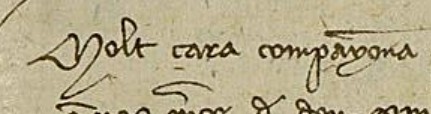
Violant tells someone that she wants them to come to Barcelona.
Episode 47
](/historians-notebook-s1-episodes/images/feb-9-aca-cr-r1819-f81r-violant.JPG)
ACA CR R1819 f81r Source: PARES
Today’s Document
- Subject: An extremely polite summons to Barcelona from Violant
- Date: February 9, 1387
- Day of the Week: Saturday
- Language: Catalan
- Archival Reference Number: ACA CR R1819 f81r
- Link to PARES
- Place: Barcelona
- Sender: Violant
- Recipient: not listed
Historical Thinking Notes
- Sourcing: I do not think the addressee of this letter is Miguel de Novals, but possibly I am misunderstanding the grammar and it is; Miguel de Novals, a Valencian noble 1, is involved in the communication and maybe a trusted messenger for Violant or for the addressee; as queen, Violant probably issues summons quite habitually
-
Contextualization: medieval elites frequently entrusted messengers and heralds to deliver summons and to perform rituals of deference
-
Corroboration: the document examined in Episode 16 offers an interesting corroboration to this one in that we see another form of summons, a seemingly less deferential one, when Violant issued one to Maria de Luna;
-
Close-Reading: all the conditional language in this document reads to me like an extreme level of politeness, but maybe there is some irony; perhaps the brevity of this letter is a sign of preoccupation
What is this document doing?
- This document, in its brevity, confirms Violant’s elevated social stature in relation to the recipient.
- The document fails to perform the usual chancery function of establishing a record of correspondence that includes the addressee.
Questions
- Who is the addressee of this document?
- Why did the chancery decide it was ok to skip writing down the addressee? (Or is it somehow Miguel de Novals despite some pretty clear grammar indicating that he is a messenger?)
- Who would be waiting for this level of reassurance that Violant wants them to come to Barcelona instead of simply making the journey there?
- Is Miguel de Novals’s connection to Valencia a hint? Who in Valencia might Violant want to summon?
- Why is this letter so short?
- Is the brevity of this letter a sign of preoccupation and/or a sign that the recipient is of less stature?
AI Usage
I used ChatGPT to help with the medieval Catalan grammar in this document and also to research the person mentioned inside it, Miguel de Novals. This episode also mentions the ethical problems with AI usage, the copyright violation in particular. There are other ethical problems such as environmental impact and labor exploitation. Two books in this page’s bibliography, one by Kate Crawford and the other by Ethan Mollick, do a good job of explaining the ethical dimensions of using AI.
Bibliography
- Crawford, Kate. Atlas of AI: Power, Politics, and the Planetary Costs of Artificial Intelligence. Yale University Press, 2021.
- López Juan, Guillermo. “Converso Evangelisation, Funerary Practices, and Social Integration in Valencia, 1391–1482.” Journal of Medieval Iberian Studies 16, no. 3 (2024): 389–415.
- Mollick, Ethan. Co-Intelligence: Living and Working with AI. Portfolio/Penguin, 2024.
-
Guillermo López Juan, “Converso Evangelisation, Funerary Practices, and Social Integration in Valencia, 1391–1482,” Journal of Medieval Iberian Studies 16, no. 3 (2024): 389–415, at 395. ↩