Season 1, Episode 46
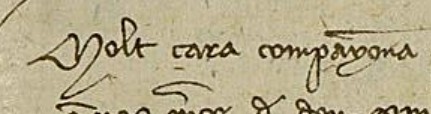
Joan intervenes in a situation with royal officials in Lleida.
Episode 46
](/historians-notebook-s1-episodes/images/feb-8-aca-cr-r1827-f27r-joan.jpg)
ACA CR R1827 f27r Source: PARES
](/historians-notebook-s1-episodes/images/feb-8-aca-cr-r1827-f27v-joan.jpg)
ACA CR R1827 f27r Source: PARES
Today’s Document
- Subject: managing bailiffs and veguers
- Date: February 8, 1387
- Day of the Week: Friday
- Language: Latin
- Archival Reference Number: ACA CR R1827 f27r
- Link to PARES
- Place: Barcelona
- Sender: Joan
- Recipients: the curia and veguer of Lleida
Historical Thinking Notes
-
Sourcing: as king, the supreme political authority, Joan was expected to make rulings on disputes and to instruct his officials on courses of action; more would need to be known about the situation in Lleida to understand the purpose of the document and the identities of the recipients; however, the bailiffs and veguers would have to account for their decisions if the populations in their juridictions complained to the king
-
Contextualization: Lleida was a prosperous town and a cultural center with its university founded in 1300; bailiffs and veguers played different roles in the enforcement of the rule of the royal family over various territories in the Crown of Aragon; see the Additional Notes below for a further explanation
-
Corroboration: other Latin documents addressed to the vicario of a particular town or region will help to clarify the role of this one
-
Close-Reading: the word ‘curie’ before ‘e vicario’ might refer to the idea that the veguer of Lerida works within a ‘small court’ governance structure there1
What is this document doing?
- This document performs the managerial status of Joan over the officials in the administration of the Crown of Aragon.
- The document demonstrates the lengthiness of judicial processes and conflict resolution in the fourteenth-century Crown of Aragon.
Questions
- What was the problem in Lleida that instigated the need for Joan’s intervention?
- How recently had the veguers of Lleida been appointed?
- Does this document reflect any changes in policy from those of the previous administration of Joan’s father?
- What were the penalties, if any, imposed by this document?
- What personal backgrounds did Raymundo, Arnoldi, and Bernardo bring to the situation that gave rise to this document?
Additional Notes
On the centuries-long pattern of governance for the Crown of Aragon, Marie Kelleher provides an excellent summary of the administrative context for this document.
The distinct legal and political traditions of the various parts of this federated crown meant that the monarchs had to rule their territories separately in spite of their sporadic attempts to institute a more centralized rule. In the cities of Catalonia, local royal officials like the veguers, who exercised jurisdiction over a broad range of civil and criminal cases, and the bailiffs, who oversaw royal finance and properties, shared local rule with municipal councils in a system that was more transactional than top-down.2
In his ‘Notes on the Translations of Proper Names,’ Thomas Bisson uses Lleida as an example of the difficulty of choosing whether to use the the conventional medieval Catalan name.3
AI Usage
I made extensive use of ChatGPT for this episode. I tried to have it transcribe some paleography but it did not work too well. I also attempted to locate more information in the secondary literature about some of the people in this document but that also turned up limited results.
Bibliography
- Bisson, Thomas N. Medieval Crown of Aragon: A Short History. Clarendon Press, 1986.
- Boucoyannis, Deborah. Kings as Judges: Power, Justice, and the Origins of Parliaments. Cambridge University Press, 2021.
- Kelleher, Marie A. The Hungry City: A Year in the Life of Medieval Barcelona. Cornell University Press, 2024.
-
Deborah Boucoyannis describes the curia as a small court governance structure in Catalonia, in Deborah Boucoyannis, Kings as Judges: Power, Justice, and the Origins of Parliaments (Cambridge University Press, 2021), 188. ↩
-
Marie A. Kelleher, The Hungry City: A Year in the Life of Medieval Barcelona (Cornell University Press, 2024), 115. ↩
-
Thomas Bisson, Medieval Crown of Aragon: A Short History (Clarendon Press, 1986), 191. ↩