Season 1, Episode 35
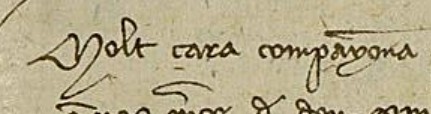
Violant informs Ramon de Perellos, the Viscount of Roda, that the King of Navarre has died.1
Episode 35
](/historians-notebook-s1-episodes/images/jan-28-aca-cr-r1818-f96v-violant.JPG)
ACA CR R1818 f96v Source: PARES
Today’s Document
- Subject: Violant informs Ramon de Perellos of the death of the King of Navarre
- Date: January 28, 1387
- Day of the Week: Monday
- Language: Catalan
- Archival Reference Number: ACA CR R1818 f96v
- Link to PARES
- Place: Barcelona
- Sender: Violant
- Recipients: Ramon de Perellos, Viscomte de Roda
Historical Thinking Notes
- Sourcing: the recipient, Ramon de Perellos has been described by modern scholar Lledo Ruiz Domingo as ‘an essential statesman’2; both Ramon de Perellos, the Viscount of Roda, and Sibilla de Perellos, the Viscountess of Roda, have a close relationship with Violant, to the extent that Violant sometimes shares very personal details in her letters to them;
-
Contextualization: the transition of power requires Violant and Joan to shore up the support of their political and social networks - keeping Ramon de Perellos in the loop is just one part of this larger effort; for a decades-long period in the late fourteenth century, Ramon de Perellos played a vital role in securing and reinforcing the relationshps between the royal family of the Crown of Aragon and other power players in the region, espcially the King of France and the Avignon Pope
-
Corroboration: a large number of documents survive about the career of Ramon de Perellos and combined with the correspondence between Violant and Sibilla de Perellos, its clear that Ramon de Perellos was among the most trusted allies of Joan and Violant; other letters feature Guillaume de Copons as an emissary from both Joan and Violant to high status figures such as the Duc de Berry
-
Close-Reading: the language in the letter is very vague, relying on words like ‘fets’ and ‘affers’ to allude to a set of specific actions and events related to transitions of power in Navarre and the Crown of Aragon; although this might indicate a heightened sensitivity to the topics at hand, it could also simply be a time-saving measure as it is far quicker to have an emissary verbally recount information than to consider the best phrasing in written correspondence
What is this document doing?
- This document reinforces the network connection between Violant and Ramon de Perellos.
- The document also invests Guillaume de Copons with the authority to speak on Violant’s behalf.
Questions
- Did Violant think that Ramon de Perellos really might not have already heard about the death of the King of Navarre?
- Had Guillaume de Copons previously acted as an emissary between Violant and Ramon de Perellos?
- What information would de Copons provide in person that Ramon de Perellos would not have heard from other sources?
- Where was Ramon de Perellos living at this time? Possibly Avignon?
- How long would it take Guillaume de Copons to travel to Ramon de Perellos and would the letter arrive before him or in his hand?
- Had Guillaume de Copons been promoted to a higher station after Violant’s ascension to the throne?
- Did Joan also give Guillaume de Copons a message for Ramon de Perellos or was this an instance when Violant alone handled the network connection?
Additional Notes
A particular letter from September 1388 demonstrates Violant’s closeness to Ramon de Perellos and Sibilla de Perellos. In that letter, analyzed by Dawn Bratsch-Prince, Violant shares very personal details about her experience of pregnancy, including her ‘gran vomit.’3
AI Usage
In my review of the secondary literature on Ramon de Perellos, I could not easily find the name of the Viscountess of Roda. I went to ChatGPT to get a quick start on confirming the name of Sibilla de Perellos and then did some additional research to make sure that it was correct.
Bibliography
- Bratsch-Prince, Dawn. “The Politics of Self-Representation in the Letters of Violant de Bar (1365–1431).” Medieval Encounters 12, no. 1 (2006): 2–25.
- Domingo, Lledó Ruiz. “Surrounding the Future Queen of the Crown of Aragon: Violant of Bar’s Household as Duchess of Girona (1384–1386)” Royal Studies Journal 10, no. 1 (June 22, 2023): 96–135. Available for free download at the Royal Studies Journal website.
- Haren, Michael, and Yolande de Pontfarcy, eds. The Medieval Pilgrimage to St Patrick’s Purgatory: Lough Derg and the European Tradition. Clogher Historical Society, 1988.
- Ponsich, Claire. “Un témoignaige de la Culture en Cerdagne, la correspondance de Violant de Bar (1380-1431).” In Le Moyen Âge dans les Pyrénées catalanes: art, culture et société, edited by Michel Zimmerman, Pierre Bonnassie, and Mathias Delcor, 147–94. Trabucaire, 2005.
-
this document is cited in Claire Ponsich, “Un témoignaige de la Culture en Cerdagne, la correspondance de Violant de Bar (1380-1431),” in Le Moyen Âge dans les Pyrénées catalanes: art, culture et société, 2005, (Canet, France: Trabucaire, 2005), 147–94, at 184. ↩
-
Lledó Ruiz Domingo, “Surrounding the Future Queen of the Crown of Aragon: Violant of Bar’s Household as Duchess of Girona (1384–1386)” Royal Studies Journal 10, no. 1 (June 22, 2023): 96-135 at 14. ↩
-
Dawn Bratsch-Prince, “The Politics of Self-Representation in the Letters of Violant de Bar (1365–1431),” Medieval Encounters 12, no. 1 (2006): 2–25, at 16-17. Bratsch-Prince cites ACA CR R.2053 f.79v-80r. ↩