Season 1, Episode 30
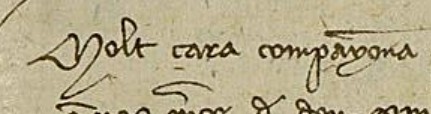
Joan collects a fine that he imposed on the Muslims of Fraga for an outbreak of violence against the Jews of that city.
Episode 30
](/historians-notebook-s1-episodes/images/jan-23-aca-cr-r1890-f52r-joan.jpg)
ACA CR R1890 f52r Source: PARES
](/historians-notebook-s1-episodes/images/jan-23-aca-cr-r1890-f52v-joan.jpg)
ACA CR R1890 f52v Source: PARES
](/historians-notebook-s1-episodes/images/jan-23-aca-cr-r1890-f53r-joan.jpg)
ACA CR R1890 f53r Source: PARES
Today’s Document
- Subject: Collection of a fine from the Muslim aljama of Fraga
- Date: January 23, 1387
- Day of the Week: Wednesday
- Language: Latin
- Archival Reference Number: ACA CR R1890 f52r-53r
- Link to PARES
- Place: Barcelona
- Sender: Joan
- Recipients: Muslim aljama of Fraga
Historical Thinking Notes
-
Sourcing: the simple purpose of this document is to certify the receipt of the fine imposed on the Muslims of Fraga, but the length of it appears to indicate that the situation called for justification and judgment; the king, perhaps as the chief political authority of Fraga only recently with his ascension to the throne, might perceive a need to be especially thorough; the audience appears to be the entirety of the Muslim aljama, although the community probably had a leadership council of some kind that would be the actual readership of this document
-
Contextualization: the long background of interfaith encounter in Iberia followed some of the major patterns of interaction in other parts of the Muslim world, and in this document we can see vestiges, in the alternative governance of faith-based neighborhoods, of the dhimmi status that Christians and Jews had under Muslim rule; processions were a big deal in Iberia at this time and a procession was a common response to all kinds of events, political ones as well as famines and floods
-
Corroboration: this document fits in with a large selection of aljama management documents in the Archive of the Crown of Aragon in the fourteenth century; members of the royal family directly managed the affairs of the aljamas and many entire books on interfaith encounter in Iberia have been written largely from this source base 1
- Close-Reading: the words ‘criminal’ and ‘criminalis’ in the middle page of the document indicate the severity of the acts being punished, but on a cursory scan of the document I could not find words for killing or death; it is hard for me to tell whether this document has a business-like tone or a tone of reproach
What is this document doing?
- This document positions the King of the Crown of Aragon as the adjudicator of conflict between faith groups in Fraga.
- The document closes the financial transaction that opened with the imposition of the fine.
- The document presumes the responsibility of the aljama as a corporate entity for the criminal behavior of faith group members in the municipality.
Questions
- What are the details of the violence that occurred between the Muslims and Jews?
- Was it typical for Muslims to get blamed more than Jews or was something about this episode that clearly justified putting the blame on the Muslims?
- Was Fraga a place in which Jews and Muslims often got into conflict with each other?
- How many people, proportionally, were in the Christian, Jewish, and Muslim populations of Fraga?
- How many Muslims in Fraga had proficiency in Latin?
- Why did the order in the procession matter so much - were there material benefits as well as status in the procession order?
- Was this a large fine when divided up among the inhabitants of the Muslim aljama in Fraga?
- Would the Jewish community of Fraga feel that justice had been done after this fine?
Additional Notes
David Nirenberg, in Communities of Violence, provides a partial transcription of this document. At one point the Muslims are judged to have ‘mortally wounded’ some of the Jews. The phrased used is ‘letaliter vulnerando.’2
Bibliography
- Agresta, Abigail. The Keys to Bread and Wine: Faith, Nature, and Infrastructure in Late Medieval Valencia. Cornell University Press, 2022.
- Boswell, John. The Royal Treasure: Muslim Communities under the Crown of Aragon in the Fourteenth Century. Yale University Press, 1977.
- Catlos, Brian A. Muslims of Latin Christendom, c. 1050-1614. Cambridge University Press, 2014.
- Gampel, Benjamin R. Anti-Jewish Riots in the Crown of Aragon and the Royal Response, 1391-1392. Cambridge University Press, 2016.
- Nirenberg, David. Communities of Violence: Persecution of Minorities in the Middle Ages. Princeton University Press, 1996.