Season 1, Episode 22
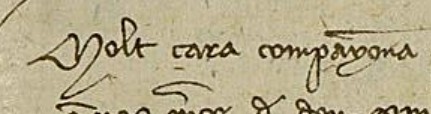
Joan orders payment to a harp-maker for at least two custom-made harps.
Episode 22
](/historians-notebook-s1-episodes/images/jan-15-aca-cr-r1953-f18r-joan.jpg)
ACA CR R1953 f18r Source: PARES
Today’s Document
- Subject: Joan arranges payments for custom-made harps
- Date: January 15, 1387
- Day of the Week: Tuesday
- Language: Latin
- Archival Reference Number: ACA CR R1953 f18r
- Link to PARES
- Place: Granollers
- Sender: Joan
- Recipients: Petro Palau, the harp-maker
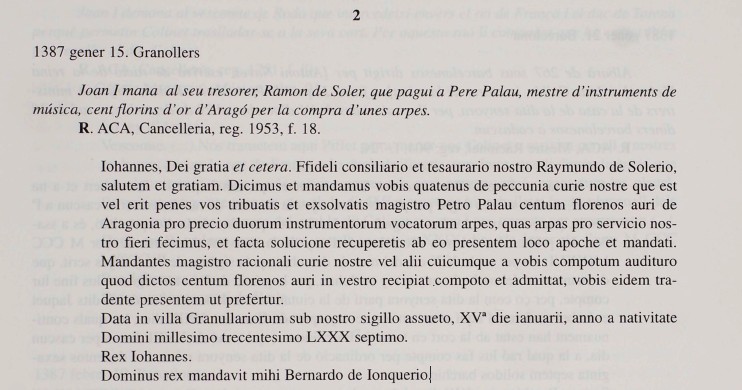
Excerpt from José Trenchs Odena and Ignasi J. Baiges i Jardí, ‘Documents sobre música, músics i instruments musicals a la casa reial catalano-aragonesa (segles XIV-XV): el regnat de Joan I,’ Estudis castellonencs, no. 9 (2000): 135–318, at 139
Historical Thinking Notes
- Sourcing: Joan assigns the payment arrangements to Ramon de Soler, the same person mentioned in yesterday’s document about a sale in Girona; based on what I have read about Joan’s priorities, I am far less surprised to see a music-related document at this busy time versus yesterday’s document about a property transaction in Girona - Benjamin Gampel is very good at explaining how Joan prioritized what occupied his attention 1
-
Contextualization: in music history, Guillaume Machaut is a really big deal - and Violant and Joan obtained several of his manuscripts in an effort to spread Ars Nova throughout the Crown of Aragon; in addition, Violant and Joan patronized many troubadours and were thus plugged in to the larger picture of musical developments in Western Europe, extending all the way into Germany; the beginning of Ars Subtilior occurred during their reign and the complex musical theory behind this new style of music appealed greatly to Violant and Joan
-
Corroboration: a different register contains a document from the next day in which Joan records receipt of the money for this payment to harp-maker Petro Palau; 100 florins equals 1100 solidis, making these harps about three times the amount of money paid to Violant’s baker for his services from October to December 1386, as discussed in Episode 5; I would really like to find a document in which Violant is connected to the purchase of a musical instrument, as I haven’t found any corroboration for this particular interest of theirs as a joint project - I have found documents that indicate their cooperation in troubadour patronage, Machaut manuscripts, and literary pursuits
-
Close-Reading: I really want to know more about these ‘arpas’ as this one word could mean a harp of any variety of shapes and sizes
What is this document doing?
- This document intiates the next step in a financial transation.
- The document also demonstrates Joan’s attention to his musical interests even in the midst of all other kinds of business.
Questions
- What kinds of harps did Petro Palau make for Joan?
- Why did Joan order these harps in particular?
- Where are the harps at the time of the creation of this document?
- Had porters already started to pack up Joan’s musical instrument collection in preparation for its transportation from Girona to Barcelona?
- How did the harps fit into the larger project of Joan’s musical instrument collection and his interest in music?
- Would visiting troubadours play these harps or were they only for Joan’s personal use?
- Who was Petro Palau and was he known for making a great many instruments of varying kinds?
- Did Violant also pursue these instruments, with an interest as great as Joan’s?
Bibliography
- Alberni, Anna. ‘Machaut’s Literary Legacy in the Crown of Aragon: The Catalan Chansonnier Vega-Aguiló and the Anonymous Roman de Cardenois.’ In Medieval Francophone Literary Culture Outside France: Studies in the Moving Word, edited by Nicola Morato and Dirk Schoenaers, 391-410. Brepols, 2019.
- Earp, Lawrence Marshburn. Guillaume de Machaut: A Guide to Research. Garland Pub., 1995.
- Gampel, Benjamin R. Anti-Jewish Riots in the Crown of Aragon and the Royal Response, 1391-1392. Cambridge University Press, 2016.
- Gómez Muntané, Maria del Carmen. ‘Minstrel Schools in the Late Middle Ages.’ Translated by Barbara Haggh. Early Music 18, no. 2 (1990): 213–16.
- Gomez Muntané, María del Carmen. La música medieval en España. Edition Reichenberger, 2001.
- Stone, Anne. “Ars Subtilior.” In The Cambridge History of Medieval Music, edited by Mark Everist and Thomas Forrest Kelly, 1125–46. Cambridge University Press, 2018.
- Trenchs Odena, José, and Ignasi J. Baiges i Jardí. ‘Documents sobre música, músics i instruments musicals a la casa reial catalano-aragonesa (segles XIV-XV): el regnat de Joan I.’ Estudis castellonencs, no. 9 (2000): 135–318.
-
Benjamin R. Gampel, Anti-Jewish Riots in the Crown of Aragon and the Royal Response, 1391-1392 (Cambridge University Press, 2016), Chapter 8 ↩