Season 1, Episode 182
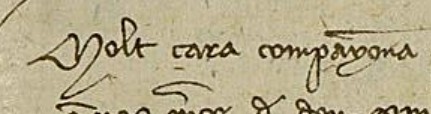
Violant commissions Jacme Escrivia as the alcaide, military commander, of the Castle of Elda.
Episode 182
](/historians-notebook-s1-episodes/images/jun-24-aca-cr-r1819-f206v-violant-img215.jpg)
ACA CR R1819 f206v Source: PARES
](/historians-notebook-s1-episodes/images/jun-24-aca-cr-r1819-f207r-violant-img216.jpg)
ACA CR R1819 f207r Source: PARES
Today’s Document
- Subject: Violant commissions a knight to become the commander of castle near the border with Granada
- Date: June 24, 1387
- Day of the Week: Monday
- Language: Latin
- Archival Reference Number: ACA CR R1819 f206v-207r
- Link to PARES
- Place: Barcelona
- Sender: Violant
- Recipients: Jacobus Scribe (Jacme Escrivia)
Historical Thinking Notes
-
Sourcing: this castle likely had been in Sibilla de Fortià’s portfolio before Violant became queen, and now Violant acted as the decision-maker for the castle’s leadership; Joan appears to have had no role in this military appointment; the recipient, Jacme Escrivia, is identified as a knight and might have distinguished himself in previous military actions in order to be considered for this posting; the importance of this appointment is indicated by the formality of the document and also that one of the witnesses was the Archbishop of Zaragoza
-
Contextualization: during the reign of Pere the Ceremonius, from 1336 to 1387, military generals in Valencia frequently raised alarms about the Mudéjar population clandestinely supporting a joint invasion by Granada and Morocco, aided by Castile during the reign of Pedro the Cruel1; this dramatic scenario never came to pass, but the political elites of the Crown of Aragon maintained an outlook toward the Kingdom of Granada that remained permanently adversarial and suspect even in times of declared peace; the role of commander of a castle was called alcaide not just in the regions of the Crown of Aragon close to Granda but also far away in Aragon itself2
-
Corroboration: the document examined in Episode 103, earlier in this same register, also related to the frontier region near Granada; Joan wrote a letter to the King of Granada around March 12th, as Episode 78 examined a letter to the Pope on the same folio, ACA CR R1751 f25r
-
Close-Reading: instead of the typical wording at the start of the dating clause, usually ‘datum,’ this document’s dating clause begins ‘Quod est actum’ meaning ‘it is done’ or ‘that which was done’; this document, unlike almost all the others examined in the podcast, makes an assertion about the physical presence of the monarch and the witnesses
What is this document doing?
- This document presumes that the queen’s authority is sufficient to intall an important military commander.
- The document attests to the physical presence of several people in a specific room of the royal palace.
Questions
- Was there anything unusual about this appointment or the document creation for it?
- Where was Joan at the time of the signing of this document?
- Why did some documents have the signature symbol included in the chancery copy and others, like this one, left it blank?
- What had Jacme Escrivia done to merit this important position?
- Was there any immediate context of tension with Granada in June 1387?
Signature Symbols
](/historians-notebook-s1-episodes/images/jun-24-aca-cr-r1819-f90r-violant-signum.jpg)
From earlier in the same register, an example of signature symbols from Violant and the same scribe, Pere de Besant. ACA CR R1819 f90r Source: PARES
AI Usage
The transcription and translation of this document was carried out by my OpenClaw pipeline, and I will say that Claude alone did a pretty good job of transcription. However, I still needed help identifying the castle and I wanted to be sure about the meaning of the initial lines of this document on folio 206v, so I did some further consultation with Claude for additional info.
When I was working on the Notable Documents section below, I wanted to know why Joan and Violant moved from Barcelona to Vilafranca in October of 1387. Claude hallucinated an archival source. That said, Claude was correct that it was because of fear of plague, which I confirmed by consulting Rafael Tasis i Marca and Josep Roca (see the October 19th entry in the list below).
Notable Documents from July to December 1387
- July 1, ACA CR R1972 f146r: Joan instructs his procurator in Mallorca to purchase another mappa mundi from the Creseques workshop3
- July 2, ACA CR R1923 f992: Bad news from Pisa leads Joan to write to the prohomens of several cities telling them to advise Catalan merchants to avoid Pisa4
- July 6, ACA CR R2056 f99v-100r: Violant, in a letter to Maria of Sicily, claims that the sum offered for Yolande of Aragon’s dowry is the largest ever dowry offered by a King of the Crown of Aragon5
- July 12, ACA CR2053 f16r: Violant writes to Charles III of Navarre that Joan is convalescing well, and does not specificy whether this is from yet another illness or still the one from late April6
- July 17, ACA CR R1954 f4v: Joan writes to the Pope about reports of miracles attributed to the recently deceased Cardinal of Luxembourg; Joan also asks the Pope to send him one of the dead Cardinal’s rings7
- July 25, ACA CR R2053 f19r: Violant writes to the Marquis de Villena about Joan’s good health within the context of miracles connected to the recently deceased Cardinal of Luxembourg8
- August 17, ACA CR R1751 f96r-97r: Within a long list of items in a letter to the Pope, Joan requests that Violant get the Pope’s official release from her pledge to stop wearing jewelry in an effort to gain favor with God in the moments of Joan’s illness earlier in the year; no documentary evidence has yet been found in Violant’s registers regarding this pledge, which she must have made at some point between January and June of 13879
- August 25, ACA CR R1751 f107r: For reasons having to do with ill health, Joan asks the Pope about a renowned German astrologer10
- September 11, ACA CR R2053 30r: Violant tells Luchino Scarampi to return to Avignon to resume the negotiations for the marriage of Yolande of Aragon11
- September 15, ACA CR R1760 12r: Joan challenges the authority of the Papal Inquisition in the Crown of Aragon12
- September 18, ACA CR Cartas Reales, Juan I, Caja 1, nº117: Joan inquires about the criminal prosecution of Antico Dezpí, who allegedly falsified documents13
- September 19, ACA CR R1922 f143r-v: Joan expresses his concern about the overhunting of partridges14
- October 8, ACA CR R1952 f48r: Joan thanks Violant’s father, Robert de Bar, for several books that he sent15
- October 18, ACA CR R2053 f34r: Violant, during her journey to the monastery at Montserrat to give thanks to the Virgin for saving Joan, writes to the king’s physician to send her news of Joan’s present condition16
- October 19, ACA CR 1952 f48v: Joan writes from the Monastery of Valdonzella that, due to an outbreak of plague in Barcelona, he is relocating the royal court at Vilafranca de Penedes17; the court remained at Vilafranca until late January 1388 at which time they returned to Barcelona
- October 30, ACA CR R1829 f113v: Joan, at the insistence of the papal inquisitor Nicolas Eymerich, issues a condemnation of the works of Ramon Llull18
- November 4, ACA CR R1923 f135r: continuing the thread about the tensions with Pisa, Joan advises all of the Catalan merchants expelled from Pisa to relocate to Siena19
- November 22, ACA CR 2056 f100v: Violant has heard that Sibilla da Fortia is getting a great many visitors while under house arrest and so Violant orders that no more visitors will be allowed20
- December 18, ACA CR f45r: Joan asks Antonio Joval of Mallorca to send him astrological texts and instruments owned by Ponc de Joval21
Bibliography
- Ferrer i Mallol, Maria Teresa. La frontera amb l’Islam en el segle XIV cristians i sarraïns al país Valencia. Barcelona: Institució Milà i Fontanals, Consell Superior d’Investigacions Cientifiques, 1988.
- Lafuente Gómez, Mario. “La figura del alcaide en las fortificaciones aragonesas de realengo a mediados del siglo XIV.” Turiaso 19 (2008): 241-274.
-
Maria Teresa Ferrer i Mallol, La frontera amb l’Islam en el segle XIV cristians i sarraïns al país Valencia,(Barcelona: Institució Milà i Fontanals, Consell Superior d’Investigacions Cientifiques, 1988), 147. ↩
-
Mario Lafuente Gómez, “La figura del alcaide en las fortificaciones aragonesas de realengo a mediados del siglo XIV,” Turiaso 19 (2008): 241-274. ↩
-
Antonio Rubió y Lluch, Documents per l’historia de la cultura catalana mig-eval, Vol. 1 (Barcelona: Institut d’Estudis Catalans, 1908), 345-346. ↩
-
Maria Teresa Ferrer Mallol and Carles Vela Aulesa, “Un mercader italià a la cort catalanoaragonesa: Luchino Scarampi,” Acta historica et archaeologica mediaevalia 32 (2015): 301–478 at 359, Doc. 72. ↩
-
Maria Teresa Ferrer Mallol and Carles Vela Aulesa, “Un mercader italià a la cort catalanoaragonesa: Luchino Scarampi,” Acta historica et archaeologica mediaevalia 32 (2015): 301–478 at 359, Doc. 73. ↩
-
Dawn Bratsch-Prince, “The Politics of Self-Representation in the Letters of Violant de Bar (1365–1431),” Medieval Encounters 12, no. 1 (2006): 2–25, at 14 fn42. ↩
-
Maria Teresa Ferrer Mallol and Carles Vela Aulesa, “Un mercader italià a la cort catalanoaragonesa: Luchino Scarampi,” Acta historica et archaeologica mediaevalia 32 (2015): 301–478 at 359, Doc. 75. ↩
-
Mateu Rodrigo Lizondo and Jaume Riera i Sans. Col·lecció documental de la Cancelleria de la Corona d’Aragó: textos en llengua catalana, 1291-1420 (Universitat de València, 2013), 802. ↩
-
Maria Teresa Ferrer Mallol and Carles Vela Aulesa, “Un mercader italià a la cort catalanoaragonesa: Luchino Scarampi,” Acta historica et archaeologica mediaevalia 32 (2015): 301–478 at 361, Doc. 81. ↩
-
Josep M. Roca, Johan I d’Aragó (Barcelona: Institució Patxot, 1929), 387-388 and 436. ↩
-
Maria Teresa Ferrer Mallol and Carles Vela Aulesa, “Un mercader italià a la cort catalanoaragonesa: Luchino Scarampi,” Acta historica et archaeologica mediaevalia 32 (2015): 301–478 at 362, Doc. 83. ↩
-
Benjamin R. Gampel, Anti-Jewish Riots in the Crown of Aragon and the Royal Response, 1391-1392 (Cambridge University Press, 2016), 206 fn21. ↩
-
Fondo Histórico de Aragón, https://fondohistoricodearagon.fundacionibercaja.es/ficha/241120 ↩
-
Mateu Rodrigo Lizondo and Jaume Riera i Sans. Col·lecció documental de la Cancelleria de la Corona d’Aragó: textos en llengua catalana, 1291-1420 (Universitat de València, 2013), 803. ↩
-
my own archival work, https://pares.mcu.es/ParesBusquedas20/catalogo/show/12777462 ↩
-
Dawn Bratsch-Prince, “A Queen’s Task: Violant de Bar and the Experience of Royal Motherhood in Foureenth-Century Aragón,” La Corónica: A Journal of Medieval Hispanic Languages, Literatures & Cultures 27, no. 1 (1998): 21–34, at 30. ↩
-
Rafael Tasis i Marca, Joan I: el rei caçador i músic (Editorial Aedos, 1959), 147; Josep M. Roca, Johan I d’Aragó (Barcelona: Institució Patxot, 1929), 229. Note that Roca erroneously identifies the folio as 47v. ↩
-
Antonio Rubió y Lluch, Documents per l’historia de la cultura catalana mig-eval, Vol. 1 (Barcelona: Institut d’Estudis Catalans, 1908), 347-348; Claire Ponsich, “De la parole d’apaisement au reproche. Un glissement rhétorique du conseil ou l’engagement politique d’une reine d’Aragon?” Cahiers d’études Hispaniques Medievales 31 (2008): 81–117, at 112. ↩
-
Víctor Hurtado, “Berenguer Morey, mercader de Barcelona i la seva activitat diplomática amb Pisa l’any 1387,” La Corona d’Aragona in Italia (Secc.XIII-XVIII): Congresso Di Storia Della Corona d’Aragona 14a 1990 Sassari-Alghero. 1996, 527–44, at 538. ↩
-
Josep Roca, “La Reyna empordanesa,” Memorias de la Real Academia de Buenas Letras de Barcelona (1928), 2–211, at 209. ↩
-
Antonio Rubió y Lluch, Documents per l’historia de la cultura catalana mig-eval, Vol. 1 (Barcelona: Institut d’Estudis Catalans, 1908), 349-350. ↩