Season 1, Episode 18
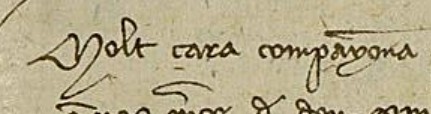
Joan writes to the Montserrat monastery and convent to ask them to host Miguel Rossell, the bearer of the letter. This episode also is a good model for how to interact with AI chatbot results in a critical manner.
Episode 18
](/historians-notebook-s1-episodes/images/jan-11-aca-cr-r1952-f19r-joan.jpg)
ACA CR R1952 f19r Source: PARES
Today’s Document
- Subject: letter of recommendation to Montserrat monastery and convent
- Date: January 11, 1387
- Day of the Week: Friday
- Language: Catalan
- Archival Reference Number: ACA CR R1952 f19r
- Link to PARES
- Place: near Granollers
- Sender: Joan
- Recipient: those in charge of room and board at Montserrat
Historical Thinking Notes
- Sourcing: my current reading of Joan’s letters and charters from early January is that all of them are likely higher priority topics since Joan’s illness would limit his stamina for administrative work; if that is an accurate view, then the simple letter of recommendation for Miguel Rossell must have more to it than meets the eye - that this is Joan’s initial move in a larger strategy to ensure that Montserrat, the premier religious site in Catalonia, is on his side in supporting the Avignon Papacy; on the other hand, there’s no direct evidence in the document itself that this was a top priority letter and Miguel Rossell’s recommendation letter could very well have been just the next in a long list of Joan’s to-dos
](/historians-notebook-s1-episodes/images/montserrat1.jpg)
Montserrat Monastery and Convent Source: Chensiyuan, CC BY-SA 3.0, via Wikimedia Commons

-
Contextualization: the Great Western Schism began in 1378 and Pere the Ceremonious decided to maintain neutrality between Avignon and Rome; Joan, however, firmly allied with Avignon, mostly due to his longstanding affinity for France and French culture - an affinity that can be traced to his teenage years; across western Christendom, secular and ecclesiastical authorities had to decide what kind of allegiance they would declare - some regions had a strong secular leader who ensured all the ecclesiastical authorities stayed with the favored pope but in other regions division persisted among ecclesiastical stakeholders; Pere’s neutral stance signaled to both Avignon and Rome that the Crown of Aragon’s ecclesiastical institutions were up for competition
-
Corroboration: there are later documents from Joan in January 1387 that will likely shed light on whether Miguel Rossell was an agent sent to Montserrat to help Joan push the institution toward the Avignon Papacy; also later documents would help to figure out why Joan then supported the Rome-based candidate for the position of prior
-
Close-Reading: the inclusion of the word ‘convent’ in this letter indicates to me that there were both monks and nuns at Montserrat at this time; ChatGPT has notions of the deeper meanings of this letter, that Miguel Rossell is being sent to Monserrat for the purpose of ‘forcing compliance,’ but I am not convinced of this
Images from Daniel Girona i Llagostera’s Itineraries
](/historians-notebook-s1-episodes/images/girona-llagostera-infant-p590.jpg)
Page 590 of Daniel Girona i Llagostera’s Itinerary for Joan during his years as Primogenit. Source: Daniel Girona i Llagostera, ‘Itinerari de l’Infant En Joan, Fill Del Rei En Pere III. 1350-1387.’
](/historians-notebook-s1-episodes/images/girona-llagostera-rei-p96.jpg)
Page 96 of Daniel Girona i Llagostera’s Itinerary for Joan during his reign as king. Source: Daniel Girona i Llagostera, ‘Itinerari Del Rei En Joan I, 1387-1388.’ Estudis Universitaris Catalans. 13 (1928): 93–134.
](/historians-notebook-s1-episodes/images/girona-llagostera-rei-p97.jpg)
Page 97 of Daniel Girona i Llagostera’s Itinerary for Joan during his reign as king. Source: Daniel Girona i Llagostera, ‘Itinerari Del Rei En Joan I, 1387-1388.’ Estudis Universitaris Catalans. 13 (1928): 93–134.
What is this document doing?
- This document confirms the authority of political elites to send people to ecclesiastical institutions, ensuring their room and board.
- The document perhaps indicates the intervention of a new king into a dispute over ecclesiastical administration.
Questions
- Was Miguel Rossell just a random friar or someone acting as an agent for Joan?
- When did Miguel Rossell, or someone on his behalf, write to Joan asking for this recommendation letter?
- At this time, did Joan already know he would support the Rome-favored candidate for the position of prior at Montserrat?
- Had Clement VII, the Avignon Pope, already been in communication with Joan about the leadership of Montserrat?
- What was the population of Montserrat at this time? How did the monastery compare to the convent?
- Are there letters in this ACA register that return to this topic or are those letters in another register?
AI Usage
I think that the way that ChatGPT acted as a tool for historical research on this episode provides a good example of AI usage. I rejected ChatGPT’s notions of the tone of this document and I also am not convinced that the chatbot’s correction of my transcription of ‘jeyes’ into ‘jaus’ was justified. I know enough about the paleography to know that what I see in the fifth line of the document cannot be ‘jaus.’
However, when prompted to move beyond a website without author attribution, ChatGPT successfully provided me with a scholarly source for information about Joan and Montserrat. If I were writing a journal article about relations between secular and ecclesiastical authorities in ths time and place, this alone would in no way be sufficient. But for the purposes of sketching out the historical context for today’s document, it fit my research needs. I intend this to demonstrate a key principle in my approach to using AI - that its use must be calibrated to the research question. Before AI came on the scene, historians had faced the problem of deciding how much contextual research to conduct and when to let go of the desire to get the most comprehensive picture possible of all the angles and digressions. AI chatbots like ChatGPT reduce the amount of time chasing down farflung contextual information without much downside when compared to the pre-AI process.
In the case of today’s research, the article by Prim Bertran i Roigé located by ChatGPT’s power to full-text search simply would not have been found in a non-AI research process. It is possible that I might have thought to myself that an article on Martí would have information about Joan and Montserrat, but it’s a stretch for me to imagine that I would have zeroed in on this article if I sought out information on the Great Schism and the Crown of Aragon in a traditional research process.
Bibliography
- Bertran i Roigé, Prim. “El Cisma d’Occident en la política del Rei Martí.” In Martí l’Humà: el darrer rei de la dinastia de Barcelona (1396-1410) : l’interregne i el Compromís de Casp, edited by Maria Teresa Ferrer i Mallol, 385-413. Institut de Estudis Catalans, 2015.