Season 1, Episode 179
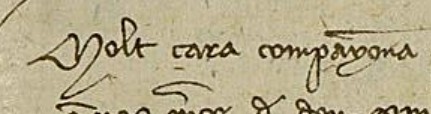
Violant instructs the bailiff of Cabra del Camp to return the armor kit of Petrus Closent since the legal case against Petrus had ended.
Episode 179
](/historians-notebook-s1-episodes/images/jun-21-aca-cr-r1822-f153v-violant-img309.jpg)
ACA CR R1822 f153v Source: PARES
](/historians-notebook-s1-episodes/images/jun-21-aca-cr-r1822-f154r-violant-img310.jpg)
ACA CR R1822 f154r Source: PARES
Today’s Document
- Subject: returning the confiscated armour of an arrested man in El Pla de Santa Maria
- Date: June 21, 1387
- Day of the Week: Friday
- Language: Latin
- Archival Reference Number: ACA CR R1822 f153v-154r
- Link to PARES
- Place: Barcelona
- Sender: Violant
- Recipient: the bailiff of Cabra del Camp
Historical Thinking Notes
-
Sourcing: the dcoument quoted in full inside today’s document is from October 1, 1386 and the official who composed it, Johannes Navarre, worked for Joan during his time as the Duke of Girona; nothing in this document suggests that in June 1387 Violant and Joan discussed it together and instead it looks like a case of overlapping jurisdiction, not co-rule; Petrus Closent appears to have been residing in El Pla de Santa Maria, but the bailiff holding his armor was in Cabra del Camp about 4km away, and both of these places are in the region of Tarragona; Petrus Closent is probably not a knight, because he would have the appellation ‘milite’ if he was a knight, and so Petrus was likely someone with relatively low social status; we have no information about whether Petrus Closent was an innocent victim of over-prosecution or had gotten away with committing a crime
-
Contextualization: this document demonstrates how, in the operation of the chancery, earlier documents resurfaced in later cases, often quoted in entirety within the new document; individuals in the realm could appeal all the way up to the monarchs for intervention even in cases that carried little impact beyond their own personal welfare1; unlike modern legal systems in which people can be stuck in litigation for decades, medieval monarchs could intervene for people stuck in legal quagmires (that said, this is not necessarily a feature that increases just outcomes, because the outcome would depend on the particular monarch’s personal judgement and biases)
-
Corroboration: the documents examined in Episode 67 and Episode 89 also contains a copy of an earlier document inside the current one
-
Close-Reading: according to the Diccionari català-valencià-balear, the term ‘arnes’ in this document is used for the collection of armour and weapons that a knight or soldier would have as a collection, like a ‘weaponry kit’; ‘arnesia’ (f153v line 11), ‘arma’ (f154r line 15) and ‘arnesiis’ (f154r line 17) in this document all refer to that kit belonging to Petrus Closent and demonstrate how Latin case endings can produce a lot of variation
What is this document doing?
- This document sides with an individual against the local law enforcement officials.
- The document short-circuits the legal process, demonstrating the supreme power of the monarch.
Questions
- What was Petrus Closent accused of by the bailiff of Cabra del Camp?
- Was Petrus Closent an honorable person?
- Had Joan’s official, Johannes Navarre, ordered the bailiff to return Petrus’s armor in October of 1386? If so, why had the bailiff ignored that order?
- What types of pieces of armor and weaponry did Petrus have in his kit?
- Was this matter handled entirely by court officials or did Violant participate in the decision-making?
AI Usage
The transcription and translation of this document was carried out by my OpenClaw pipeline. During the automated process, Gemini gave up after only a few lines of transcription for f153v but then carried out a complete transcription for f154r. The result was that the final output from Claude was of much higher quality for f154r.
So, as my next step, I transcribed f153v myself into a text file and then pasted Claude’s transcription of f154r into that same file. I then had Claude produce a corrected translation. I challenged Claude’s translation of a few terms, in particular ‘arnesia’ and ended up learning from that exchange in a way that I am not sure I could have done on my own without AI.
Bibliography
- Boucoyannis, Deborah. Kings as Judges: Power, Justice, and the Origins of Parliaments. Cambridge University Press, 2021.
- Kelleher, Marie A. The Hungry City: A Year in the Life of Medieval Barcelona. Cornell University Press, 2024.
- VanLandingham, Marta. Transforming the State: King, Court and Political Culture in the Realms of Aragon (1213-1387). Brill, 2002.
-
Marie Kelleher’s book, The Hungry City, contains many examples of these appeals. Marie A. Kelleher, The Hungry City: A Year in the Life of Medieval Barcelona (Cornell University Press, 2024). ↩