Season 1, Episode 136
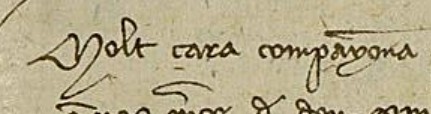
Violant states her astonishment at the weakness of a knight’s job performance and asks him if he has time to do the job she commissioned for him.
Episode 136
](/historians-notebook-s1-episodes/images/may-9-aca-cr-r1819-f98v-violant-img199.jpg)
ACA CR R1819 f98v Source: PARES
](/historians-notebook-s1-episodes/images/may-9-aca-cr-r1819-f99r-violant-img200.jpg)
ACA CR R1819 f99r Source: PARES
Today’s Document
- Subject: expression of displeasure at the poor job performance of a knight
- Date: May 9, 1387
- Day of the Week: Thursday
- Language: Catalan
- Archival Reference Number: ACA CR R1819 f98v-99r
- Link to PARES
- Place: Barcelona
- Sender: Violant
- Recipient: Berenguer d’Olms
Historical Thinking Notes
-
Sourcing: apparently the knight Berenguer d’Olms considered Violant’s commission optional; Violant, for her part, had a financial interest in ensuring that the tax collection being carried out by Jacme Quinta proceeded successfully
-
Contextualization: when conceptualizing women’s power in the Middle Ages, many complications arise and a very helpful article by Marie Kelleher helps to navigate through thorny topics like ‘soft versus hard power’ and the intersection of social class with patriarchy in medieval societies1; queen lieutenants possessed a great deal of authority both legally and de facto in the late medieval Crown of Aragon
-
Corroboration: the document examined in Episode 64 offers an interesting corroboration as that February 26th document is the original commission Violant sent to Berenguer d’Olms to commission him to join Jacme Quinta in tax collection in Catalonia
-
Close-Reading: it’s become clear that when Joan or Violant uses the word ‘marvellam’ or ‘marvellada’ to mean ‘we are astonished,’ this means that the recipient is about to be chastised; Violant uses the word ‘flacament’ to describe Berenguer d’Olms’s actions thus far and that means ‘weakly’; the word ‘dessus’, which in this sense means ‘above all,’ appearing in superscript might have been an intentional pun by the scribe
What is this document doing?
- This document invokes shame as it scolds a knight for his lax service to the monarch.
- The document implies that the knight might choose to reject a job offer from the queen.
Questions
- Was Berenguer d’Olms pushing back against Violant’s exercise of power? Or was maybe that he was actually busy with other things?
- How sarcastic was Violant’s intended tone in this letter?
- Had Violant heard about Berenger d’Olms behaving ‘flacament’ from Jacme Quinta, the treasury agent?
AI Usage
The transcription and translation of this document was carried out by my OpenClaw pipeline. This instance of agentic AI output was of such low quality that it was essentially useless.
Bibliography
- Earenfight, Theresa. “Absent Kings: Queens as Political Partners in the Medieval Crown of Aragon.” In Queenship and Political Power in Medieval and Early Modern Spain, edited by Theresa Earenfight, 33-51. Ashgate, 2005.
- Kelleher, Marie A. “What Do We Mean by” Women and Power”?” Medieval Feminist Forum: A Journal of Gender and Sexuality 51, no. 2 (2016): 104–15.
-
Marie A. Kelleher, “What Do We Mean by ‘Women and Power’?” Medieval Feminist Forum: A Journal of Gender and Sexuality 51, no. 2 (2016): 104–15. ↩