Season 1, Episode 126
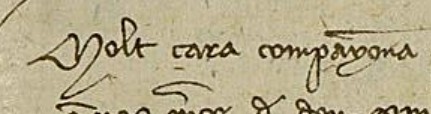
Violant asks James the Cardinal of Valencia and about seven monasteries to recite prayers for Joan’s health. Joan’s secret seal register contains a letter urgently summoning a Muslim doctor from Xàtiva.
Episode 126
](/historians-notebook-s1-episodes/images/apr-29-aca-cr-r2053-f7r-violant-img016.jpg)
ACA CR R2053 f7r Source: PARES
](/historians-notebook-s1-episodes/images/apr-29-aca-cr-r2053-f7v-violant-img017.jpg)
ACA CR R2053 f7v Source: PARES
](/historians-notebook-s1-episodes/images/apr-29-aca-cr-r1751-f53r-joan-img108.jpg)
ACA CR R1751 f53r Source: PARES
](/historians-notebook-s1-episodes/images/apr-29-aca-cr-r1751-f53v-joan-img109.jpg)
ACA CR R1751 f53v Source: PARES
Today’s Documents
- Subject: initiating an intercession of holy prayer for Joan’s health and an urgent summons for a doctor
- Date: April 29, 1387
- Day of the Week: Monday
- Language: Catalan
- Archival Reference Number for Violant’s letter: ACA CR R2053 f7r-v
- Link to PARES for Violant’s Letter
- Archival Reference Number for Joan’s letter: ACA CR R1751 f53r-v
- Link to PARES for Joan’s Letter
- Place: Barcelona
- Sender: Violant (Joan’s register has Violant’s scribe in the probata)
- Recipients: Violant’s letters to James the Cardinal of Valencia and to several monasteries; Joan’s summons to Abrahim, a Muslim doctor in Xàtiva
Page 221 from Roca’s book with my annotations
](/historians-notebook-s1-episodes/images/apr-29-p211-roca.jpg)
Page 221 of Josep Roca’s book Johan I d’Aragó with my annotations Source: Revistes Catalanes amb Accés Obert
It is clear from the material in Rafael Tasis i Marca’s pages about the first half of 1387 that Tasis i Marca misinterpreted Roca.1
Historical Thinking Notes for Violant’s Documents
-
Sourcing: the recipient, as a Cardinal, would have the authority to instruct churches to say prayers for the king; Violant, as the wife of the king, probably faced intense emotional pressure at this moment as well as the prospect of political danger
-
Contextualization: according to widely held Christian beliefs at this time, the prayers of nuns and monks in religious orders throughout the land would have an intercessionary effect
-
Corroboration: Violant directly contradicts her letter to James from four days ago, Episode 122, when today she writes, ‘qui segons sapiat se longament ha es malalt,’ who you know has been sick for a long time
-
Close-Reading: Violant uses the phrase ‘cort celestial’ to signal the field on which intercessionary powers might play out to produce a favorable outcome in the recovery of her husband’s health
Historical Thinking Notes for Joan’s Document
-
Sourcing: as one of the most powerful people in the land, the king would theoretically have access to the best physicians; Joan seeks out the Muslim doctor in Xàtiva for that reason and religious boundaries do not matter in the context of a severe illness
-
Contextualization: medical knowledge did cross the boundaries of religious communities, as has been demonstrated convincincly by the research of Carmen Caballero-Navas2
-
Corroboration: there is evidence that the royal family regularly employed Jewish physicians but it is far less common to see a record of a Muslim doctor
-
Close-Reading: the admonition against delay underscores the severity of Joan’s health crisis; this is further confirmed by the instruction to have the doctor travel ‘night and day’
What are these documents doing?
- These documents communicate a medical emergency, calling out for both spiritual and material help.
- The documents reflect a willingness to employ diverse methods in response to disease.
Questions
- What had Joan, or his court, heard about Abrahim, the Muslim doctor in Xàtiva?
- Was Abrahim found? Did he make the journey to Barcelona?
- What does it mean that Violant’s scribe is writing in Joan’s register?
- How did the kinship relation between Joan and James factor into Violant’s letter to him? Why did Violant not write to other ecclesiastical leaders in the realm?
- How did Violant choose the convents and monasteries for her next letter? Did a list of those already exist?
Additional Notes
According to Jerónimo Zurita, April 29th is also the date of the execution of two of Sibilla da Fortià’s advisors. However, I cannot find an archival source for this (neither through my own research nor through citations in secondary sources).
AI Usage
The transcription and translation of the document by Violant was carried out by my OpenClaw pipeline.
The transcription and translation of the document in Joan’s register was also carried out by my OpenClaw pipeline.
Bibliography
- Bratsch-Prince, Dawn E. “A Reappraisal of the Correspondence of Violant de Bar (1365-1431).” Catalan Review: International Journal of Catalan Culture 8, nos. 1–2 (1994): 295–312.
- Caballero-Navas, Carmen. “The Care of Women’s Health and Beauty: An Experience Shared by Medieval Jewish and Christian Women.” Journal of Medieval History 34, no. 2 (2008): 146–63.
- Roca, Josep M. Johan I d’Aragó. Barcelona: Institució Patxot, 1929.
- Tasis i Marca, Rafael. Joan I: el rei caçador i músic. Editorial Aedos, 1959.